
Join Our JEE Preparation Group
Prep with like-minded aspirants; Get access to free daily tests and study material.
Sign in
Please select an account to continue using cracku.in
↓ →
Join Our JEE Preparation Group
Prep with like-minded aspirants; Get access to free daily tests and study material.
List-I shows four configurations made of straight and semi-circular narrow tubes containing air. A sound wave of wavelength $$\lambda=0.29\,\mathrm{m}$$ enters these structures at the point $$S$$ and a sound detector is placed at $$D$$. Between the points $$S$$ and $$D$$, the sound travels only through the tubes. List-II contains the possible smallest values of $$l$$ (refer to the figures) for which the detector $$D$$ records maximum amplitude. Ignore effects of sharp corners. [Given $$\cos(15^\circ)=0.97$$]
Choose the option that best describes the match between the entries in List-I to those in List-II.
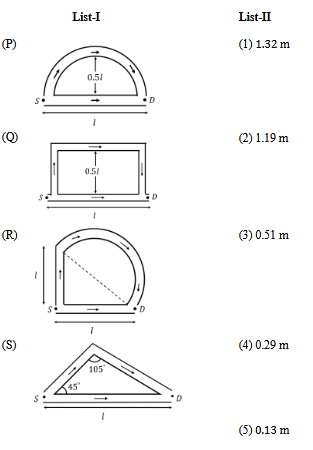
For structure (P):
$$\Delta x = \pi R - 2R = (\pi - 2)\frac{l}{2}$$
$$\text{For maxima: } (\pi - 2)\frac{l}{2} = n\lambda$$
$$l_{\min} = \frac{2\lambda}{\pi - 2} = \frac{2(0.29)}{3.14 - 2} = 0.51\text{ m}$$
For structure (Q):
$$\Delta x = 2l - l = l$$
$$\text{For maxima: } l = n\lambda$$
$$l_{\min} = \lambda = 0.29\text{ m}$$
For structure (R):
$$\Delta x = l + \pi R - l = \pi R$$
$$\text{From geometry: } R = \frac{l}{\sqrt{2}} \implies \Delta x = \frac{\pi l}{\sqrt{2}}$$
$$\text{For maxima: } \frac{\pi l}{\sqrt{2}} = n\lambda$$
$$l_{\min} = \frac{\sqrt{2}\lambda}{\pi} = \frac{\sqrt{2}(0.29)}{3.14} = 0.13\text{ m}$$
For structure (S):
$$\Delta x = (\sqrt{2}x + 2x) - (x + \sqrt{3}x) = (\sqrt{2} + 2 - \sqrt{3} - 1)x = 0.682x$$
$$\text{Given: } x + \sqrt{3}x = l \implies x = \frac{l}{1 + \sqrt{3}} = 0.366l$$
$$\Delta x = 0.682(0.366l) = 0.249l$$
$$\text{For maxima: } 0.249l = n\lambda$$
$$l_{\min} = \frac{\lambda}{0.249} = \frac{0.29}{0.249} \approx 1.19\text{ m}$$
Create a FREE account and get:
_1.webp)

Educational materials for JEE preparation

Ask our AI anything

AI can make mistakes. Please verify important information.
AI can make mistakes. Please verify important information.


