
Join Our JEE Preparation Group
Prep with like-minded aspirants; Get access to free daily tests and study material.
Sign in
Please select an account to continue using cracku.in
↓ →
Join Our JEE Preparation Group
Prep with like-minded aspirants; Get access to free daily tests and study material.
A hollow, right circular cone of base radius $$R$$ and height $$h$$, with its tip at the origin is rotating about the $$Z$$-axis with an angular velocity $$\omega$$, as shown in the figure. The cone carries a total charge $$Q$$ uniformly distributed on its curved surface. The magnitude of magnetic field at a point $$(0,0,z)$$, where $$z\gg R$$ and $$z\gg h$$, is $$\dfrac{n\mu_0}{4\pi}\dfrac{QR^2\omega}{z^3}$$. The value of $$n$$ is:
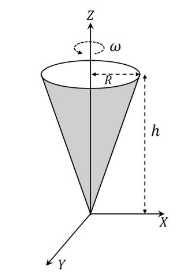
Correct Answer: 0.50
Using magnetic field of a dipole on its axis for $$z \gg R, h$$: $$B = \frac{\mu_0}{4\pi} \frac{2M}{z^3}$$
Using element of a hollow cone at distance $$x$$ along the slant height $$L = \sqrt{R^2+h^2}$$:
$$r = x\sin\alpha = x\frac{R}{L}$$
$$dA = 2\pi r dx = 2\pi x \frac{R}{L} dx$$
Using surface charge density: $$\sigma = \frac{Q}{\pi R L}$$
$$dq = \sigma dA = \frac{Q}{\pi R L} \left(2\pi x \frac{R}{L} dx\right) = \frac{2Q}{L^2} x dx$$
Using magnetic moment of a rotating ring element:
$$dM = dI \cdot \pi r^2 = \left(\frac{\omega}{2\pi} dq\right) \pi r^2 = \frac{1}{2} \omega r^2 dq$$
$$dM = \frac{1}{2} \omega \left(x\frac{R}{L}\right)^2 \left(\frac{2Q}{L^2} x dx\right) = \frac{QR^2\omega}{L^4} x^3 dx$$
$$M = \int_0^L \frac{QR^2\omega}{L^4} x^3 dx = \frac{QR^2\omega}{L^4} \left[\frac{L^4}{4}\right] = \frac{1}{4}QR^2\omega$$
$$B = \frac{\mu_0}{4\pi} \frac{2\left(\frac{1}{4}QR^2\omega\right)}{z^3} = \frac{0.5\mu_0}{4\pi} \frac{QR^2\omega}{z^3}$$
Was this solution helpful?
Click on the Email ☝️ to Watch the Video Solution
Create a FREE account and get:
_1.webp)

Educational materials for JEE preparation

Ask our AI anything

AI can make mistakes. Please verify important information.
AI can make mistakes. Please verify important information.
