
Join Our JEE Preparation Group
Prep with like-minded aspirants; Get access to free daily tests and study material.
Sign in
Please select an account to continue using cracku.in
↓ →
Join Our JEE Preparation Group
Prep with like-minded aspirants; Get access to free daily tests and study material.
As shown in the figure, an insulated container is fitted with a thermally conducting but immovable partition ($$P_1$$) and a freely movable but thermally insulated piston ($$P_2$$). The partition $$P_1$$ with thermal conductivity $$K$$, cross sectional area $$A$$ and width $$x$$ divides the container into two sections, $$S_1$$ and $$S_2$$, each containing one mole of a monoatomic gas. The piston $$P_2$$ moves freely such that the gas in $$S_2$$ is always at the atmospheric pressure. Initially, the difference between the temperatures of $$S_1$$ and $$S_2$$ is $$\Delta T_0$$. The time it takes for the temperature difference to become $$\dfrac{\Delta T_0}{2}$$ is $$nxR/KA$$, where $$R$$ is the universal gas constant. The value of $$n$$ is:
[ Given: $$\ln 2\approx 0.7$$ ]
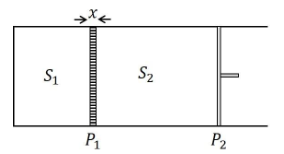
Correct Answer: 0.66
Using heat exchange relations:
$$dQ = -C_{v1} dT_1 = C_{p2} dT_2$$
$$dT_1 = -\frac{2 dQ}{3R},\quad dT_2 = \frac{2 dQ}{5R}$$
$$d(\Delta T) = dT_1 - dT_2 = -dQ\left(\frac{2}{3R} + \frac{2}{5R}\right) = -\frac{16}{15R} dQ$$
Substituting $$dQ = \frac{KA}{x}\Delta T dt$$:
$$\frac{d(\Delta T)}{\Delta T} = -\frac{16KA}{15xR} dt$$
$$\int_{\Delta T_0}^{\Delta T_0/2} \frac{d(\Delta T)}{\Delta T} = -\frac{16KA}{15xR} \int_{0}^{t} dt$$
$$\ln 2 = \frac{16KA}{15xR} t \implies t = \frac{15\ln 2}{16}\frac{xR}{KA}$$
$$n = \frac{15 \times 0.7}{16} = 0.65625 \approx 0.66$$
Create a FREE account and get:
_1.webp)

Educational materials for JEE preparation

Ask our AI anything

AI can make mistakes. Please verify important information.
AI can make mistakes. Please verify important information.


