
Join Our JEE Preparation Group
Prep with like-minded aspirants; Get access to free daily tests and study material.
Sign in
Please select an account to continue using cracku.in
↓ →
Join Our JEE Preparation Group
Prep with like-minded aspirants; Get access to free daily tests and study material.
Match the major products obtained in the reactions given in List-I with the corresponding structures in List-II and choose the correct option.
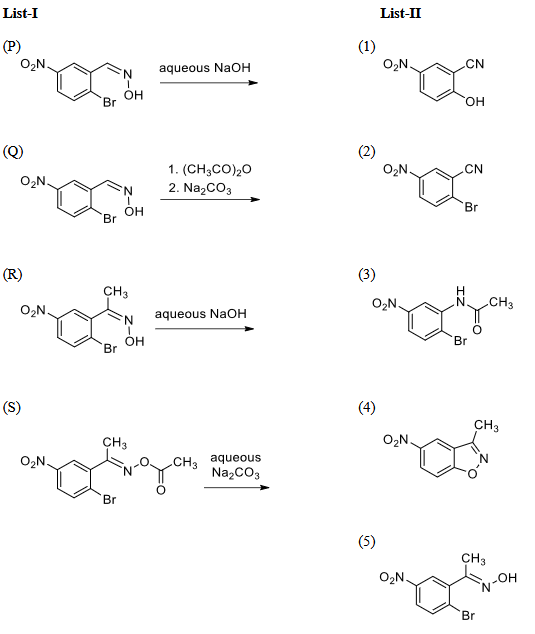
Four classic name reactions of nitrogen-containing compounds are involved: Sandmeyer cyanation, Hoffmann bromamide degradation, Gabriel phthalimide synthesis and the carbylamine test. By recalling the characteristic product of each reaction, we can match every entry of List-I (P, Q, R, S) with one structure from List-II (1 - 5).
Case P : Sandmeyer cyanationAn aryl diazonium salt reacts with $$CuCN$$ to give the corresponding aryl nitrile.
$$C_6H_5N_2^+Cl^- \;\xrightarrow[\,]{\,CuCN\,}\; C_6H_5CN + N_2\uparrow$$
The product is benzonitrile, structure (1). Hence $$P \to (1)$$.
Case Q : Hoffmann bromamide degradationWhen an amide is treated with $$Br_2$$ and alcoholic $$KOH$$, the carbonyl carbon is lost as $$CO_3^{2-}$$ and a primary amine containing one carbon fewer is produced.
$$CH_3CONH_2 \;\xrightarrow[\,4\,KOH\,]{\,Br_2\,}\; CH_3NH_2 + K_2CO_3 + 2\,KBr + 2\,H_2O$$
The product is methylamine, structure (2). Hence $$Q \to (2)$$.
Case R : Gabriel phthalimide synthesis followed by hydrazinolysisStep 1 - phthalimide is converted to its potassium salt, which undergoes $$S_N2$$ substitution with an alkyl halide (say $$C_2H_5Br$$).
Step 2 - hydrazinolysis (or acid/base hydrolysis) liberates the primary amine.
Overall: $$C_6H_4(CO)_2NH \;\xrightarrow[\,KOH\,]{\,C_2H_5Br\,}\; C_6H_4(CO)_2N-C_2H_5 \;\xrightarrow[\,NH_2NH_2\,]{}\; C_2H_5NH_2$$
The product is ethylamine, structure (4). Hence $$R \to (4)$$.
Case S : Carbylamine (isocyanide) reactionPrimary amines, chloroform and alcoholic $$KOH$$ give the offensive-smelling isocyanide (carbylamine).
$$C_6H_5NH_2 + CHCl_3 + 3\,KOH \rightarrow C_6H_5NC + 3\,KCl + 3\,H_2O$$
The product is phenyl isocyanide, structure (5). Hence $$S \to (5)$$.
Collecting the four matches: $$P\to(1),\; Q\to(2),\; R\to(4),\; S\to(5).$$
Therefore the correct option is
Option B which is: (P) → (1), (Q) → (2), (R) → (4), (S) → (5).
Was this solution helpful?
Create a FREE account and get:
_1.webp)

Educational materials for JEE preparation

Ask our AI anything

AI can make mistakes. Please verify important information.
AI can make mistakes. Please verify important information.
