
Join Our JEE Preparation Group
Prep with like-minded aspirants; Get access to free daily tests and study material.
Sign in
Please select an account to continue using cracku.in
↓ →
Join Our JEE Preparation Group
Prep with like-minded aspirants; Get access to free daily tests and study material.
The List-II contains products obtained from the reaction of compounds in List-I with $$O_3$$/$$Zn$$-$$H_2O$$ followed by cyclization (via more stable enolate) in the presence of aqueous $$NaOH$$. Match each entry in List-I with appropriate entry in List-II and choose the correct option.
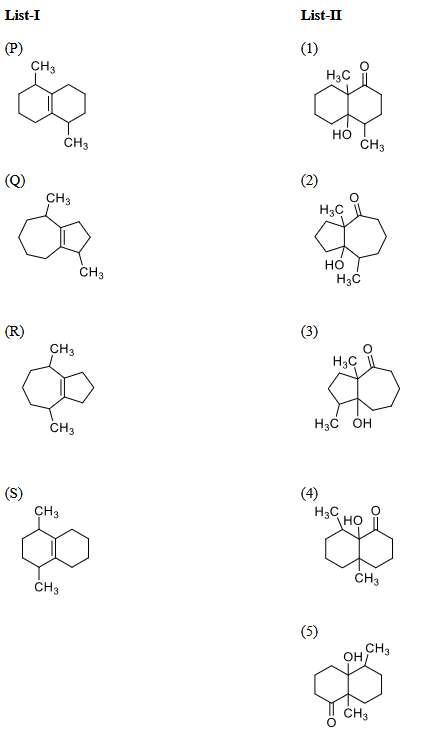
Ozonolysis in the presence of $$O_3/Zn$$-$$H_2O$$ cleaves every $$C=C$$ bond and converts the two vinylic carbons into carbonyl groups (an aldehyde if the carbon was $$\;-CH=$$ and formaldehyde if it was $$\;=CH_2$$).
With the dienes given in List-I, this step therefore furnishes an ω-dialdehyde (or an ω-aldehyd-one when a double bond is internally substituted) plus two molecules of $$HCHO$$ that are of no further consequence.
When the dialdehyde is now treated with aqueous $$NaOH$$ the more stable enolate (the one that is more highly substituted) is generated first. That enolate performs an intramolecular aldol addition on the other carbonyl group, producing a β-hydroxy-carbonyl compound. The size of the ring obtained is decided purely by the number of carbon atoms that originally separate the two carbonyl groups:
Number of carbon atoms between the two $$-CHO$$ groups = $$n$$
Ring size produced in the aldol step = $$(n+1)$$ (because a new C-C bond is formed between the α-carbon of one carbonyl and the carbonyl carbon of the other).
The two double bonds of P are situated at C-1 and C-9 of a nonane chain (1,8-nonadiene). After ozonolysis
$$CH_2=CH-(CH_2)_5-CH=CH_2\xrightarrow[Zn/H_2O]{O_3}OHC-(CH_2)_5-CHO+2HCHO$$
Six methylenes are now counted from one carbonyl carbon to the other, so $$n=5$$ and the intramolecular aldol gives a six-membered β-hydroxy aldehyde. That product is entry (2) of List-II.
Case QQ is 1,7-octadiene. Ozonolysis furnishes
$$CH_2=CH-(CH_2)_4-CH=CH_2\longrightarrow OHC-(CH_2)_4-CHO+2HCHO$$
Now $$n=4$$; the aldol cyclisation therefore delivers a five-membered β-hydroxy aldehyde, which is shown as entry (1) in List-II.
Case RR is a methyl-substituted analogue of Q (2-methyl-1,7-octadiene). Ozonolysis gives
$$CH_2=CH-CH(CH_3)-(CH_2)_3-CH=CH_2\longrightarrow OHC-CH(CH_3)-(CH_2)_3-CHO+2HCHO$$
Again $$n=4$$, so a five-membered ring is formed. Because the more substituted enolate is generated at the α-carbon that bears the $$CH_3$$ group, the methyl ends up on the ring carbon bearing the newly formed hydroxyl group. This corresponds to entry (5) in List-II.
Case SS is 2-methyl-1,8-nonadiene. Its ozonolysis product is
$$CH_2=CH-CH(CH_3)-(CH_2)_4-CH=CH_2\longrightarrow OHC-CH(CH_3)-(CH_2)_4-CHO+2HCHO$$
Now $$n=5$$, hence the aldol condensation builds a six-membered ring. As in case R the enolate forms preferentially at the $$CH(CH_3)$$ end, so the methyl group becomes attached to the β-hydroxy carbon of the ring, giving entry (3) of List-II.
Collecting the results:
(P) → (2), (Q) → (1), (R) → (5), (S) → (3)
Therefore the correct option is:
Option C which is: (P)→(2), (Q)→(1), (R)→(5), (S)→(3)
Was this solution helpful?
Create a FREE account and get:
_1.webp)

Educational materials for JEE preparation

Ask our AI anything

AI can make mistakes. Please verify important information.
AI can make mistakes. Please verify important information.
