
Join Our JEE Preparation Group
Prep with like-minded aspirants; Get access to free daily tests and study material.
Sign in
Please select an account to continue using cracku.in
↓ →
Join Our JEE Preparation Group
Prep with like-minded aspirants; Get access to free daily tests and study material.
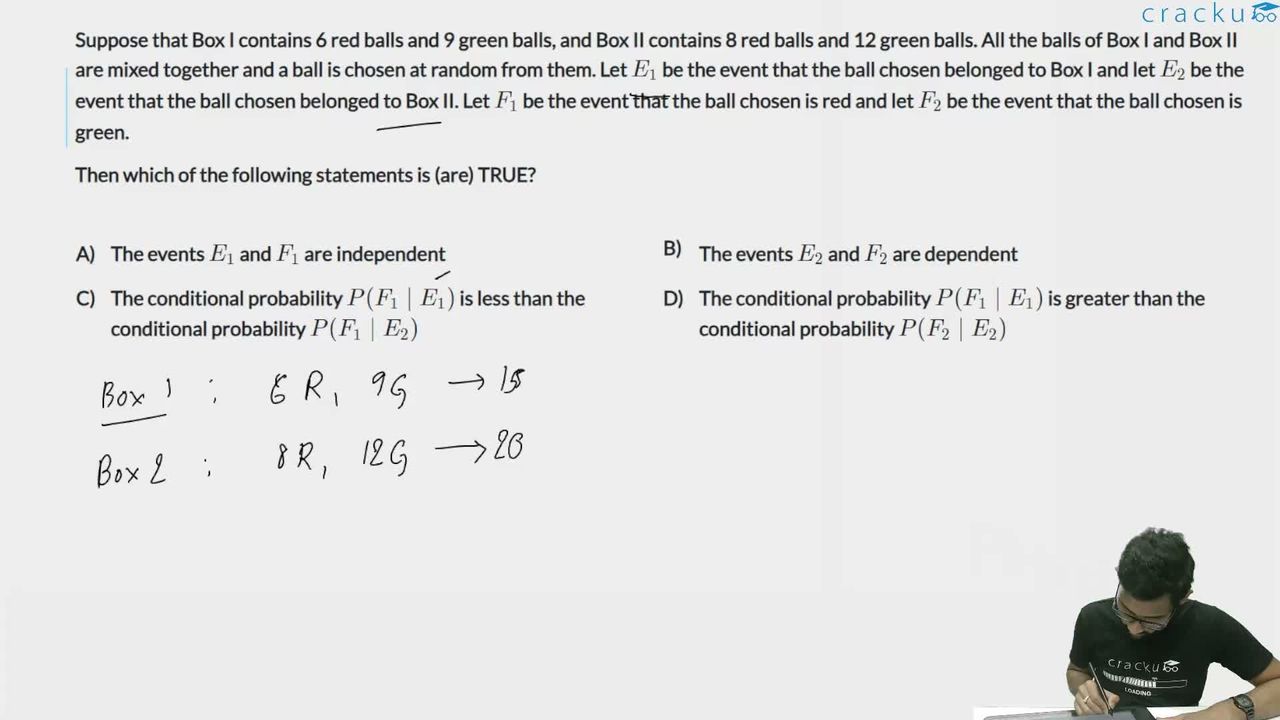
Suppose that Box I contains 6 red balls and 9 green balls, and Box II contains 8 red balls and 12 green balls. All the balls of Box I and Box II are mixed together and a ball is chosen at random from them. Let $$E_1$$ be the event that the ball chosen belonged to Box I and let $$E_2$$ be the event that the ball chosen belonged to Box II. Let $$F_1$$ be the event that the ball chosen is red and let $$F_2$$ be the event that the ball chosen is green.
Then which of the following statements is (are) TRUE?
Let us determine the total counts of the balls and find the probabilities for each event.
Box I contains:
$$ \text{Red balls} = 6 $$
$$ \text{Green balls} = 9 $$
$$ \text{Total balls in Box I} = 6 + 9 = 15 $$
Box II contains:
$$ \text{Red balls} = 8 $$
$$ \text{Green balls} = 12 $$
$$ \text{Total balls in Box II} = 8 + 12 = 20 $$
All balls are mixed together:
$$ \text{Total Red balls } (F_1) = 6 + 8 = 14 $$
$$ \text{Total Green balls } (F_2) = 9 + 12 = 21 $$
$$ \text{Overall Total balls} = 15 + 20 = 35 $$
Step 1: Calculate Individual Probabilities
The probability that a chosen ball belongs to Box I is:
$$ P(E_1) = \frac{15}{35} = \frac{3}{7} $$
The probability that a chosen ball belongs to Box II is:
$$ P(E_2) = \frac{20}{35} = \frac{4}{7} $$
The probability that a chosen ball is red is:
$$ P(F_1) = \frac{14}{35} = \frac{2}{5} $$
The probability that a chosen ball is green is:
$$ P(F_2) = \frac{21}{35} = \frac{3}{5} $$
Step 2: Evaluate Independence of $$ E_1 $$ and $$ F_1 $$
The intersection probability $$ P(E_1 \cap F_1) $$ represents choosing a red ball that came from Box I:
$$ P(E_1 \cap F_1) = \frac{6}{35} $$
Now, let us calculate the product of their individual probabilities:
$$ P(E_1) \cdot P(F_1) = \frac{3}{7} \cdot \frac{2}{5} = \frac{6}{35} $$
Since $$ P(E_1 \cap F_1) = P(E_1) \cdot P(F_1) $$, the events $$ E_1 $$ and $$ F_1 $$ are independent. Therefore, Statement A is TRUE.
Step 3: Evaluate Independence of $$ E_2 $$ and $$ F_2 $$
The intersection probability $$ P(E_2 \cap F_2) $$ represents choosing a green ball that came from Box II:
$$ P(E_2 \cap F_2) = \frac{12}{35} $$
Now, let us calculate the product of their individual probabilities:
$$ P(E_2) \cdot P(F_2) = \frac{4}{7} \cdot \frac{3}{5} = \frac{12}{35} $$
Since $$ P(E_2 \cap F_2) = P(E_2) \cdot P(F_2) $$, the events $$ E_2 $$ and $$ F_2 $$ are independent. This means any statement claiming they are dependent is FALSE.
Step 4: Evaluate Conditional Probabilities
Let us calculate $$ P(F_1 \mid E_1) $$:
$$ P(F_1 \mid E_1) = \frac{P(E_1 \cap F_1)}{P(E_1)} = \frac{\frac{6}{35}}{\frac{15}{35}} = \frac{6}{15} = \frac{2}{5} $$
Let us calculate $$ P(F_1 \mid E_2) $$:
$$ P(F_1 \mid E_2) = \frac{P(E_2 \cap F_1)}{P(E_2)} = \frac{\frac{8}{35}}{\frac{20}{35}} = \frac{8}{20} = \frac{2}{5} $$
Since $$ P(F_1 \mid E_1) = P(F_1 \mid E_2) = \frac{2}{5} $$, the conditional probabilities are equal. Therefore, Statement C is FALSE.
Let us check the last comparison involving $$ P(F_2 \mid E_2) $$:
$$ P(F_2 \mid E_2) = \frac{P(E_2 \cap F_2)}{P(E_2)} = \frac{\frac{12}{35}}{\frac{20}{35}} = \frac{12}{20} = \frac{3}{5} $$
Comparing the values, $$ \frac{2}{5} $$ is not greater than $$ \frac{3}{5} $$, making any statement asserting $$ P(F_1 \mid E_1) > P(F_2 \mid E_2) $$ FALSE.
Conclusion
The correct statements are:
A. The events $$ E_1 $$ and $$ F_1 $$ are independent.
Was this solution helpful?
Click on the Email ☝️ to Watch the Video Solution
Create a FREE account and get:
_1.webp)

Educational materials for JEE preparation

Ask our AI anything

AI can make mistakes. Please verify important information.
AI can make mistakes. Please verify important information.
