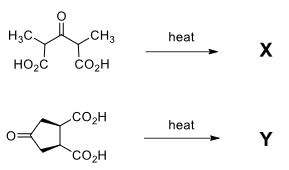
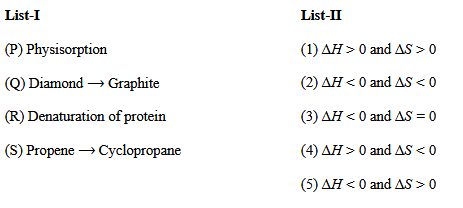
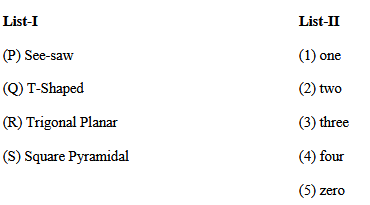
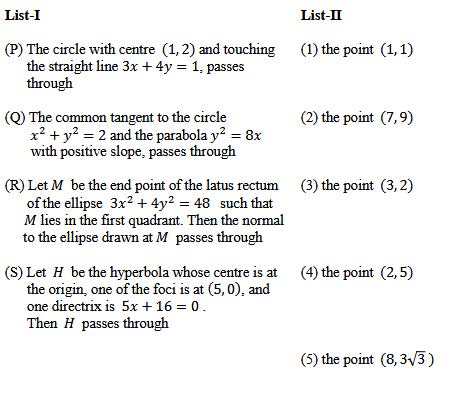
For the following questions answer them individually
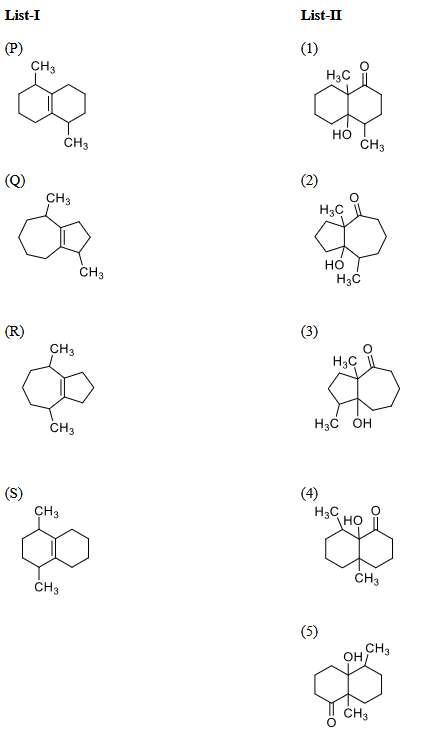
The List-II contains products obtained from the reaction of compounds in List-I with $$O_3$$/$$Zn$$-$$H_2O$$ followed by cyclization (via more stable enolate) in the presence of aqueous $$NaOH$$. Match each entry in List-I with appropriate entry in List-II and choose the correct option.
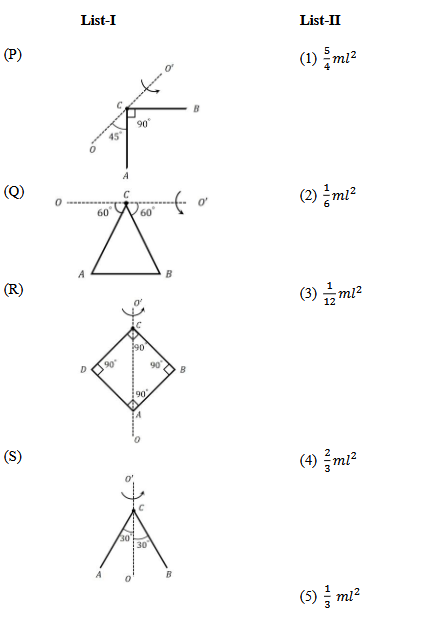
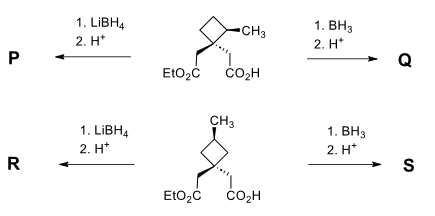
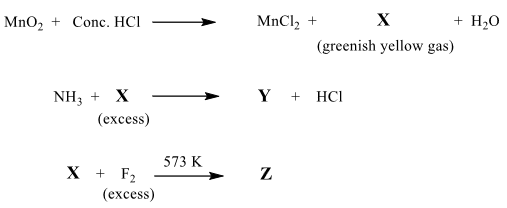
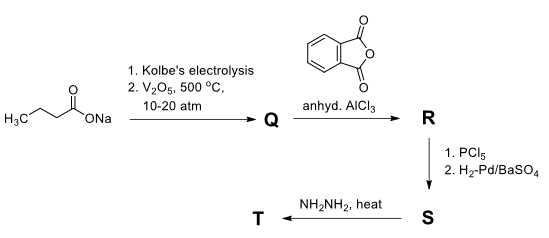
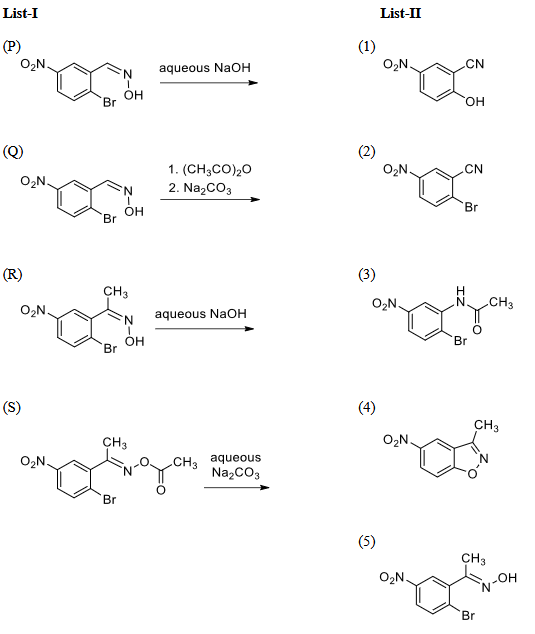
Match the major products obtained in the reactions given in List-I with the corresponding structures in List-II and choose the correct option.
Consider the function $$f:(0,\infty)\to(-\infty,\infty)$$ given by
$$f(x)=\sqrt{x}\,\log_e(x)-x+1.$$
Then which one of the following statements is TRUE?
Let $$P$$ be the point on the parabola $$y=x^2$$ such that the slope of the tangent to the parabola at the point $$P$$ is $$4$$. Let $$Q$$ be the point in the first quadrant lying on the circle $$x^2+y^2=2$$ such that the slope of the tangent to the circle at the point $$Q$$ is $$-1$$. Let $$R$$ be the point in the first quadrant lying on the ellipse $$x^2+4y^2=8$$ such that the slope of the tangent to the ellipse at the point $$R$$ is $$-\tfrac{1}{2}$$. Then the radius of the circle passing through the points $$P,Q$$ and $$R$$ is
Which one of the following matrices can be obtained by performing elementary row transformations on the $$3\times 3$$ identity matrix?
Considering only the principal values of the inverse trigonometric functions, the value of
$$\cot^{-1}(\cot(-11))+10\,\sin\!\left(2\cos^{-1}\!\left(\tfrac{1}{\sqrt{2}}\right)\right)+10\sin(2\tan^{-1}(2))$$
is
Suppose that Box I contains 6 red balls and 9 green balls, and Box II contains 8 red balls and 12 green balls. All the balls of Box I and Box II are mixed together and a ball is chosen at random from them. Let $$E_1$$ be the event that the ball chosen belonged to Box I and let $$E_2$$ be the event that the ball chosen belonged to Box II. Let $$F_1$$ be the event that the ball chosen is red and let $$F_2$$ be the event that the ball chosen is green.
Then which of the following statements is (are) TRUE?
Let $$P$$ be the plane such that it contains the straight line $$\dfrac{x-1}{2}=\dfrac{y-3}{3}=\dfrac{z+2}{1}$$ and is perpendicular to the plane $$x+2y+3z=4$$. Let $$P_1$$ be the plane which passes through the point $$(4,2,2)$$ and is parallel to $$P$$.
Then which of the following statements is (are) TRUE?
Let $$\mathbb{R}$$ denote the set of all real numbers. Let $$f:\mathbb{R}\to\mathbb{R}$$ be an arbitrary function and let $$g:\mathbb{R}\to\mathbb{R}$$ be the function defined by
$$g(x)=x\,f(x),\quad\text{for all }x\in\mathbb{R}.$$
Then which of the following statements is (are) TRUE?
Consider the matrix $$M=\begin{bmatrix}2&-1\\1&0\end{bmatrix}.$$
Let $$p,q,r,s,a,b,c$$ and $$d$$ be integers such that $$M^{26}=\begin{bmatrix}p&q\\r&s\end{bmatrix}$$ and $$\displaystyle\sum_{k=1}^{26}M^k=\begin{bmatrix}a&b\\c&d\end{bmatrix}.$$
Then which of the following statements is (are) TRUE?