JEE WhatsApp Group



JEE Advanced is among the most competitive engineering entrance examinations in India, serving as the gateway to admissions into the prestigious Indian Institutes of Technology (IITs). A thorough understanding of the exam pattern is essential for candidates to prepare strategically and manage their time effectively during the actual examination.
As the official information brochure for JEE Advanced 2027 is yet to be released, candidates may refer to the previous year's exam pattern as a reliable reference. IIT Delhi, the designated conducting institute for JEE Advanced 2027 (following IIT Roorkee in 2026), will officially announce any modifications to the exam pattern once the brochure is published.
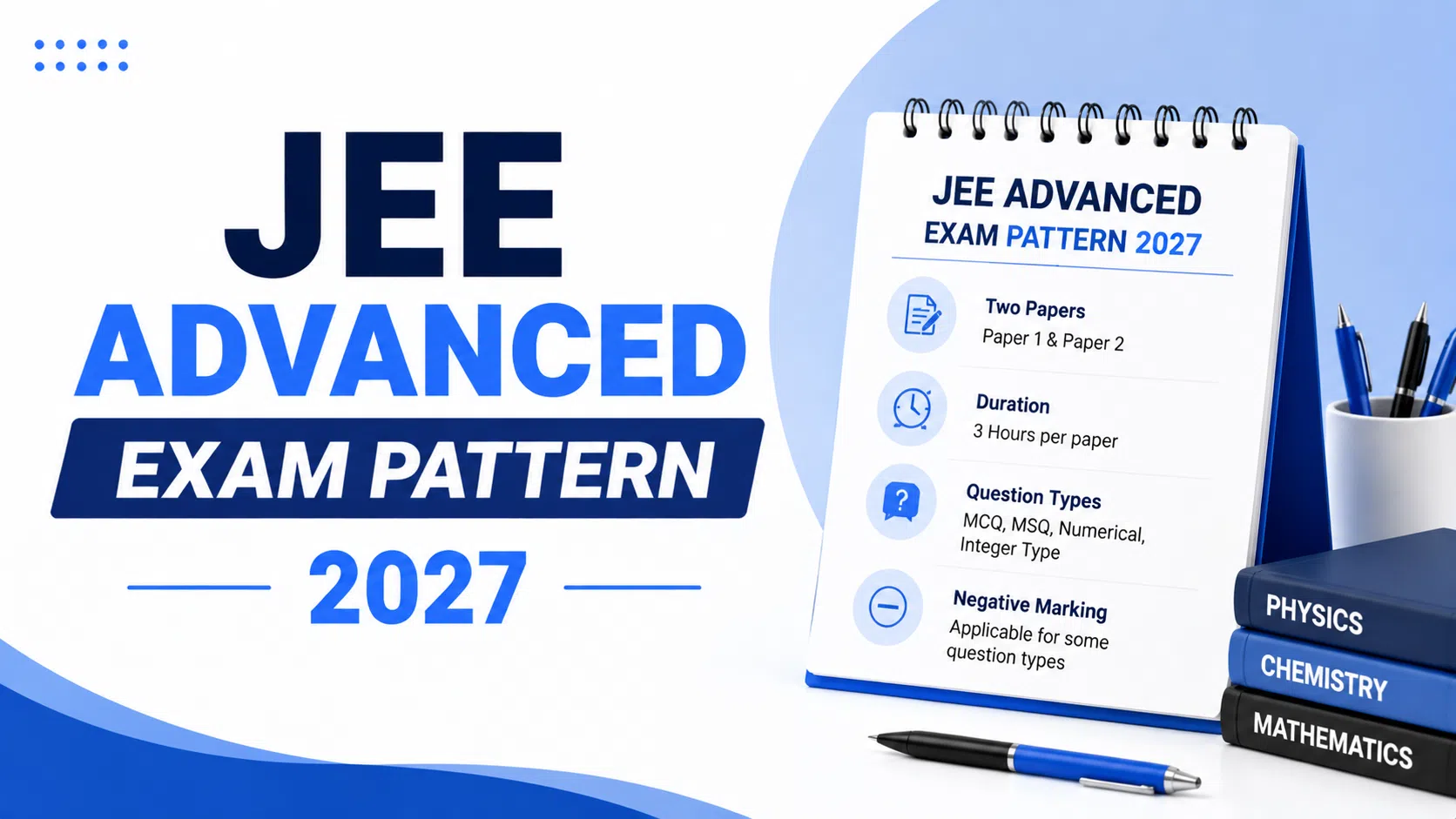
JEE Advanced Exam Pattern 2027
Particulars | Details |
Exam Name | JEE Advanced 2027 |
Exam Mode | Computer-Based Test (CBT) |
Number of Papers | 2 (Paper 1 & Paper 2) |
Subjects | Physics, Chemistry, Mathematics |
Medium | English & Hindi |
Duration | 3 Hours per Paper |
Total Duration | 6 Hours |
Question Types | MCQ, MSQ, Numerical, Integer Type |
Negative Marking | Applicable for selected question types |
Also Read: JEE Advanced Eligibility Criteria 2027, Documents, Age Limit
JEE Advanced Paper 1 and Paper 2 Structure
JEE Advanced comprises two papers conducted on the same day in different shifts. Both papers contain questions from all three subjects and evaluate skills such as analytical thinking, conceptual understanding, and problem-solving ability.
Particulars | Paper 1 | Paper 2 |
Duration | 3 Hours | 3 Hours |
Subjects | PCM | PCM |
Mode | CBT | CBT |
Compulsory | Yes | Yes |
Ranking Consideration | Included | Included |
Subject-Wise Distribution
Subject | Included in Paper 1 | Included in Paper 2 |
Physics | Yes | Yes |
Chemistry | Yes | Yes |
Mathematics | Yes | Yes |
Important Points
- Both papers are conducted on the same day in separate shifts.
- Missing any one paper results in disqualification from the ranking process.
- The difficulty level may vary between Paper 1 and Paper 2.
- Both papers contribute equally to the final rank calculation.
Also Read: JEE Advanced Exam Date 2027, Schedule, Timings, Result
JEE Advanced Question Types 2027
One of the distinguishing features of JEE Advanced is the variety of question formats used. Unlike many entrance examinations that rely exclusively on MCQs, candidates must master a diverse range of JEE questions from single-choice MCQs to open-ended numerical types each testing a different cognitive skill under exam conditions.
Expected Question Types in JEE Advanced 2027
Question Type | Description |
Single Correct MCQ | Only one option is correct |
Multiple Correct MCQ (MSQ) | More than one option may be correct |
Numerical Answer Type (NAT) | Candidates enter a specific numerical value |
Integer Type Questions | Answer is a non-negative integer |
Match the Following | Matching-based questions (if applicable) |
Comprehension-Based Questions | Questions based on passages (if applicable) |
Also Read: JEE Advanced Cutoff 2026, Expected & Previous Year Trends
JEE Advanced Marking Scheme 2027
The marking scheme of JEE Advanced is one of the most critical aspects of the exam, as it varies across sections and question types. One of the best ways to internalise these rules before exam day is to attempt a JEE mock test that mirrors the actual section structure and marking penalties. Candidates must also carefully read the instructions provided at the start of each section before attempting questions. The values below are based on recent year patterns and are subject to change.
Expected JEE Advanced Marking Scheme
Question Type | Correct Answer | Incorrect Answer | Partial Marking |
Single Correct MCQ | +3 | -1 | No |
Multiple Correct MCQ (MSQ) | +4 | -2 (any wrong option selected) | Yes (+1, +2, or +3) |
Numerical Value (NAT) | +3 or +4 | 0 (No Negative) | No |
Integer Type Questions | +3 or +4 | 0 or -1 (Varies by section) | No |
Matching List / Paragraph | +3 | -1 | Sometimes |
Negative Marking Rules in JEE Advanced 2027
Negative marking is one of the most significant challenges in JEE Advanced. Random guessing is strongly discouraged, as incorrect answers in applicable sections can substantially reduce a candidate's overall score.
Expected Negative Marking Rules
Question Type | Negative Marking |
Single Correct MCQ | Yes (-1 per wrong answer) |
Multiple Correct MCQ (MSQ) | Yes (-2 for selecting any wrong option) |
Numerical Questions | Usually No (0 marks for wrong answer) |
Integer Questions | Usually No (0 marks, may vary by paper) |
Important Changes & Trends in JEE Advanced Exam Pattern
Every year, students anticipate significant changes in the JEE Advanced pattern. However, IIT Delhi (and conducting IITs historically) generally retain the core structure while making minor adjustments to question distribution, marking schemes, and section formats.
Recent Exam Pattern Trends
Parameter | Recent Trend |
Number of Papers | Two Compulsory Papers |
Exam Mode | CBT |
Subjects | PCM |
Duration | 3 Hours per Paper |
Question Types | Multiple Formats |
Partial Marking | Available for MSQs |
Negative Marking | Applicable in Certain Sections |
JEE Advanced Exam Pattern 2027: Conclusion
The JEE Advanced Exam Pattern 2027 is expected to retain its core structure of two compulsory computer-based papers covering Physics, Chemistry and Mathematics. Each paper is likely to be conducted for three hours and may include single-correct MCQs, multiple-correct questions, numerical answer type questions and integer-type questions. Understanding the paper structure, marking scheme and negative marking rules will help candidates plan their preparation more effectively.
Candidates should practise different JEE Advanced question types and attempt full-length mock tests for both Paper 1 and Paper 2. They must also read the instructions for every section carefully, as the marking scheme and partial marking rules may differ. Since the official pattern is yet to be announced, students should regularly check the official JEE Advanced 2027 brochure for confirmed updates and changes.