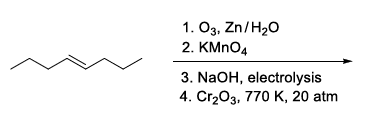
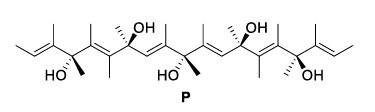
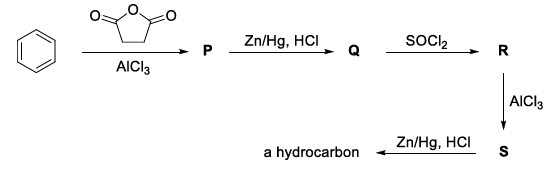
For the following questions answer them individually
Let $$\alpha$$ and $$\beta$$ be real numbers such that $$-\dfrac{\pi}{4} < \beta < 0 < \alpha < \dfrac{\pi}{4}$$. If $$\sin(\alpha + \beta) = \dfrac{1}{3}$$ and $$\cos(\alpha - \beta) = \dfrac{2}{3}$$, then the greatest integer less than or equal to $$\left(\dfrac{\sin\alpha}{\cos\beta} + \dfrac{\cos\beta}{\sin\alpha} + \dfrac{\cos\alpha}{\sin\beta} + \dfrac{\sin\beta}{\cos\alpha}\right)^2$$ is _______.
If $$y(x)$$ is the solution of the differential equation $$x \, dy - (y^2 - 4y) \, dx = 0$$ for $$x > 0$$, $$y(1) = 2$$, and the slope of the curve $$y = y(x)$$ is never zero, then the value of $$10y(\sqrt{2})$$ is _______.
The greatest integer less than or equal to $$\displaystyle\int_1^2 \log_2(x^3 + 1) \, dx + \int_1^{\log_2 9} (2^x - 1)^{1/3} \, dx$$ is _______.
The product of all positive real values of $$x$$ satisfying the equation $$x^{(16(\log_5 x)^3 - 68\log_5 x)} = 5^{-16}$$ is _______.
If $$\beta = \displaystyle\lim_{x \to 0} \dfrac{e^{x^3} - (1-x^3)^{1/3} + \left((1-x^2)^{1/2} - 1\right)\sin x}{x \sin^2 x}$$, then the value of $$6\beta$$ is _______.
Let $$\beta$$ be a real number. Consider the matrix $$A = \begin{pmatrix} \beta & 0 & 1 \\ 2 & 1 & -2 \\ 3 & 1 & -2 \end{pmatrix}$$. If $$A^7 - (\beta - 1)A^6 - \beta A^5$$ is a singular matrix, then the value of $$9\beta$$ is _______.
Consider the hyperbola $$\dfrac{x^2}{100} - \dfrac{y^2}{64} = 1$$ with foci at S and S$$_1$$, where S lies on the positive x-axis. Let P be a point on the hyperbola, in the first quadrant. Let $$\angle$$SPS$$_1 = \alpha$$, with $$\alpha < \dfrac{\pi}{2}$$. The straight line passing through the point S and having the same slope as that of the tangent at P to the hyperbola, intersects the straight line S$$_1$$P at P$$_1$$. Let $$\delta$$ be the distance of P from the straight line SP$$_1$$, and $$\beta = S_1P$$. Then the greatest integer less than or equal to $$\dfrac{\beta\delta}{9}\sin\dfrac{\alpha}{2}$$ is _______.
Consider the functions $$f, g : \mathbb{R} \to \mathbb{R}$$ defined by $$f(x) = x^2 + \dfrac{5}{12}$$ and $$g(x) = \begin{cases} 2\left(1 - \dfrac{4|x|}{3}\right), & |x| \leq \dfrac{3}{4} \\ 0, & |x| > \dfrac{3}{4} \end{cases}$$
If $$\alpha$$ is the area of the region $$\left\{(x,y) \in \mathbb{R} \times \mathbb{R} : |x| \leq \dfrac{3}{4}, \, 0 \leq y \leq \min\{f(x), g(x)\}\right\}$$, then the value of $$9\alpha$$ is _______.
Let PQRS be a quadrilateral in a plane, where QR = 1, $$\angle$$PQR = $$\angle$$QRS = 70$$^\circ$$, $$\angle$$PQS = 15$$^\circ$$ and $$\angle$$PRS = 40$$^\circ$$. If $$\angle$$RPS = $$\theta^\circ$$, PQ = $$\alpha$$ and PS = $$\beta$$, then the interval(s) that contain(s) the value of $$4\alpha\beta \sin\theta^\circ$$ is/are
Let $$\alpha = \displaystyle\sum_{k=1}^{\infty} \sin^{2k}\left(\dfrac{\pi}{6}\right)$$.
Let $$g : [0, 1] \to \mathbb{R}$$ be the function defined by $$g(x) = 2^{\alpha x} + 2^{\alpha(1-x)}$$.
Then, which of the following statements is/are TRUE?