JEE WhatsApp Group



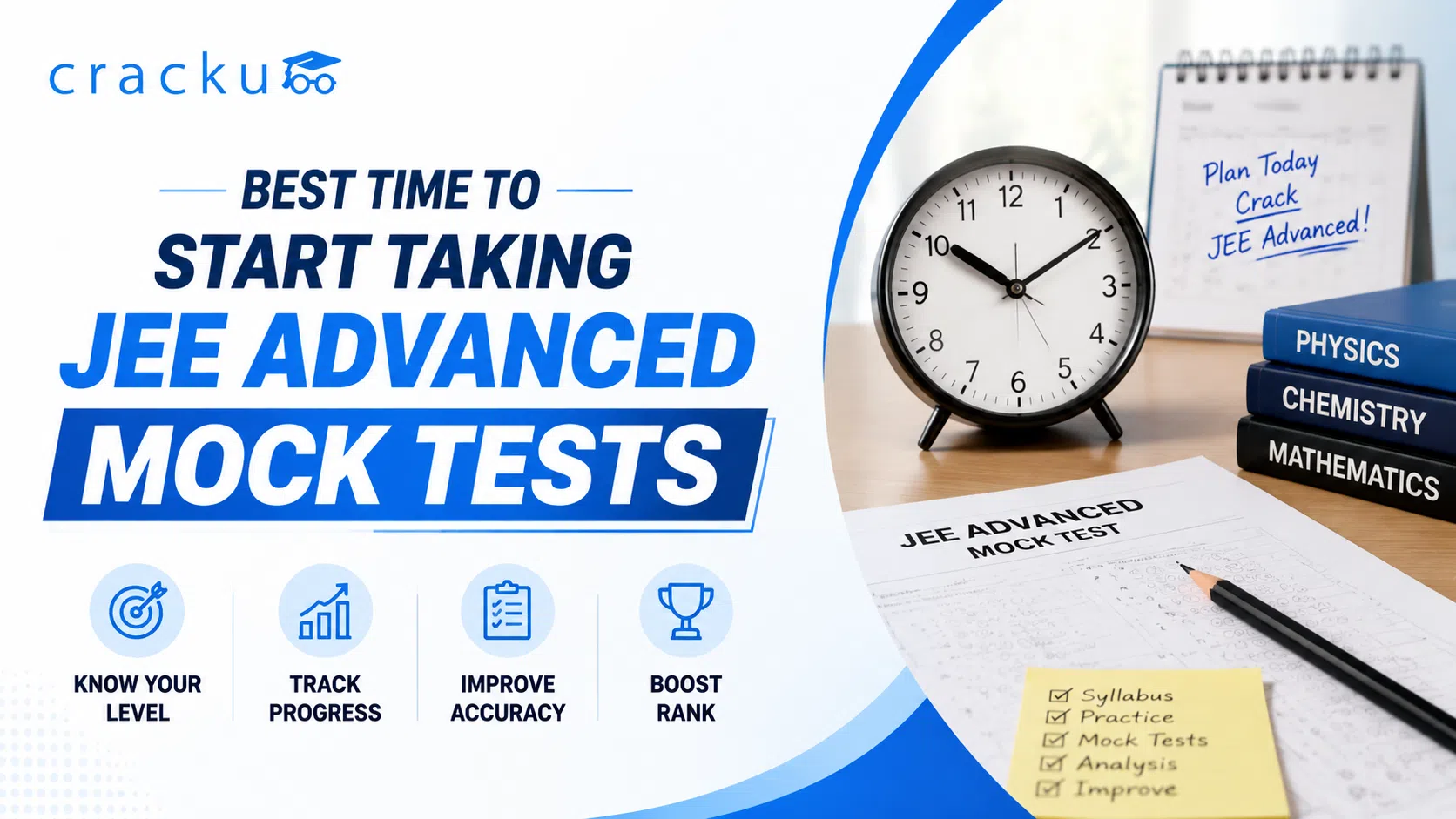
Best Time to Start Taking JEE Advanced Mock Tests
The best time to start taking JEE Advanced mock tests is contingent on how much syllabus you have already covered. It is important to avoid waiting until the last month. When you prepare for the JEE Advanced, practice mock tests in stages for a better performance rather than all at once.
If you are still learning your basics like class 10th and 12th topics, then start with chapter-wise and subject-wise tests. Once most of your syllabus is complete, move to part tests. Start with full-length JEE Advanced mock tests only when you can sit for three hours, solve mixed questions, and review your mistakes properly.
To practise with timed papers and improve exam attempt strategy, check out Cracku’s widely used JEE Advanced Mock Test. JEE Advanced aspirants must note that a good JEE preparation plan 2026 includes the following:
- Topic-wise tests during concept building
- Part-syllabus tests during revision
- Full-length mocks after major syllabus coverage
- Paper 1 and Paper 2 practice in exam-like slots
- Proper analysis after every test
Why Mock Tests Are Crucial for JEE Advanced Preparation
JEE Advanced is not only about knowing formulas. It tests application, accuracy, question selection, speed, and patience. Even if you are able to understand each topic in chapter, you may still lose marks due to poor time management or wrong question choice. Mock tests help because they show the real gap between preparation and performance.
Mock tests also help students revise Physics, Chemistry, and Maths subjects together. It allows a student to recall concepts from different chapters in one sitting. Before starting full mocks, you must solve enough JEE Questions from different difficulty levels to build the base needed for mixed JEE Advanced-level papers. Refer to the table below highlighting the importance of mock tests for JEE Advanced preparation.
Mock Test Benefit | Why It Matters for JEE Advanced |
Exam Simulation | You’ll learn to handle Paper 1 and Paper 2 pressure |
Time Management | You’ll know when to skip, solve, or return to a question |
Accuracy Check | Silly mistakes and calculation errors will become visible |
Weak-area Tracking | You will be able identify chapters that need revision |
Question Selection | You will learn which questions are worth attempting first |
Exam Stamina | Full-length mocks build focus for long test hours |
Also Read: JEE Advanced Syllabus 2027 , Books, Chapters & Study Plan
Ideal Mock Test Timeline for JEE Advanced Aspirants
JEE Advanced aspirants must not start full-length mocks too early without concept clarity. You must also not delay mocks until the final few weeks. The right approach is a phased timeline. Remember to increase mock frequency only when you are able to analyze the tests properly. Writing five tests without review is less useful than writing two tests and correcting every mistake. Those in the early stage can use a JEE Question Bank before moving to full mocks.
Preparation Stage | Type | Ideal Mocks Per Week |
Class 11 or early Class 12 | Chapter-wise | 1-2 |
After completing major topics | Subject-wise | 1-2 |
4-6 months before JEE Advanced | Part-syllabus | 1 |
2-3 months before JEE Advanced | Full-length | 1-2 |
Last 45 days | Full-length Paper 1 & Paper 2 sets | 2-3 |
Last 10-14 days | Selected mocks & revision | Fewer tests, deeper analysis |
Also Read: JEE Mains vs JEE Advanced, Exam Pattern, Eligibility & Syllabus
Signs You're Ready to Attempt Full-Length JEE Advanced Mock Tests
You’ll know you’re ready for full-length JEE Advanced mock tests when your preparation has stabilized. At this stage, full mocks must not involve guesswork. Do not wait for 100% syllabus completion as this stage is never perfect. If 70-80% of the syllabus is ready, start full mocks and keep revising weak chapters side by side.
Also, do not use full-length mocks as the only study method. While mock tests show the problems, revision helps fix them. Use JEE Study Material to revise concepts that you feel are weak during test analysis. Check the stages below to know when you are ready to attempt full-length mocks.
- Completed most high-weightage chapters.
- Able to solve mixed questions from Physics, Chemistry, and Maths.
- Know the basic formulas and concepts without checking notes.
- Able to sit for three hours without losing focus.
- Can Attempt difficult questions without panic.
- Can review a paper honestly after the test.
- Already solved enough chapter-wise and part tests.
Also Read: JEE Advanced Eligibility Criteria 2027, Documents, Age Limit
How to Analyze Your JEE Advanced Mock Tests
Mock test analysis is more important than the score itself. A low score can still help if you are able to find the exact reason behind the mistakes. Try not to refer to the answer key. Instead, break the paper into mistakes, skipped questions, time loss, and accuracy issues. Here is a step-by-step process for mock test analysis.
After every mock test, divide your mistakes into 3 categories:
- Conceptual mistakes
- Calculation mistakes
- Question-reading mistakes
While conceptual mistakes need revision, calculation mistakes need slower written practice. Mistakes of question-reading need better focus and careful reading. Remember that a mock test is useful only when the next mock improves because of the previous one.
Step | What to Check | What to Do Next |
Check Attempted Questions | How many questions were attempted? | See if attempts were too high or too low |
Review Correct Answers | Which questions were solved well? | Maintain the same approach |
Review Wrong Answers | Was it concept, calculation, or reading error? | Add it to an error notebook |
Review Skipped Questions | Were they difficult or unknown? | Separate weak chapters from tough questions |
Check Time Spent | Which questions took too long? | Improve question selection |
Reattempt Mistakes | Can you solve them without a solution? | Revise the concept if needed |
Track Repeated Errors | Are mistakes repeating? | Fix the root cause first |
Common Mistakes Students Make While Starting JEE Advanced Mock Tests
Many students start mock tests with the wrong approach. They treat mocks as scorecards instead of learning tools. This slows down improvement.
Starting Full Mocks Too Early
Avoid full-length JEE Advanced mocks before completing enough syllabus. Start with chapter tests if your basics are still weak. Move to full mocks only when you can handle mixed questions.
Ignoring Mock Test Analysis
This is the biggest mistake students make while starting JEE Advanced mock tests. You may take a mock, check marks, and then move on but it does not improve your score. Every mock should be followed by detailed analysis. Spend enough time checking wrong answers, skipped questions, and time traps.
Taking Too Many Mocks Without Revision
More mock tests do not mean that your preparation is going well. If the same mistakes repeat, you are only practicing errors. Therefore, after every test, revise weak topics before taking the next one.
Comparing Scores With Others
JEE Advanced often has negative marking and partial marking. Blind guessing can reduce the score quickly. Learn to control risks by attempting a question only when the logic is clear.
Not Practising Paper 1 and Paper 2 Together
During the final phase, practise both papers in one day. Keep the same break pattern as the actual exam. Many students practise one paper well but lose focus in the second paper.
Avoiding Difficult Questions
Do not skip every tough-looking question during practice. Instead, learn how to read, break, and attempt layered problems. For daily discipline, you may use a JEE Daily Target to balance mock analysis, revision, and question practice.
Also Read: JEE Advanced Exam Date 2027, Schedule, Timings, Result
Best Time to Start Taking JEE Advanced Mock Tests: Conclusion
Starting JEE Advanced mock tests at the right time can significantly improve your exam performance. Instead of waiting until the final weeks, students should follow a phased approach by beginning with chapter-wise tests, moving to part-syllabus tests, and finally attempting full-length JEE Advanced mock papers after completing major topics.
A successful JEE Advanced mock test strategy is not only about increasing the number of tests but also about analyzing every mistake carefully. Regular practice, proper revision, improved question selection, and better time management can help students convert mock test performance into actual exam success. Use every mock test as a learning opportunity and gradually build the confidence required for JEE Advanced.
.webp)