

 Group
Group
 Group
Group


 Preferred Source

 Google Discover

JEE Differential Equations PYQ
Solving JEE Differential Equations PYQ questions helps students understand how differential equations are tested in JEE Main and JEE Advanced. Most questions from this chapter require students to form or solve a differential equation using standard methods such as variable separation, homogeneous equations and linear differential equations.
A differential equation contains one or more derivatives of a dependent variable with respect to an independent variable. Its general form can be written as:
$$F(x,y,dxdy,dx2d2y,…)=0$$
Previous-year questions help students recognise standard equation forms and select the correct solution method. Regular practice also improves algebraic accuracy, integration skills and the ability to apply initial conditions. Including these problems in your JEE Study Material can make chapter-wise revision more organised and effective.
JEE Differential Equations Important PYQ PDF
The JEE Differential Equations Important PYQ PDF provided below contains selected previous-year questions for focused practice. It can be downloaded and used during chapter-wise preparation, revision or before attempting full-length tests.
Students should first solve every question independently and check the solution only after completing their attempt. While practicing, note the type of differential equation, the method used and any calculation errors. Revisiting difficult JEE Differential Equations Questions regularly will help strengthen conceptual understanding and improve confidence.
The PDF can also serve as a quick revision resource before the examination. Try solving its questions within a fixed time to develop better speed and accuracy.
Important Topics Covered in Differential Equations PYQs
Questions from this chapter usually test the formation, order, degree and solution of differential equations. Students should understand the standard forms clearly because selecting the correct method is often the most important step.
Important topics covered in JEE Questions on differential equations include:
- Order and degree of a differential equation
- Formation of differential equations
- General and particular solutions
- Differential equations with separable variables
- Homogeneous differential equations
- Linear differential equations
- Initial-value problems
- Applications of differential equations
For a differential equation of the form:
$$dxdy=f(x)g(y)$$
the variables can be separated as:
$$g(y)dy=f(x)dx$$
A first-order linear differential equation is generally written as:
$$dxdy+P(x)y=Q(x)$$
Its integrating factor is:
$$IF=e∫P(x)dx$$
The solution is then obtained using:
$$y(IF)=∫Q(x)(IF)dx+C$$
Students should also revise standard integration formulas because almost every solution requires integration after the equation is simplified.
How to Solve Differential Equations PYQs Effectively
Begin by identifying the order, degree and form of the given equation. Do not start manipulating the expression immediately. First determine whether it is separable, homogeneous, linear or requires the formation of a differential equation.
Follow these steps while solving chapter-wise problems:
- Rewrite the equation in a recognisable standard form.
- Identify the most suitable solution method.
- Separate the variables when possible.
- Use substitution carefully for homogeneous equations.
- Calculate the integrating factor for linear equations.
- Include the arbitrary constant in the general solution.
- Apply the given initial condition to find the particular solution.
- Differentiate the final answer to verify it whenever possible.
Attempting a JEE Mock Test after completing topic-wise practice will show whether you can select the correct method under exam pressure. Maintain a notebook of errors involving integration, substitutions and initial conditions. This will help prevent repeated mistakes during revision.
List of JEE Differential Equations PYQs
The questions listed below can be attempted as a chapter-wise test. These problems have been selected from the JEE Mains Previous Paper collection to help students become familiar with the level and style of questions asked in the examination.
Set a fixed time limit and solve the questions without checking the answers. After completing the test, review every incorrect or skipped question and revise the method required to solve it.
Question 1
Consider a curve $$y = y(x)$$ in the first quadrant as shown in the figure. Let the area $$A_1$$ is twice the area $$A_2$$. Then the normal to the curve perpendicular to the line $$2x - 12y = 15$$ does NOT pass through the point
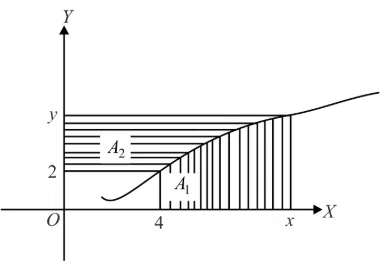
correct answer:- 3
Question 2
Let $$y = y(x)$$ be the solution of the differential equation $$(3y^2 - 5x^2)y\,dx + 2x(x^2 - y^2)\,dy = 0$$ such that $$y(1) = 1$$. Then $$|(y(2))^3 - 12y(2)|$$ is equal to:
correct answer:- 1
Question 3
Let the tangent at any point P on a curve passing through the points (1, 1) and ($$\frac{1}{10}$$, 100), intersect positive x-axis and y-axis at the points A and B respectively. If PA : PB = 1 : k and $$y = y(x)$$ is the solution of the differential equation $$e^{\frac{dy}{dx}} = kx + \frac{k}{2}$$, $$y(0) = k$$, then $$4y(1) - 5\log_e 3$$ is equal to _______.
correct answer:- 5
Question 4
The slope of the tangent to a curve $$C: y = y(x)$$ at any point $$[x, y)$$ on it is $$\dfrac{2e^{2x} - 6e^{-x} + 9}{2 + 9e^{-2x}}$$. If $$C$$ passes through the points $$\left(0, \dfrac{1}{2} + \dfrac{\pi}{2\sqrt{2}}\right)$$ and $$\left(\alpha, \dfrac{1}{2}e^{2\alpha}\right)$$ then $$e^{\alpha}$$ is equal to
correct answer:- 2
Question 5
Let a smooth curve $$y = f(x)$$ be such that the slope of the tangent at any point $$(x, y)$$ on it is directly proportional to $$\left(\dfrac{-y}{x}\right)$$. If the curve passes through the points $$(1, 2)$$ and $$(8, 1)$$, then $$\left|y\left(\dfrac{1}{8}\right)\right|$$ is equal to
correct answer:- 2

Question 6
Let a curve $$y = y(x)$$ pass through the point $$(3, 3)$$ and the area of the region under this curve, above the $$x$$-axis and between the abscissae $$3$$ and $$x (> 3)$$ be $$\left(\dfrac{y}{x}\right)^3$$. If this curve also passes through the point $$(\alpha, 6\sqrt{10})$$ in the first quadrant, then $$\alpha$$ is equal to ______.
correct answer:- 6
Question 7
Let $$f$$ be a differentiable function satisfying $$f(x) = \frac{2}{\sqrt{3}} \int_0^{\sqrt{3}} f\left(\frac{\lambda^2 x}{3}\right) d\lambda$$, $$x > 0$$ and $$f(1) = \sqrt{3}$$. If $$y = f(x)$$ passes through the point $$(\alpha, 6)$$, then $$\alpha$$ is equal to _______.
correct answer:- 12
Question 8
The population $$P = P(t)$$ at time $$t$$ of a certain species follows the differential equation $$\frac{dP}{dt} = 0.5P - 450$$. If $$P(0) = 850$$, then the time at which population becomes zero is:
correct answer:- 2
Question 9
If $$y = y(x)$$ is the solution of the differential equation, $$\frac{dy}{dx} + 2y\tan x = \sin x$$, $$y\left(\frac{\pi}{3}\right) = 0$$, then the maximum value of the function $$y(x)$$ over $$R$$ is equal to:
correct answer:- 4
Question 10
Let $$f: \mathbb{R} \to \mathbb{R}$$ be such that $$f(xy) = f(x)f(y)$$, for all $$x, y \in \mathbb{R}$$ and $$f(0) \ne 0$$. Let $$g: [1, \infty) \to \mathbb{R}$$ be a differentiable function such that $$x^2 g(x) = \int_1^x (t^2 f(t) - tg(t))\,dt.$$ Then $$g(2)$$ is equal to :
correct answer:- 3

Question 11
Let $$y = y(x)$$ be the solution of the differential equation $$x \tan\left(\frac{y}{x}\right) dy = \left(y \tan\left(\frac{y}{x}\right) - x\right) dx$$, $$-1 \le x \le 1$$, $$y\left(\frac{1}{2}\right) = \frac{\pi}{6}$$. Then the area of the region bounded by the curves $$x = 0$$, $$x = \frac{1}{\sqrt{2}}$$ and $$y = y(x)$$ in the upper half plane is:
correct answer:- 1
Question 12
If $$x\phi(x) = \int_5^x (3t^2 - 2\phi'(t)) dt$$, $$x > -2$$, $$\phi(0) = 4$$, then $$\phi(2)$$ is _________.
correct answer:- 4
Question 13
Which of the following is true for $$y(x)$$ that satisfies the differential equation $$\frac{dy}{dx} = xy - 1 + x - y$$; $$y(0) = 0$$:
correct answer:- 1
Question 14
Let $$y = y(x)$$ be the solution of the differential equation $$(2x \log_e x)\frac{dy}{dx} + 2y = \frac{3}{x}\log_e x$$, $$x > 0$$ and $$y(e^{-1}) = 0$$. Then, $$y(e)$$ is equal to
correct answer:- 1
Question 15
Let $$y = y(x)$$ be a solution curve of the differential equation $$(y+1)\tan^2 x \, dx + \tan x \, dy + y \, dx = 0$$, $$x \in \left(0, \frac{\pi}{2}\right)$$. If $$\lim_{x \to 0^+} xy(x) = 1$$, then the value of $$y\left(\frac{\pi}{4}\right)$$ is:
correct answer:- 3

Question 16
The rate of growth of bacteria in a culture is proportional to the number of bacteria present and the bacteria count is 1000 at initial time $$t = 0$$. The number of bacteria is increased by 20% in 2 hours. If the population of bacteria is 2000 after $$\frac{k}{\log_e(\frac{6}{5})}$$ hours, then $$\left(\frac{k}{\log_e 2}\right)^2$$ is equal to:
correct answer:- 2
Question 17
Let $$\alpha x = \exp(x^\beta y^\gamma)$$ be the solution of the differential equation $$2x^2 y dy - (1 - xy^2)dx = 0$$, $$x > 0, y(2) = \sqrt{\log_e 2}$$. Then $$\alpha + \beta - \gamma$$ equals :
correct answer:- 1
Question 18
The difference between degree and order of a differential equation that represents the family of curves given by $$y^2 = a\left(x + \frac{\sqrt{a}}{2}\right), a > 0$$ is ______.
correct answer:- 2
Question 19
If $$\frac{dx}{dy} = \frac{1 + x - y^2}{y}$$, $$x(1) = 1$$, then $$5x(2)$$ is equal to:
correct answer:- 5
Question 20
Let $$f:(0,\infty)\to R$$ be a function which is differentiable at all points of its domain and satisfies the condition $$x^2 f'(x) = 2x f(x) + 3,$$ with $$f(1)=4.$$ Then $$2f(2)$$ is equal to:
correct answer:- 1

Question 21
Let $$y = y(x)$$ be the solution of the differential equation $$\cos x\frac{dy}{dx} + 2y\sin x = \sin 2x$$, $$x \in \left(0, \frac{\pi}{2}\right)$$. If $$y(\pi/3) = 0$$, then $$y(\pi/4)$$ is equal to:
correct answer:- 3
Question 22
If $$y = y(x)$$ is the solution of the differential equation $$\frac{dy}{dx} + \frac{4x}{x^2-1}y = \frac{x+2}{(x^2-1)^{5/2}}$$, $$x \gt 1$$ such that $$y(2) = \frac{2}{9}\log_e 2 + \sqrt{3}$$ and $$y\sqrt{2} = \alpha\log_e(\sqrt{\alpha} + \beta) + \beta - \sqrt{\gamma}$$, $$\alpha, \beta, \gamma \in \mathbb{N}$$, then $$\alpha\beta\gamma$$ is equal to _____.
correct answer:- 6
Question 23
Let a differentiable function $$f$$ satisfy $$f(x) + \int_3^x \dfrac{f(t)}{t} dt = \sqrt{x+1}$$, $$x \ge 3$$. Then $$12f(8)$$ is equal to:
correct answer:- 3
Question 24
Let $$y = y(x)$$ be the solution of the differential equation $$(1 - x^2)dy = \left[xy + (x^3 + 2)\sqrt{3(1 - x^2)}\right]dx$$, $$-1 < x < 1$$, $$y(0) = 0$$. If $$y\left(\frac{1}{2}\right) = \frac{m}{n}$$, $$m$$ and $$n$$ are coprime numbers, then $$m + n$$ is equal to __________.
correct answer:- 97
Question 25
Let $$f(x)$$ be a positive function such that the area bounded by $$y = f(x), y = 0$$ from $$x = 0$$ to $$x = a > 0$$ is $$e^{-a} + 4a^2 + a - 1$$. Then the differential equation, whose general solution is $$y = c_1 f(x) + c_2$$, where $$c_1$$ and $$c_2$$ are arbitrary constants, is
correct answer:- 4

Question 26
If the solution of the differential equation $$(2x + 3y - 2)dx + (4x + 6y - 7)dy = 0$$, $$y(0) = 3$$, is $$\alpha x + \beta y + 3\log_e|2x + 3y - \gamma| = 6$$, then $$\alpha + 2\beta + 3\gamma$$ is equal to _______.
correct answer:- 29
Question 27
Let $$y = y(x)$$ be the solution of the differential equation $$\frac{dy}{dx} + \frac{2x}{(1+x^2)^2} y = xe^{\frac{1}{(1+x^2)}}$$; $$y(0) = 0$$. Then the area enclosed by the curve $$f(x) = y(x)e^{-\frac{1}{(1+x^2)}}$$ and the line $$y - x = 4$$ is __________
correct answer:- 18
Question 28
Let $$y = y(x)$$ be the solution of the differential equation $$(x^2 + 4)^2 dy + (2x^3 y + 8xy - 2)dx = 0$$. If $$y(0) = 0$$, then $$y(2)$$ is equal to
correct answer:- 1
Question 29
Let the solution $$y = y(x)$$ of the differential equation $$\frac{dy}{dx} - y = 1 + 4\sin x$$ satisfy $$y(\pi) = 1$$. Then $$y\left(\frac{\pi}{2}\right) + 10$$ is equal to ______.
correct answer:- 7
Question 30
If for the solution curve y = f(x) of the differential equation $$\frac{dy}{dx}+(\tan x)y = \frac{2+\sec x}{(1+2\sec x)^{2}}$$, $$x \in \left(-\frac{\pi}{2}, \frac{\pi}{2}\right), \quad f\left(\frac{\pi}{3}\right) = \frac{\sqrt{3}}{10}$$, then $$f\left(\frac{\pi}{4}\right)$$ is equal to :
correct answer:- 4