
 Group
Group
 Group
Group


 Preferred Source

 Google Discover
JEE Aldehydes & Ketones PYQ
Aldehydes and Ketones is an important chapter in JEE Organic Chemistry. It helps you understand the carbonyl group and the reactions of aldehydes and ketones.
In this chapter, you will study preparation methods, nucleophilic addition reactions, oxidation, reduction, aldol condensation, Cannizzaro reaction, haloform reaction, and important chemical tests.
These topics are also connected with alcohols, carboxylic acids, hydrocarbons, and many organic conversions.
Solving JEE Aldehydes & Ketones PYQ is one of the best ways to check your preparation. It helps you understand the type of questions asked in JEE Main and shows you which reactions need more revision.
On this page, you can revise the main concepts, download the PYQ PDF, learn important reactions, avoid common mistakes, and practise chapter-wise questions.
Aldehydes & Ketones PYQ
Previous-year questions help you understand which topics are asked frequently. In Aldehydes and Ketones, many questions are based on reaction products, reactivity order, named reactions, chemical tests, and conversions.
While solving JEE Advanced Questions, do not try to memorise every answer. First, look at the compound, reagent, and reaction condition.
For example, if a question asks about the reactivity of carbonyl compounds, check the groups attached to the carbonyl carbon. Aldehydes are usually more reactive than ketones because they have less steric hindrance.
Formaldehyde is generally the most reactive because it does not have any alkyl group attached to the carbonyl carbon.
For questions based on aldol and Cannizzaro reactions, always check whether the compound has an alpha-hydrogen.
Aldehydes and ketones with alpha-hydrogen can undergo aldol condensation. Aldehydes without alpha-hydrogen may undergo the Cannizzaro reaction.
Try to solve every question within a fixed time. After completing a set, check your mistakes carefully.
You may make mistakes because:
- You missed the reaction condition.
- You forgot to check for alpha-hydrogen.
- You confused oxidation and reduction.
- You selected the wrong named reaction.
- You counted the carbon atoms incorrectly.
Regular practice will improve your speed and accuracy.
JEE Aldehydes & Ketones PYQs PDF
You can download the JEE Aldehydes & Ketones PYQs PDF from the section below.
First, solve the questions without checking the answers. Try to complete the PDF in one sitting so that you can understand your current level.
After solving the questions, divide them into three groups:
- Questions you solved easily
- Questions that took more time
- Questions you could not solve
Revise the difficult topics and solve those questions again after a few days.
You can also add this PDF to your JEE Study Resources. While checking the solutions, do not only look at the correct option. Understand why the reaction gives that particular product.
In this chapter, a small change in the condition can change the final product. Dilute base, concentrated base, heat, acid, and hydrolysis can lead to different reactions.
Always read the complete question before choosing your answer.
Important Formulas for JEE Aldehydes & Ketones PYQs
This chapter does not have many numerical formulas. However, it includes several important reaction rules and orders that you should remember.
The following table can help you during JEE Advanced PYQ revision.
| Concept | Important Rule or Order | Simple Meaning |
|---|---|---|
| Nucleophilic Addition Reactivity | $$\mathrm{HCHO > RCHO > ArCHO > R_2CO}$$ | Aldehydes are generally more reactive than ketones. |
| Oxidation | $$\mathrm{RCHO \xrightarrow{[O]} RCOOH}$$ | Aldehydes oxidise easily to carboxylic acids. |
| Reduction | $$\mathrm{Carbonyl\ Compound \xrightarrow{[H]} Alcohol}$$ | Aldehydes form primary alcohols, while ketones form secondary alcohols. |
| HCN Addition | $$\mathrm{R_2C{=}O + HCN \rightarrow R_2C(OH)CN}$$ | $$\mathrm{CN^-}$$ attacks the carbonyl carbon to form a cyanohydrin. |
| Grignard Reaction | $$\mathrm{Carbonyl\ Compound + RMgX \xrightarrow{H_3O^+} Alcohol}$$ | The reaction forms a new carbon-carbon bond and increases the carbon chain. |
| Aldol Reaction | $$\mathrm{Carbonyl\ Compound\ with\ \alpha\text{-}H \rightarrow Aldol\ Product}$$ | At least one alpha-hydrogen is required. |
| Cannizzaro Reaction | $$\mathrm{Aldehyde\ without\ \alpha\text{-}H \rightarrow Alcohol + Carboxylate\ Salt}$$ | One aldehyde molecule is oxidised while another is reduced. |
| Haloform Reaction | $$\mathrm{RCOCH_3 + X_2/OH^- \rightarrow RCOO^- + CHX_3}$$ | This reaction helps identify the $$\mathrm{CH_3CO{-}}$$ group. |
| Tollens’ Test | $$\mathrm{Aldehyde \rightarrow Silver\ Mirror}$$ | Most ketones do not give a positive Tollens’ test. |
| Fehling’s Test | $$\mathrm{Aliphatic\ Aldehyde \rightarrow Red\ Precipitate}$$ | Aromatic aldehydes generally do not give a positive Fehling’s test. |
Do not memorise these reactions without understanding their conditions.
For example, benzaldehyde gives Tollens’ test but usually does not give Fehling’s test.
Acetone gives the iodoform test because it contains the methyl ketone group.
Before selecting an answer, always check the structure and reaction condition.
Common Mistakes to Avoid in JEE Aldehydes & Ketones PYQs
One common mistake is applying a named reaction without checking the structure of the compound.
For example, students may think that every aldehyde gives an aldol reaction. This is not correct. Aldol condensation requires at least one alpha-hydrogen.
Formaldehyde and benzaldehyde do not have alpha-hydrogen, so they do not undergo self-aldol condensation.
Another common mistake is assuming that every aldehyde gives all aldehyde tests.
Most aldehydes give Tollens’ test. However, aromatic aldehydes such as benzaldehyde usually do not give Fehling’s test.
Students also confuse Clemmensen reduction and Wolff–Kishner reduction.
Both reactions convert the carbonyl group into a methylene group. However, Clemmensen reduction takes place in acidic conditions, while Wolff–Kishner reduction takes place in basic conditions.
While solving conversion questions, always count the number of carbon atoms. Grignard reagents and HCN can increase the carbon chain.
While practising JEE Aldehydes & Ketones Questions, write the reagent and condition clearly above or below the reaction arrow.
This simple habit will help you avoid confusion between similar reactions.
Also remember that the final product depends on the reagent, reaction condition, and work-up step. Do not choose an intermediate as the final answer if hydrolysis or heating is mentioned.
List of JEE Aldehydes & Ketones PYQs
Use the questions given below as a short practice test.
Try to solve them like a JEE Advanced Mock Test. Set a time limit, avoid using notes, and check your answers only after completing the full test.
Question 1
Major product 'B' of the following reaction sequence is

correct answer:- 2
Question 2
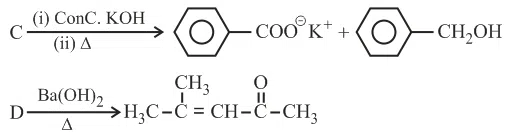
Consider the following reactions:
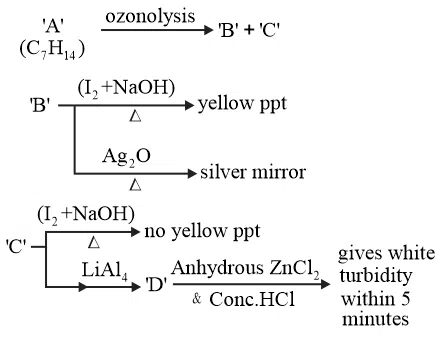
'A' is:
correct answer:- 4
Question 3
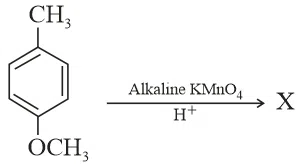
correct answer:- 3
Question 4
The compound A, $$C_{8}H_{8}O_{2}$$ reacts with acetophenone to form a single product via cross-Aldol condensation. The compound A on reaction with cone. NaOH forms a substituted benzyl alcohol as one of the two products. The compound A is :
correct answer:- 4
Question 5
From the given following (A to D) cyclic structures, those which will not react with Tollen's reagent are:
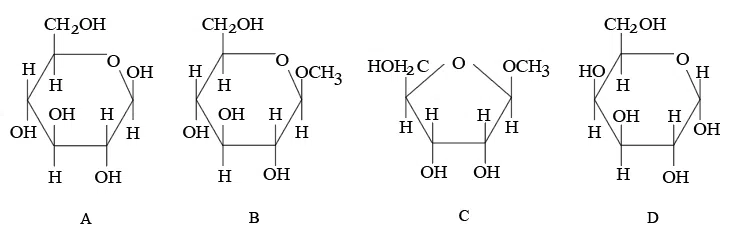
correct answer:- 3

Question 6
Compound 'P' undergoes the following sequence of reactions:

'P' is:
correct answer:- 1
Question 7
Tischenko reaction is a modification of:
correct answer:- 3
Question 8
Which of the following reagent is used for the following reaction?
$$CH_3CH_2CH_3 \to CH_3CH_2CHO$$
correct answer:- 3
Question 9
The major product obtained in the following conversion is:
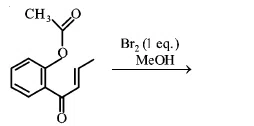
correct answer:- 1
Question 10
Which of the following compounds will show the maximum 'enol' content?
correct answer:- 2

Question 11
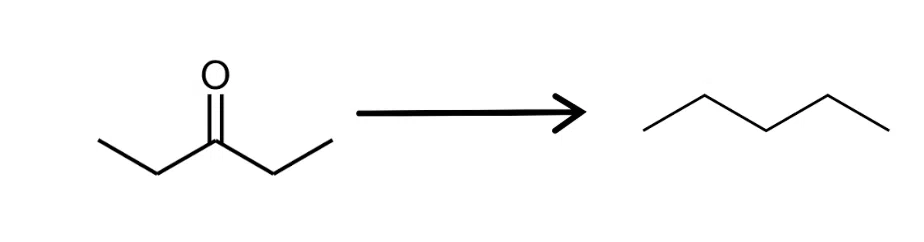
Which of the following reagent is capable of achieving this direct synthesis?
correct answer:- 2
Question 12
Consider the following statements regarding the chemical properties of aldehydes and ketones:
Statement A: Benzaldehyde readily reduces Tollens' reagent to form a silver mirror but fails to reduce Fehling's solution to form a red precipitate.
Statement B: Acetaldehyde ($$CH_3CHO$$) gives a positive Iodoform test and undergoes the Cannizzaro reaction when heated with concentrated alkali.
Statement C: The nucleophilic addition of $$HCN$$ to a carbonyl group is significantly accelerated by the addition of a catalytic amount of base.
Statement D: Acetophenone ($$C_6H_5COCH_3$$) is more reactive than Benzaldehyde ($$C_6H_5CHO$$) towards nucleophilic addition reactions.
Which of the above statements are CORRECT?
correct answer:- 2
Question 13
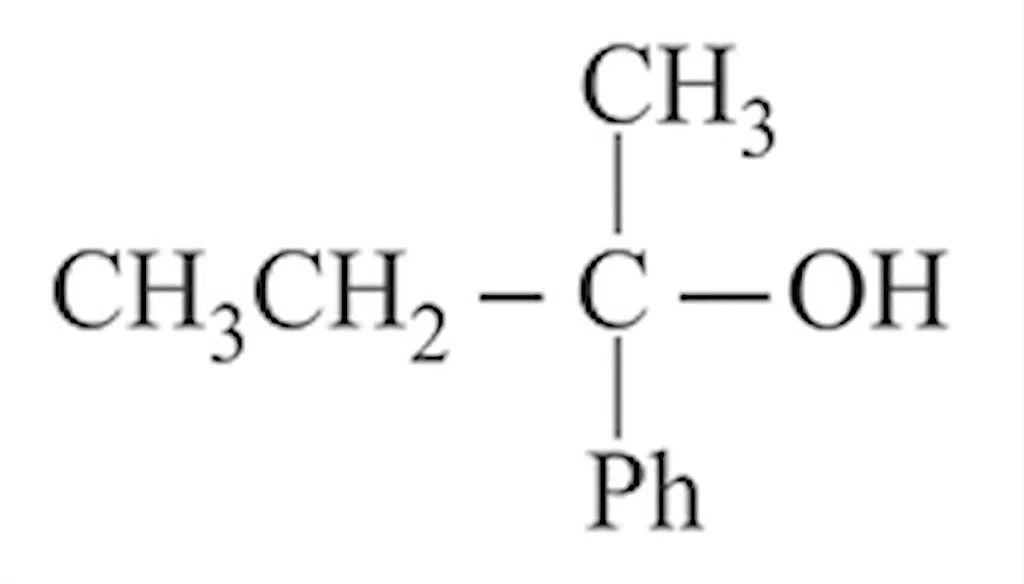
cannot be prepared by:
correct answer:- 1
Question 14
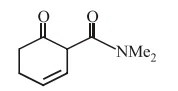
correct answer:- 1
Question 15
The compound A in the following reactions is:
$$A \xrightarrow[(ii)Conc. H_{2}SO_{4}/ \Delta]{(i)CH_{3}MgBr/H_{2}O} B \xrightarrow[(ii) Zn/H_{2}O]{(i) O_{3}} C + D$$
correct answer:- 3

Question 16
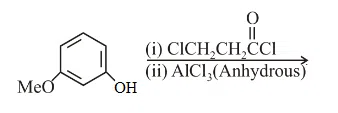
correct answer:- 3
Question 17
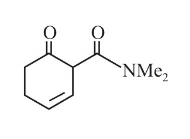
correct answer:- 1
Question 18
The ratio $$\frac{K_P}{K_C}$$ for the reaction : $$CO_{(g)} + \frac{1}{2} O_{2(g)} \rightleftharpoons CO_{2(g)}$$ is :
correct answer:- 1
Question 19
The major product [C] of the following reaction sequence will be:
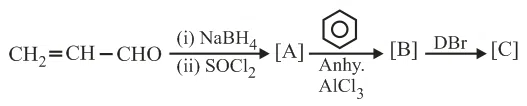
correct answer:- 1
Question 20
Consider the following reaction sequence involving an aldol condensation pathway:
$$\text{Acetone}\xrightarrow{\text{dil.\ Ba(OH)}_{2}}X\xrightarrow{\text{H}^{+},\Delta }Y\xrightarrow{\text{NaOI\ (I}_{2}+\text{NaOH)}}Z+\text{CHI}_{3}\downarrow $$
What is the IUPAC name of the major organic product $$Y$$?
correct answer:- 1

Question 21
The mass of NH$$_3$$ produced when $$131.8$$ kg of cyclohexane carbaldehyde undergoes Tollen's test is _____ kg. (Nearest Integer)
Molar mass of C $$= 12$$ g/mol, N $$= 14$$ g/mol, O $$= 16$$ g/mol
correct answer:- 80
Question 22
Match List-I with List-II.
| List-I | List-II |
|---|---|
A
 |
I. Gatterman Koch reaction |
B
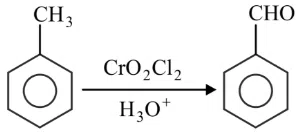 |
II. Etard reaction |
C
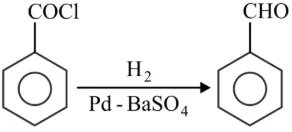 |
III. Stephen reaction |
D
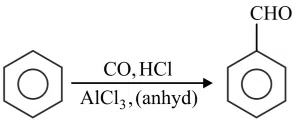 |
IV. Rosenmund reaction |
correct answer:- 1
Question 23
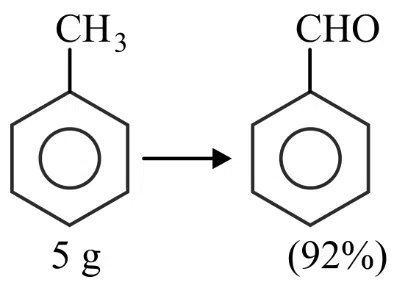
In the above reaction,5 g of toluene is converted into benzaldehyde with 92% yield. The amount of benzaldehyde produced is _____ $$\times 10^{-2}$$ g
correct answer:- 530
Question 24
Given below are two statements:
Statement I: Phenol on treatment with . $$CHCL_{3}$$/aq. $$KOH$$ under refluxing condition, followed by acidification produces $$p$$-hydroxy benzaldehyde as the major product and $$o$$-hydroxy benzaldehyde as the minor product.
Statement II: The mixture of $$p$$-hydroxybenzaldehyde and $$o$$-
hydroxybenzaldehyde can be easily separated through steam distillation.
In the light of the above statements, choose the correct answer from the options given below
correct answer:- 1
Question 25
Match the LIST-I with LIST-II
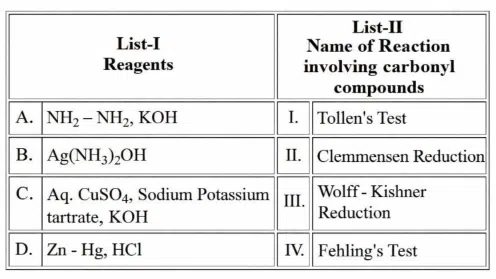
Choose the correct answer from the options given below:
correct answer:- 4

Question 26
The correct sequence of reagents for the following conversion will be
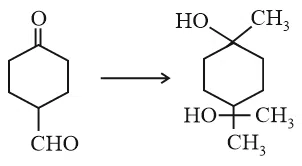
correct answer:- 4
Question 27
A compound 'X' absorbs 2 moles of hydrogen and 'X' upon oxidation with $$KMnO_{4}|H^{+}$$ gives

The total number of $$\sigma$$ bonds present in the compound 'X' is ________.
correct answer:- 27
Question 28
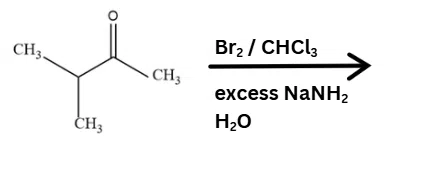
What is the structure of the major organic Final Product obtained ?
correct answer:- 1
Question 29
Which of the following conditions or reaction sequence will NOT give acetophenone as the major product?
correct answer:- 3
Question 30
Which is the major product formed when acetone is heated with iodine and potassium hydroxide?
correct answer:- 2
.webp)