Join Our JEE Preparation Group
Prep with like-minded aspirants; Get access to free daily tests and study material.
Sign in
Please select an account to continue using cracku.in
↓ →
Join Our JEE Preparation Group
Prep with like-minded aspirants; Get access to free daily tests and study material.
Identification of Fragment 'B':
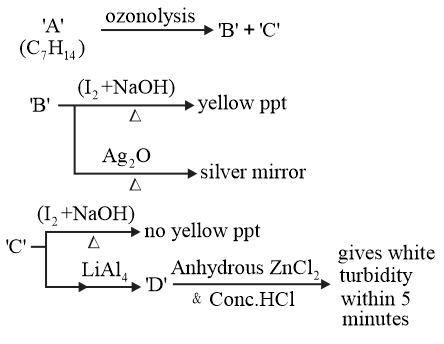
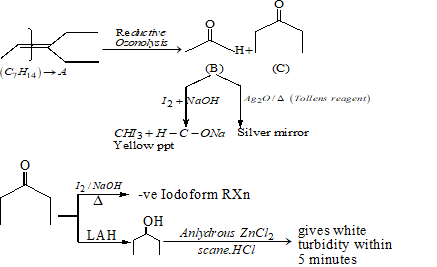
Fragment 'B' is formed via the ozonolysis of compound 'A'. It gives a positive iodoform test (yellow precipitate with $$\text{I}_2 + \text{NaOH}$$) and a positive Tollens' test (silver mirror with $$\text{Ag}_2\text{O}$$). This uniquely identifies 'B' as acetaldehyde ($$\text{CH}_3\text{CHO}$$), a 2-carbon aldehyde containing a methyl carbonyl group.
Deducing the Carbon Count of Fragment 'C':
Since the total molecular formula of 'A' is $$\text{C}_7\text{H}_{14}$$ and ozonolysis cleaves the double bond into two fragments:
$$\text{Carbons in 'C'} = \text{Total Carbons in 'A'} - \text{Carbons in 'B'} = 7 - 2 = 5\text{ carbons}$$Identification of Fragment 'C' and 'D':
A 5-carbon ketone that is not a methyl ketone must be symmetrical: 3-pentanone ($$\text{CH}_3\text{CH}_2\text{COCH}_2\text{CH}_3$$). Its reduction gives 3-pentanol (a $$2^\circ$$ alcohol).
Reconstructing Compound 'A':
Combining the carbonyl carbons of acetaldehyde ($$\text{CH}_3\text{CH=O}$$) and 3-pentanone ($$\text{O=C}(\text{CH}_2\text{CH}_3)_2$$) by forming a double bond gives the structure of 'A':
$$\text{CH}_3\text{CH}=\text{C}(\text{CH}_2\text{CH}_3)_2 \quad \text{(3-ethylpent-2-ene)}$$Isomers producing Methyl Ketones (e.g., 2-pentanone derivatives):
If compound 'A' were structured to produce 2-pentanone ($$\text{CH}_3\text{COCH}_2\text{CH}_2\text{CH}_3$$), fragment 'C' would yield a bright yellow precipitate during the iodoform reaction. This directly contradicts the observed negative test result.
Isomers producing Branched Aldehydes:
If fragment 'C' were an aldehyde (such as 2-methylbutanal or 3-methylbutanal), its subsequent reduction with $$\text{LiAlH}_4$$ would produce a primary ($$1^\circ$$) alcohol. Primary alcohols do not produce turbidity with Lucas reagent at room temperature within 5 minutes, failing to match the experiment.
Isomers producing Tertiary Alcohols:
If 'D' were a tertiary ($$3^\circ$$) alcohol, it would react with Lucas reagent to produce white turbidity immediately (under 1 minute) rather than taking the characteristic 5 minutes required for secondary alcohol pathways.
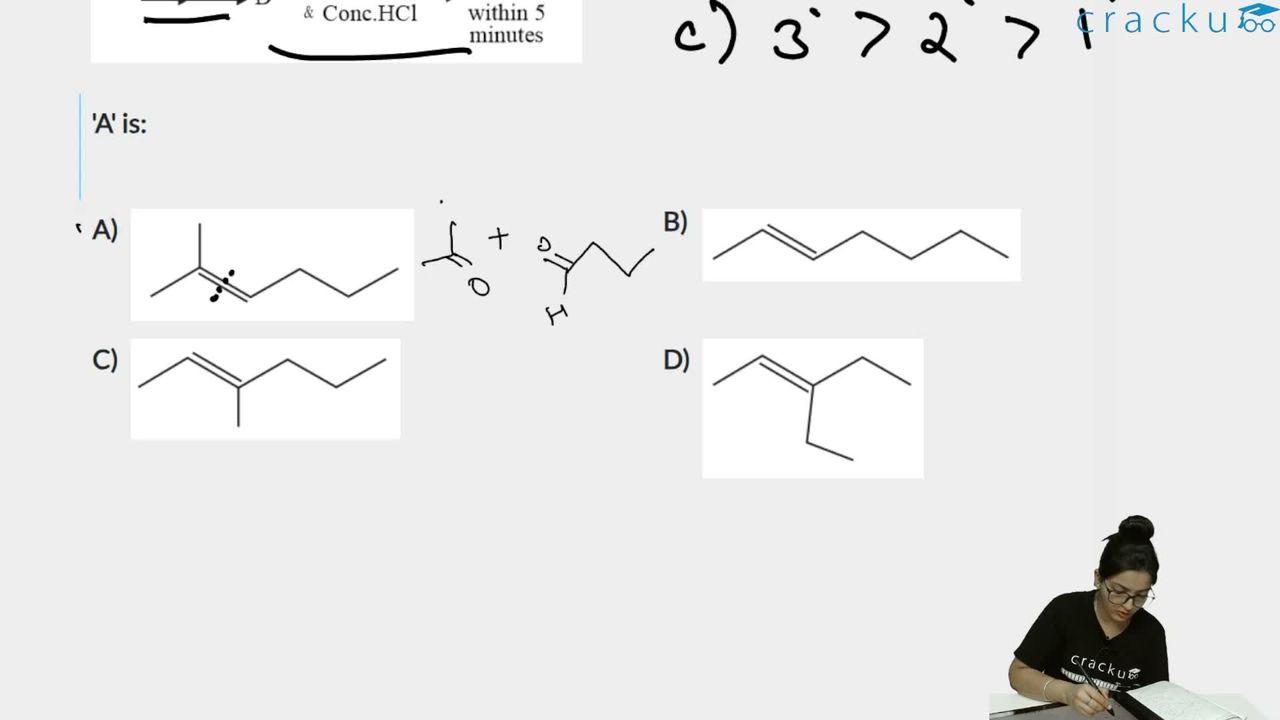
The only structure matching all chemical constraints, including carbon count, functional group classification, and targeted negative/positive tests, is 3-ethylpent-2-ene.
Answer: 3-ethylpent-2-ene
Was this solution helpful?
Click on the Email ☝️ to Watch the Video Solution
Create a FREE account and get:
_1.webp)

Educational materials for JEE preparation

Ask our AI anything

AI can make mistakes. Please verify important information.
AI can make mistakes. Please verify important information.