For the following questions answer them individually
A clock has a continuously moving second's hand of $$0.1\,\text{m}$$ length. The average acceleration of the tip of the hand (in units of $$\text{ms}^{-2}$$) is of the order of:
An insect is at the bottom of a hemispherical ditch of radius $$1\,\text{m}$$. It crawls up the ditch but starts slipping after it is at height $$h$$ from the bottom. If the coefficient of friction between the ground and the insect is $$0.75$$, then $$h$$ is: $$(g = 10\,\text{m s}^{-2})$$
If the potential energy between two molecules is given by $$U = \frac{A}{r^6} + \frac{B}{r^{12}}$$, then at equilibrium, separation between molecules, and the potential energy are:
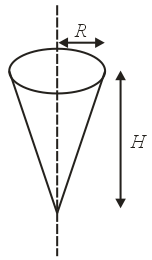
Shown in the figure is a hollow ice-cream cone (it is open at top). If its mass is M, radius of its top is R and height, H, then its moment of inertia about its axis is:
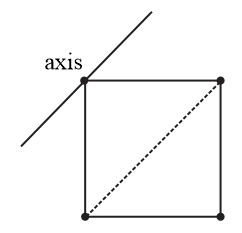
Four point masses, each of mass $$m$$, are fixed at the corners of a square of side $$l$$. The square is rotating with angular frequency $$\omega$$, about an axis passing through one of the corners of the square and parallel to its diagonal, as shown in the figure. The angular momentum of the square about the axis is:
A satellite is in an elliptical orbit around a planet $$P$$. It is observed that the velocity of the satellite when it is farthest from the planet is 6 times less than that when it is closest to the planet. The ratio of distances between the satellite and the planet at closest and farthest points is:
Molecules of an ideal gas are known to have three translational degrees of freedom. The gas is maintained at a temperature of T. The total internal energy, U of a mole of this gas, and the value of $$\gamma = \left(\frac{C_p}{C_v}\right)$$ are given, respectively, by:
An object of mass $$m$$ is suspended at the end of a massless wire of length $$L$$ and area of cross-section, A. Young modulus of the material of the wire is $$Y$$. If the mass is pulled down slightly its frequency of oscillation along the vertical direction is:
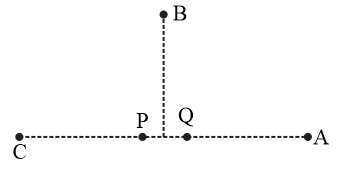
A sound source S is moving along a straight track with speed $$v$$, and is emitting sound of frequency $$v_0$$. An observer is standing at a finite distance, at the point O, from the track. The time variation of frequency heard by the observer is best represented by: ($$t_0$$ represents the instant when the distance between the source and observer is minimum)
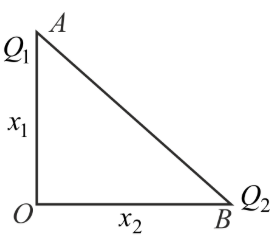
Charges $$Q_1$$ and $$Q_2$$ are at points A and B of a right-angled triangle OAB. The resultant electric field at point O is perpendicular to the hypotenuse, then $$Q_1/Q_2$$ is proportional to: