
Join Our JEE Preparation Group
Prep with like-minded aspirants; Get access to free daily tests and study material.
Sign in
Please select an account to continue using cracku.in
↓ →
Join Our JEE Preparation Group
Prep with like-minded aspirants; Get access to free daily tests and study material.
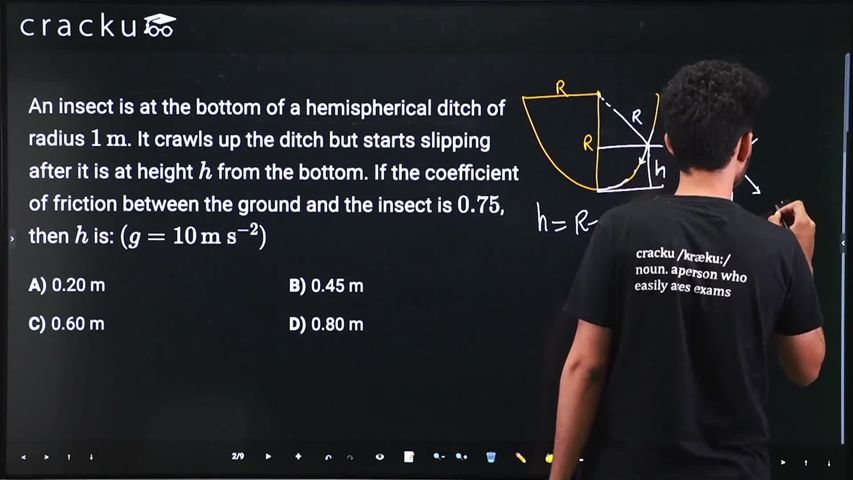
An insect is at the bottom of a hemispherical ditch of radius $$1\,\text{m}$$. It crawls up the ditch but starts slipping after it is at height $$h$$ from the bottom. If the coefficient of friction between the ground and the insect is $$0.75$$, then $$h$$ is: $$(g = 10\,\text{m s}^{-2})$$
Let the radius of the hemispherical ditch be $$R = 1\ \text{m}$$. We consider the insect when it is at some point on the inner surface that is a vertical height $$h$$ above the lowest point (the bottom).
Draw a radius from the centre of the hemisphere to the insect. Let the angle between this radius and the vertical diameter be $$\theta$$. With this definition, the lowest point corresponds to $$\theta = 0$$ and any higher point corresponds to a positive $$\theta$$.
From simple geometry of a circle, the vertical height of the point above the bottom is related to $$\theta$$ by
$$h = R - R\cos\theta.$$
Since $$R = 1\ \text{m}$$, this becomes
$$h = 1 - \cos\theta.$$
Now we analyse the forces acting on the insect when it is momentarily at rest and on the verge of slipping downwards. The forces are:
1. The weight $$mg$$ acting vertically downward.
2. The normal reaction $$N$$ acting radially inward along the radius.
3. The static friction force $$f$$ acting up the surface (because it opposes the impending downward slide).
We resolve the weight into two components with respect to the surface:
• Normal component: $$mg\cos\theta$$ (directed along the normal, toward the centre).
• Tangential component: $$mg\sin\theta$$ (directed down the surface).
By Newton’s second law in the normal direction, because there is no motion perpendicular to the surface, the normal reaction must balance the normal component of weight, so
$$N = mg\cos\theta.$$
The condition for impending slip is that the tangential component of weight equals the maximum static friction. Stating the friction formula first, the maximum static friction is
$$f_{\text{max}} = \mu N,$$
where $$\mu = 0.75$$ is the coefficient of static friction. Setting this equal to the tangential component, we get
$$mg\sin\theta = \mu N = \mu\,mg\cos\theta.$$
Dividing both sides by $$mg\cos\theta$$ yields
$$\frac{\sin\theta}{\cos\theta} = \mu \quad\Longrightarrow\quad \tan\theta = \mu.$$
Substituting $$\mu = 0.75$$, we have
$$\tan\theta = 0.75 = \frac34.$$
We can associate $$\tan\theta = \dfrac{\text{opposite}}{\text{adjacent}} = \dfrac34$$ with a right-angled triangle whose opposite side is 3, adjacent side is 4, and hypotenuse is 5. Hence
$$\cos\theta = \frac{\text{adjacent}}{\text{hypotenuse}} = \frac45 = 0.80.$$
Substituting this value in the height expression $$h = 1 - \cos\theta$$ gives
$$h = 1 - 0.80 = 0.20\ \text{m}.$$
Hence, the correct answer is Option A.
Was this solution helpful?
Click on the Email ☝️ to Watch the Video Solution
Create a FREE account and get:
_1.webp)

Educational materials for JEE preparation

Ask our AI anything

AI can make mistakes. Please verify important information.
AI can make mistakes. Please verify important information.
