
Join Our JEE Preparation Group
Prep with like-minded aspirants; Get access to free daily tests and study material.
Sign in
Please select an account to continue using cracku.in
↓ →
Join Our JEE Preparation Group
Prep with like-minded aspirants; Get access to free daily tests and study material.
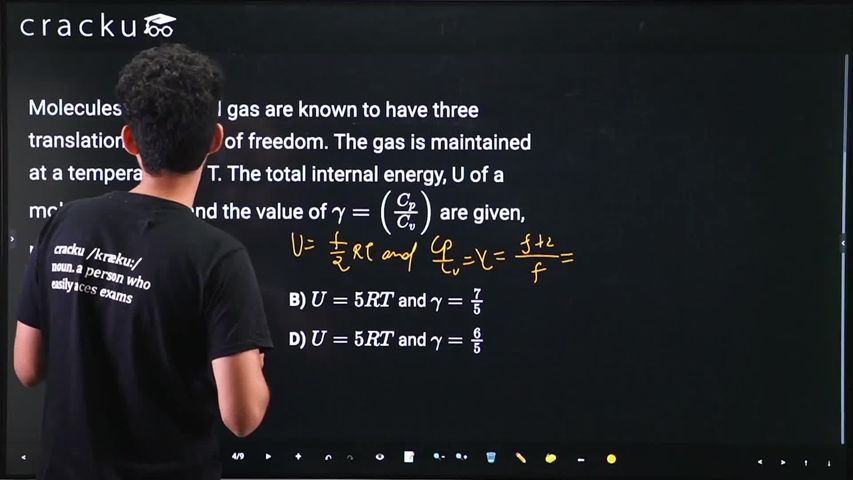
Molecules of an ideal gas are known to have three translational degrees of freedom. The gas is maintained at a temperature of T. The total internal energy, U of a mole of this gas, and the value of $$\gamma = \left(\frac{C_p}{C_v}\right)$$ are given, respectively, by:
For any gas molecule, every quadratic degree of freedom contributes an average energy of $$\dfrac{1}{2}kT$$, where $$k$$ is Boltzmann’s constant. This statement is called the equipartition of energy theorem.
For one mole of the gas, we multiply by Avogadro’s number $$N_A$$ and use the relation $$kN_A = R$$, the universal gas constant. Hence the molar internal energy is
$$U \;=\; \dfrac{f}{2}\,RT,$$
where $$f$$ is the total number of quadratic degrees of freedom available to each molecule.
Every molecule certainly possesses three translational degrees of freedom, and, because the question does not restrict the gas to be mon-atomic, we must also count the two rotational degrees of freedom that a linear/diatomic molecule has about the axes perpendicular to the bond. Thus
$$f \;=\; 3\;(\text{translation}) \;+\; 2\;(\text{rotation}) \;=\; 5.$$
Substituting this value in the expression for $$U$$ gives
$$U \;=\; \dfrac{5}{2}\,RT.$$
The molar heat capacity at constant volume is defined as the temperature derivative of the internal energy, so
$$C_v \;=\; \left(\dfrac{\partial U}{\partial T}\right)_V \;=\; \dfrac{5}{2}\,R.$$
For an ideal gas we always have the Mayer relation
$$C_p \;=\; C_v + R.$$
Substituting the value of $$C_v$$ just obtained, we find
$$C_p \;=\; \dfrac{5}{2}\,R + R \;=\; \dfrac{5}{2}\,R + \dfrac{2}{2}\,R \;=\; \dfrac{7}{2}\,R.$$
Now we compute the ratio
$$\gamma \;=\; \dfrac{C_p}{C_v} \;=\; \dfrac{\dfrac{7}{2}\,R}{\dfrac{5}{2}\,R} \;=\; \dfrac{7}{5}.$$
We have thus obtained
$$U = \dfrac{5}{2}\,RT \quad\text{and}\quad \gamma = \dfrac{7}{5}.$$
These correspond exactly to Option C.
Hence, the correct answer is Option C.
Was this solution helpful?
Click on the Email ☝️ to Watch the Video Solution
Create a FREE account and get:
_1.webp)

Educational materials for JEE preparation

Ask our AI anything

AI can make mistakes. Please verify important information.
AI can make mistakes. Please verify important information.
