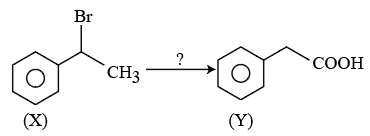
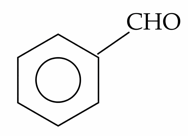
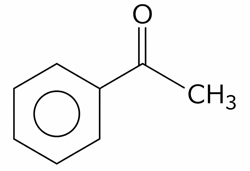
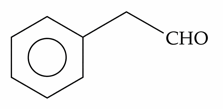
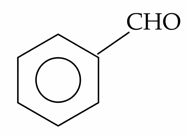
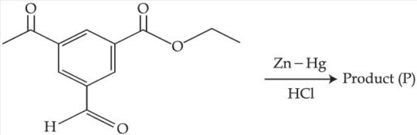
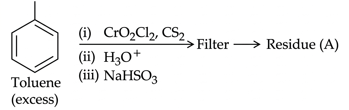
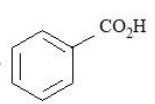
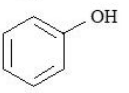
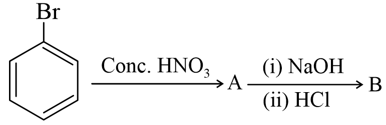
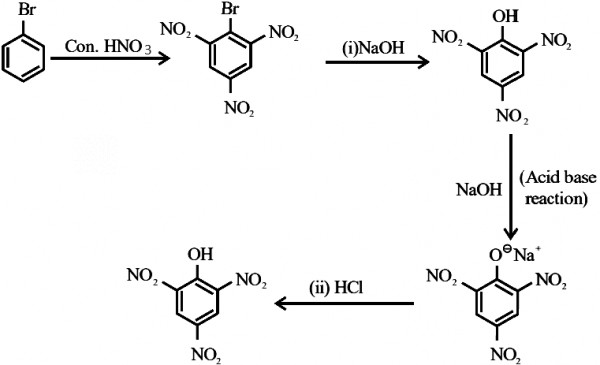
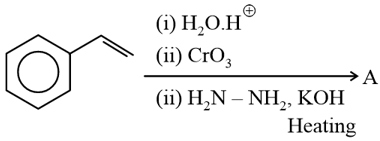
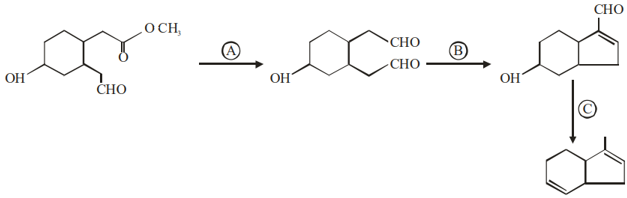
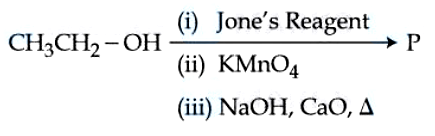
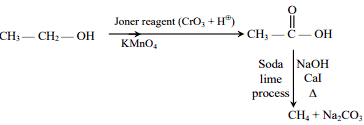
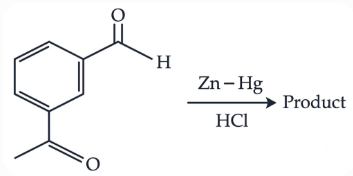
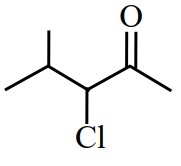
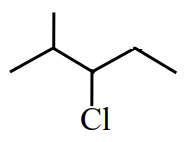
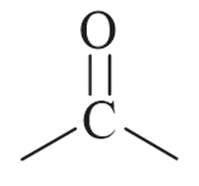
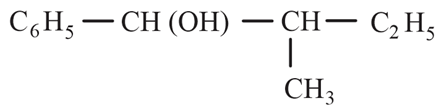
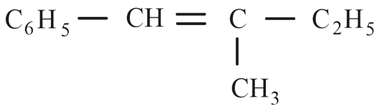
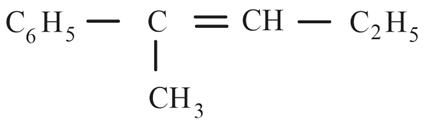
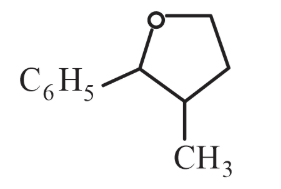
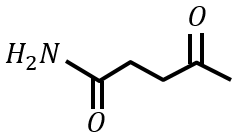
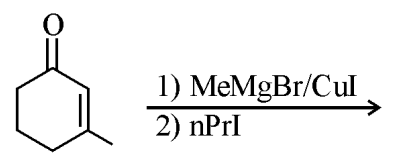
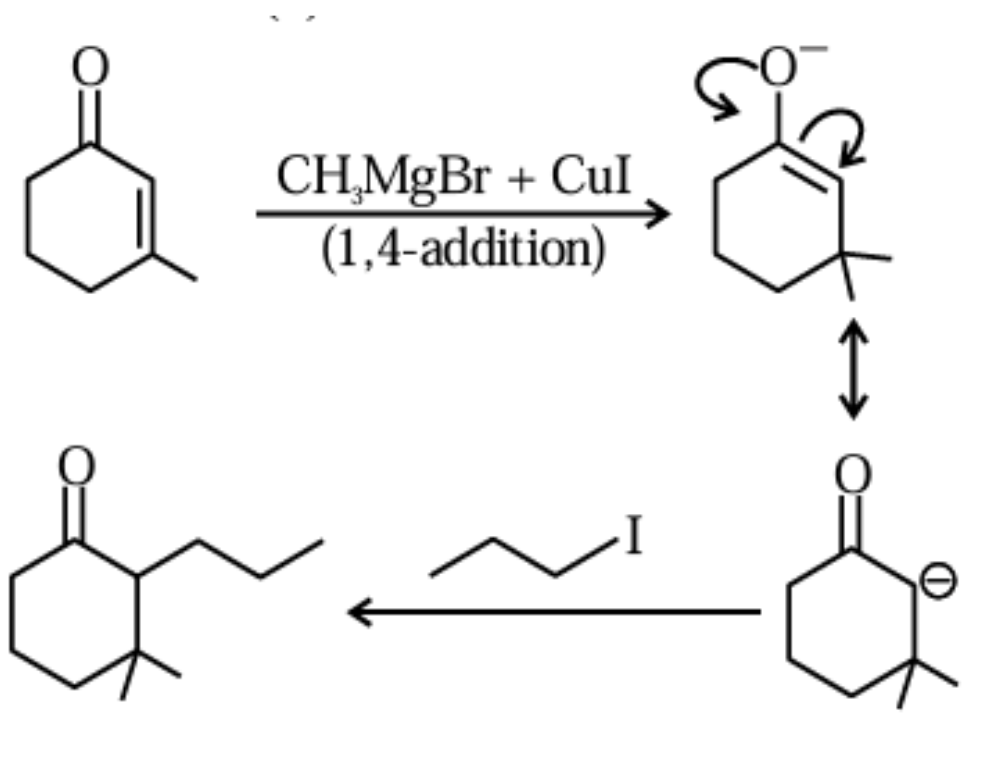
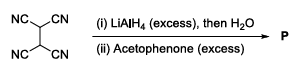
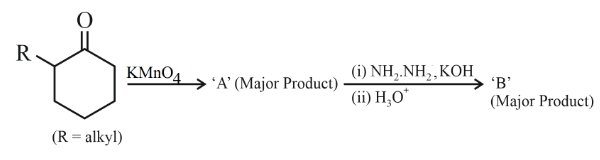
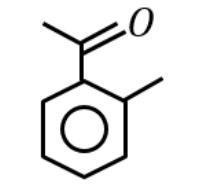
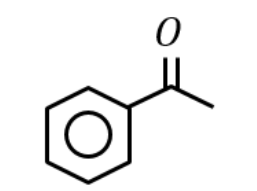
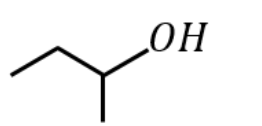
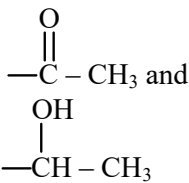
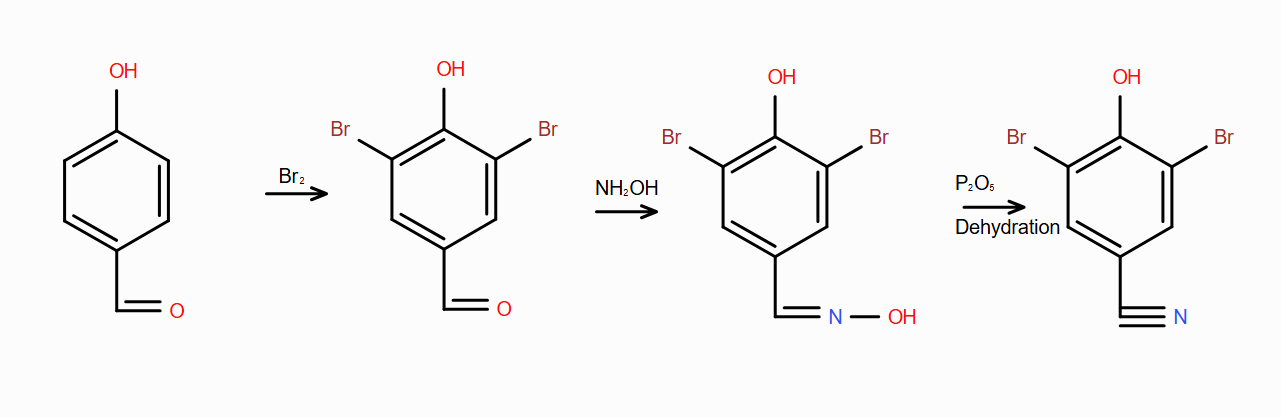
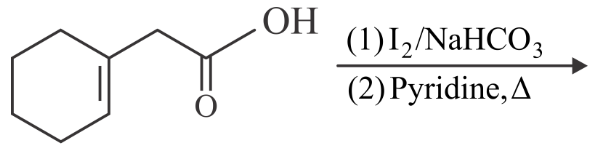
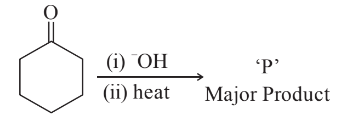
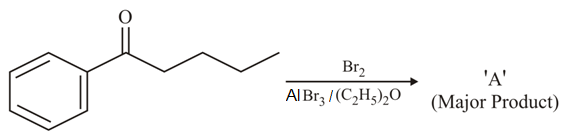
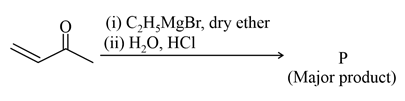
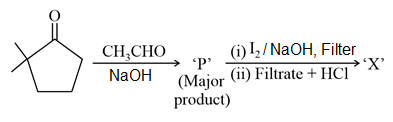
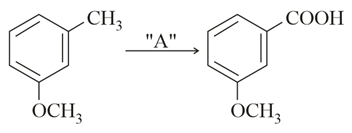
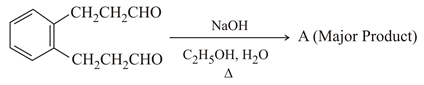
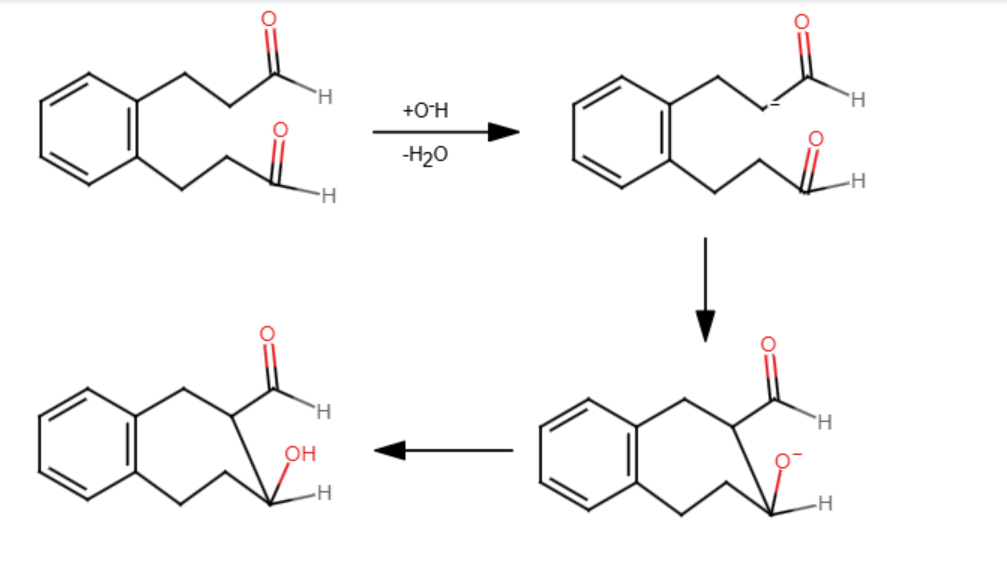
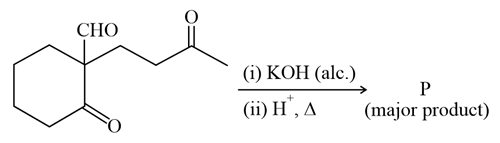
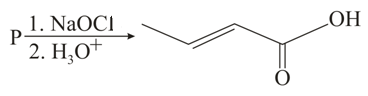
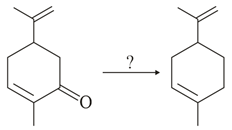
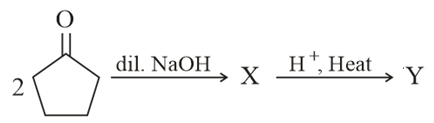
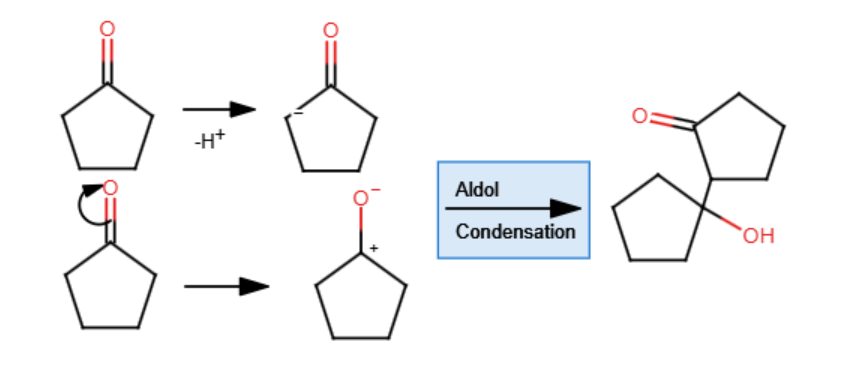
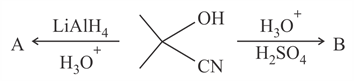
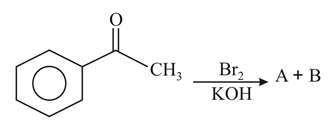
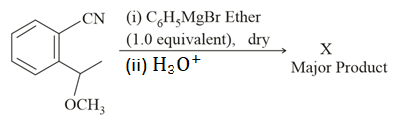
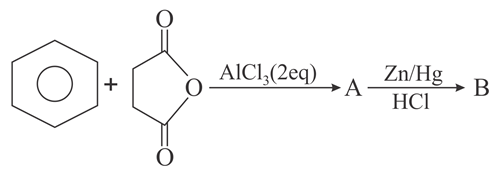
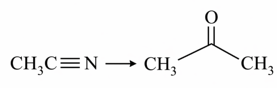
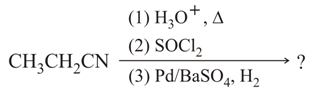
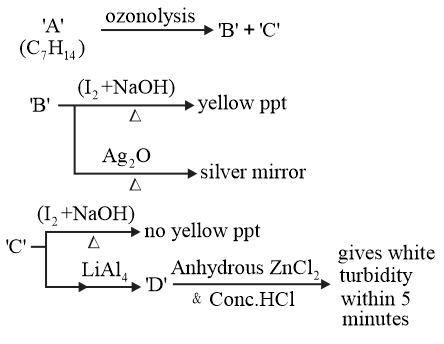
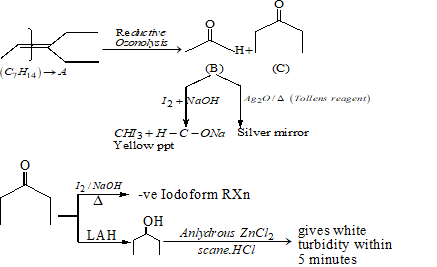
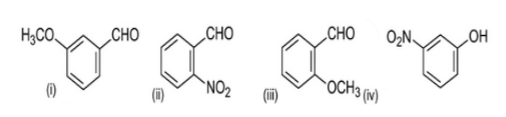
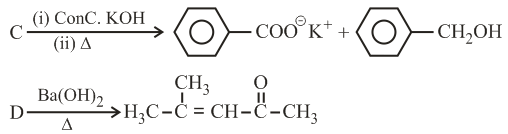
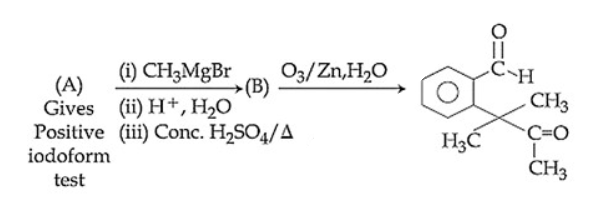
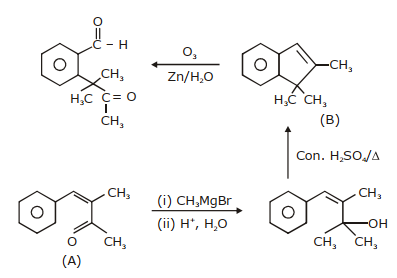
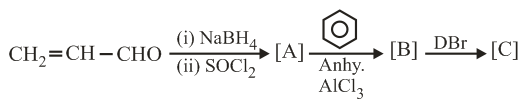
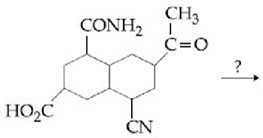
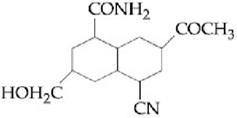
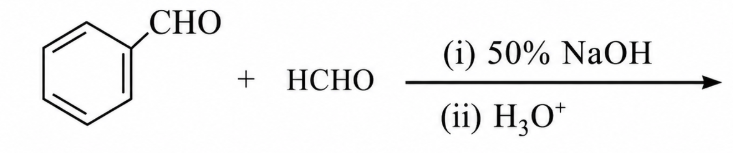
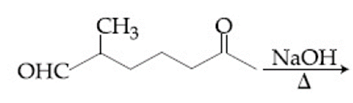
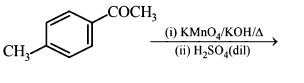
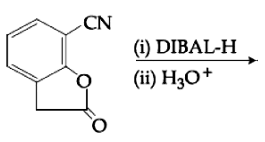
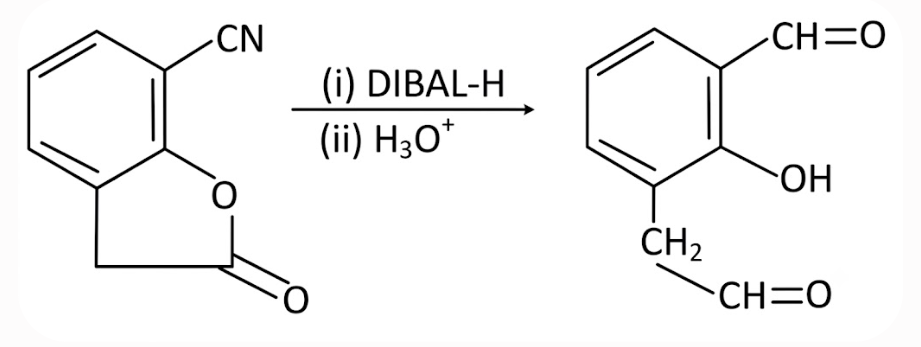
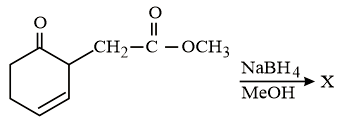
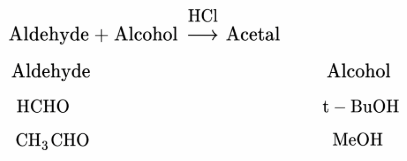
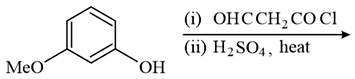
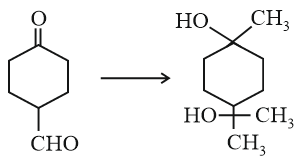
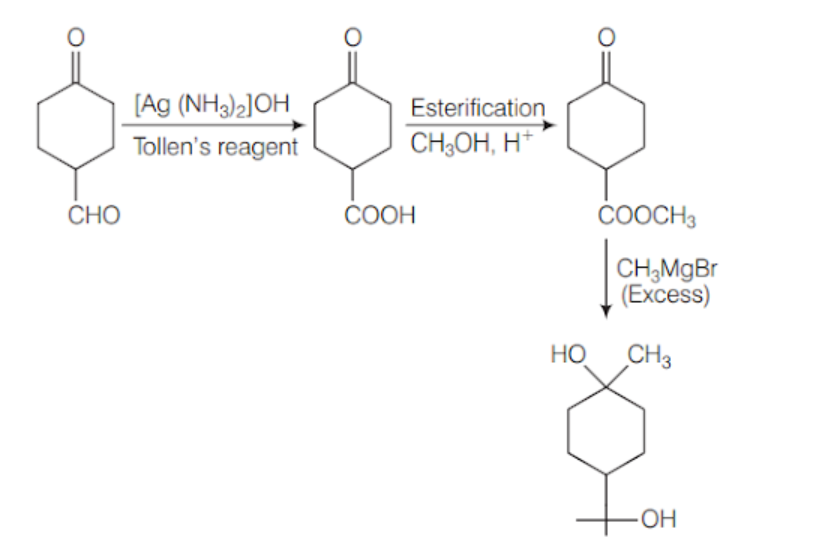
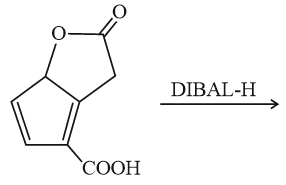
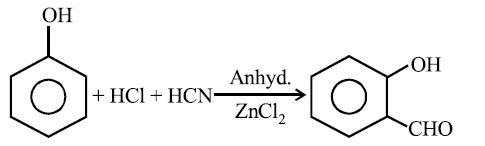
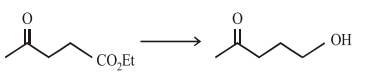
The correct sequence of reagents for the above conversion of X to Y is:
Sign in
Please select an account to continue using cracku.in
↓ →
Join Our JEE Preparation Group
Prep with like-minded aspirants; Get access to free daily tests and study material.
The correct sequence of reagents for the above conversion of X to Y is:
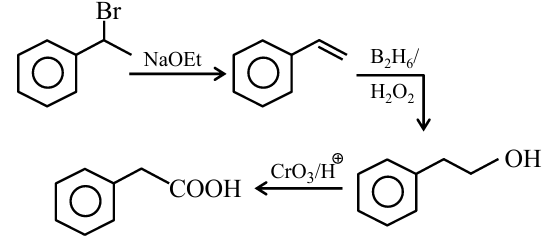
Step 1: NaOEt
Reaction name: Elimination (E2 dehydrohalogenation)
Step 2: B₂H₆ / H₂O₂
Reaction name: Hydroboration-oxidation
Step 3: Jones reagent (CrO₃ / H⁺)
Reaction name: Oxidation of primary alcohol
An organic compound "P" of molecular formula $$C_6H_{12}O_3$$ gives positive Iodoform test but negative Tollen's test. When "P" is treated with dilute acid, it produces "Q". "Q" gives positive Tollen's test and also iodoform test. The structure of "P" is :
Option A:
Structure: $$CH₃-CO-CH(OCH₃)-CH₂(OCH₃)$$
Although it contains a carbonyl group, the arrangement of $$-OCH₃$$ groups does not form a proper acetal. On hydrolysis, it does not produce an aldehyde ($$-CHO$$) because both $$OCH₃$$ are not on same carbon Therefore, the product formed will not give a positive Tollens’ test. This contradicts the condition given for compound Q.
Hence, Option (A) is not correct.
Option B:
Structure of P: $$CH₃-CO-CH₂-CH(OCH₃)₂$$
Iodoform test is given by compounds containing the $$CH₃-CO-$$ group (methyl ketone) or $$CH₃-CH(OH)-$$ group.
Tollens’ test is given by aldehydes ($$-CHO$$ group).
In compound P, the $$CH₃-CO-$$ group is present, so it gives a positive iodoform test. There is no $$-CHO$$ group, so Tollens’ test is negative. The $$-CH(OCH₃)₂$$ group is an acetal, which on hydrolysis in dilute acid converts into an aldehyde.
On hydrolysis:
$$CH₃-CO-CH₂-CH(OCH₃)₂$$ → $$CH₃-CO-CH₂-CHO$$
Compound Q formed contains both $$-CHO$$ and $$CH₃-CO-$$ groups. Hence, it gives a positive Tollens’ test (due to $$-CHO$$) and a positive iodoform test (due to $$CH₃-CO-$$ group).
Therefore, Option (B) satisfies all the given conditions.
Option C:
Structure: $$H-CO-CH₂-CH₂-CH(OCH₃)₂$$
This compound already contains an aldehyde group ($$-CHO$$). Therefore, it should give a positive Tollens’ test initially. However, the question states that compound P gives a negative Tollens’ test. This is a contradiction.
Hence, Option (C) is not correct.
Option D:
Structure: $$CH₃-CO-C(OCH₃)₂-CH₃$$
This compound is a ketal. On hydrolysis, ketals give ketones and not aldehydes. Therefore, the product Q will not contain a $$-CHO$$ group and will not give a positive Tollens’ test. This does not match the given condition.
Hence, Option (D) is not correct.
Thus, option B is the correct choice.
Iodoform test can differentiate between
A. Methanol and Ethanol
B. $$CH_{3}COOH$$ and $$CH_{3}CH_{2}COOH$$
C. Cyclohexene and cyclohexanone
D. Diethyl ether and Pentan-3-one
E. Anisole and acetone
Choose the correct answer from the options given below:
The iodoform test is used to detect the presence of a methyl group attached to a carbonyl group ($$CH_3CO-$$) or a secondary alcohol group ($$CH_3CH(OH)-$$), as well as ethanol and acetaldehyde. We need to identify which pairs can be differentiated by this test.
Key Principle: The iodoform test is positive for compounds containing the $$CH_3CO-$$ group (or structures that can be oxidized to it). Specifically, it is positive for:
- Acetaldehyde ($$CH_3CHO$$)
- Methyl ketones ($$CH_3COR$$)
- Ethanol ($$CH_3CH_2OH$$, oxidized to $$CH_3CHO$$)
- Secondary alcohols of the form $$CH_3CH(OH)R$$
Pair A: Methanol and Ethanol
- Methanol ($$CH_3OH$$): Does NOT give iodoform test (no $$CH_3CO$$ or $$CH_3CHOH$$ group)
- Ethanol ($$CH_3CH_2OH$$): Gives POSITIVE iodoform test (oxidized to acetaldehyde)
Can be differentiated.
Pair B: $$CH_3COOH$$ and $$CH_3CH_2COOH$$
- Both are carboxylic acids. Carboxylic acids do not give the iodoform test (the $$CH_3CO-$$ in acetic acid is $$CH_3COOH$$, not a ketone or aldehyde). Both are negative.
Cannot be differentiated.
Pair C: Cyclohexene and Cyclohexanone
- Cyclohexene: No $$CH_3CO$$ group. Negative.
- Cyclohexanone: It is a cyclic ketone but does NOT have a $$CH_3CO-$$ group (the carbonyl is flanked by $$CH_2$$ groups). Negative.
Cannot be differentiated.
Pair D: Diethyl ether and Pentan-3-one
- Diethyl ether ($$C_2H_5OC_2H_5$$): Negative.
- Pentan-3-one ($$CH_3CH_2COCH_2CH_3$$): No $$CH_3CO$$ group (the carbonyl is flanked by $$CH_2$$ groups). Negative.
Cannot be differentiated.
Pair E: Anisole and Acetone
- Anisole ($$C_6H_5OCH_3$$): Negative.
- Acetone ($$CH_3COCH_3$$): Has $$CH_3CO$$ group. Positive.
Can be differentiated.
The pairs that can be differentiated are A and E.
The correct answer is Option 3: A & E Only.
Given below are two statements:
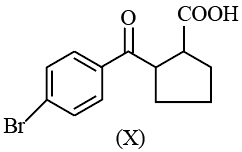
Statement I: Compound (X), shown below, dissolves in $$NaHCO_{3}$$ solution and has two chiral carbon atoms
Statement II: Compound (Y), shown below, has two carbons with $$sp^{3}$$ hybridization, one carbon with $$sp^{2}$$ and one carbon with sp hybridization
In the light of the above statements, choose the correct answer from the options given below:
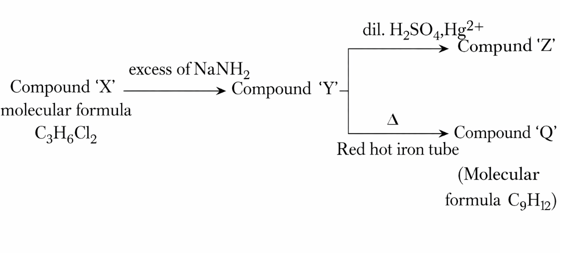
Given below are two statements for the following reaction sequence.
Statement I: Compound 'Z' will give yellow precipitate with NaOI.
Statement II: Compound 'Q' has two different types of'H' atoms (aromatic:aliphatic) in the ratio 1 :3.
In the light of the above statements, choose the correct answer from the options given below:
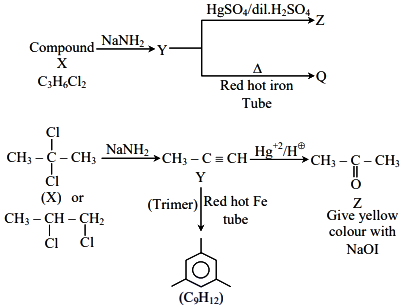
Compound Z is Acetone ($$CH_3COCH_3$$). Since it is a methyl ketone, it reacts with $$NaOI$$ (Iodoform reagent) to give a yellow precipitate of Iodoform ($$CHI_3$$).
Compound Q is Mesitylene. It has:
Given below are two statements:
Statement I: Cross aldol condensation between two different aldehydes will always produce four different products.
Statement II: When semicarbazide reacts with a mixture of benzaldehyde and acetophenone under optimum pH, it fonns a condensation product with acetophenone only.
In the light of the above statements, choose the correct answer from the options given below
We need to evaluate two statements about aldol condensation and semicarbazide reactions.
Considering Statement I: "Cross aldol condensation between two different aldehydes will always produce four different products."
In a cross aldol condensation between two different aldehydes (say A and B), the possible products arise from four combinations:
- A acts as both nucleophile (enolate) and electrophile (carbonyl)
- B acts as both nucleophile (enolate) and electrophile (carbonyl)
- A (enolate) attacks B (carbonyl)
- B (enolate) attacks A (carbonyl)
However, this produces four products ONLY when both aldehydes have alpha-hydrogens (needed to form the enolate). If one aldehyde lacks alpha-hydrogens (e.g., formaldehyde HCHO or benzaldehyde $$C_6H_5CHO$$), it cannot form an enolate and can only act as the electrophile. In such cases, fewer than four products are formed.
Since the statement says "always," it is FALSE because there are common cases (involving aldehydes without alpha-H) where fewer than four products form.
Considering Statement II: "When semicarbazide reacts with a mixture of benzaldehyde and acetophenone under optimum pH, it forms a condensation product with acetophenone only."
Semicarbazide ($$H_2N\text{-}NH\text{-}CO\text{-}NH_2$$) is a nucleophile that reacts with carbonyl compounds to form semicarbazones (C=N-NH-CO-NH$$_2$$). The reaction involves nucleophilic addition to the carbonyl group followed by elimination of water.
Between benzaldehyde (an aldehyde) and acetophenone (a ketone), benzaldehyde is more reactive toward nucleophilic addition because:
- Aldehydes are generally more reactive than ketones due to less steric hindrance at the carbonyl carbon
- Aldehydes have only one electron-donating group attached to C=O (vs. two in ketones), making the carbonyl carbon more electrophilic
Therefore, semicarbazide would preferentially react with benzaldehyde, not acetophenone. The statement claims the opposite, so it is FALSE.
Since both statements are false, the correct answer is Option (2): Both Statement I and Statement II are false.
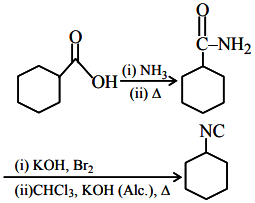
Compound 'P' undergoes the following sequence of reactions:
'P' is:
Given sequence uses:
NH₃/Δ → amide formation, Br₂/KOH → Hofmann bromamide degradation, CHCl₃/KOH → Carbylamine reaction (isocyanide formation)
A: Carboxylic acid (cyclohexyl-COOH)
NH₃/Δ → cyclohexyl-CONH₂ (amide formation)
Br₂/KOH → cyclohexyl-NH₂ (Hofmann degradation, one C less)
CHCl₃/KOH → cyclohexyl-NC (Carbylamine)
Gives required product → correct
B: Aldehyde (cyclohexyl-CH₂-CHO)
NH₃ does not convert aldehyde to amide under these conditions
No proper substrate for Hofmann reaction
Fails
C: Ketone (cyclohexyl-CO-CH₃)
NH₃ forms imine, not amide
Hofmann reaction needs amide → not possible
Fails
D: Amide (cyclohexyl-CONH₂)
Already amide, so NH₃/Δ does nothing
Br₂/KOH → cyclohexyl-NH₂
CHCl₃/KOH → cyclohexyl-NC
But initial step is unnecessary and does not match sequence properly
Not correct as per given pathway
Final answer: A
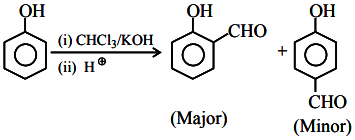
Given below are two statements:
Statement I: Phenol on treatment with . $$CHCL_{3}$$/aq. $$KOH$$ under refluxing condition, followed by acidification produces $$p$$-hydroxy benzaldehyde as the major product and $$o$$-hydroxy benzaldehyde as the minor product.
Statement II: The mixture of $$p$$-hydroxybenzaldehyde and $$o$$-
hydroxybenzaldehyde can be easily separated through steam distillation.
In the light of the above statements, choose the correct answer from the options given below
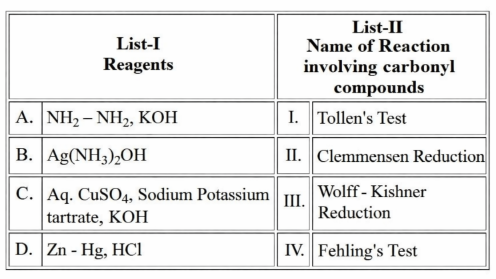
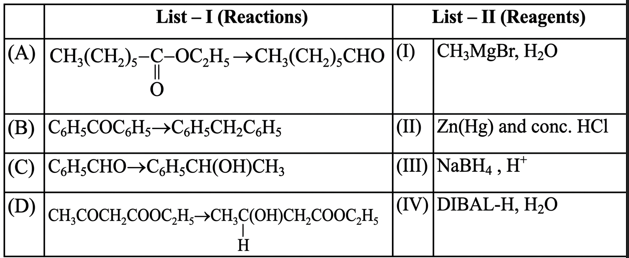
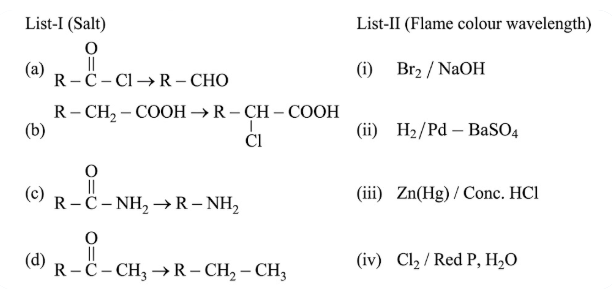
Match List - I with List - II.
Choose the correct answer from the options given below:
The compound A, $$C_{8}H_{8}O_{2}$$ reacts with acetophenone to form a single product via cross-Aldol condensation. The compound A on reaction with cone. NaOH forms a substituted benzyl alcohol as one of the two products. The compound A is :
We need to identify compound A ($$C_8H_8O_2$$) that undergoes cross-Aldol condensation with acetophenone and gives a substituted benzyl alcohol with conc. NaOH.
Clue 1: Cross-Aldol condensation with acetophenone ($$C_6H_5COCH_3$$) gives a single product. This means A must be an aldehyde without alpha-hydrogens (so it acts only as the electrophilic component, avoiding multiple products).
Clue 2: A with conc. NaOH gives a substituted benzyl alcohol. This is the Cannizzaro reaction, which occurs only with aldehydes lacking alpha-hydrogens. In this reaction, one molecule is oxidised to carboxylic acid and another is reduced to alcohol (benzyl alcohol).
Clue 3: Molecular formula $$C_8H_8O_2$$.
Checking Option 4: 4-Methoxybenzaldehyde ($$p\text{-}CH_3OC_6H_4CHO$$)
Formula: $$C_8H_8O_2$$ ✓ (CH$$_3$$O = OCH$$_3$$ on benzene ring + CHO)
It is an aldehyde with no alpha-hydrogen ✓
It can undergo cross-Aldol with acetophenone ✓
It undergoes Cannizzaro reaction with NaOH to give 4-methoxybenzyl alcohol ✓
The correct answer is Option 4: 4-methoxy benzaldehyde.
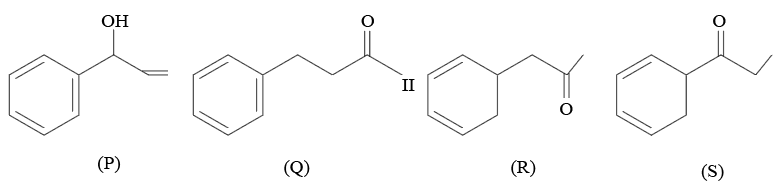
Given below are the four isomeric compounds (P, Q, R, S)

Identify correct statements from below
A. Q, R and S will give precipitate with 2, 4 - DNP.
B. P and Q will give positive Bayer's test.
C. Q and R will give sooty flame.
D. Rand S will give yellow precipitate with $$I_{2}/NaOH$$.
E. Q alone will deposit silver with Tollen's reagent.
Choose the correct option.
Given below are two statements:
Statement I: 2,6-diethylcyclohexanone and 6-methyl-2-n-propylcyclohexanone are metamers.
Statement II: 2,2,6,6-tetramethylcyclohexanone exhibits keto-enol tautomerism.
In the light of the above statements, choose the correct answer from the options given below:
'x' is the product which is obtained by the hydrolysis of prop-1-yne in the presence of mercuric sulphate under dilute acidic medium at 333 K. 'y' is the product which is obtained by the reaction of ethane nitrile with methyl magnesium bromide in dry ether followed by hydrolysis. IUPAC name of product obtained from 'x' and 'y' in the presence of barium hydroxide followed by heating is :
An optically active alkyl bromide C$$_4$$H$$_9$$Br, reacts with ethanolic KOH to form major compound [A] which reacts with bromine to give compound [B]. Compound [B] reacts with ethanolic KOH and sodamide to give compound [C]. One molecule of water adds to compound [C] on warming with mercuric sulphate and dilute sulphuric acid at 333 K to form compound [D]. The functional group in compound D will be confirmed by :
An organic compound "x" where molar ratio of C, O and H are equal, on treatment with 50% KOH under reflux followed by acidification produced "y". The most likely structure of "y" is :
[Molar mass of 'x' is 58 g mol$$^{-1}$$]
Let the molar ratios of the elements in compound $$x$$ be equal.
So its empirical formula is $$C_nH_nO_n$$.
Molar mass calculation:
Atomic masses: C = 12, H = 1, O = 16.
Molar mass of $$C_nH_nO_n = 12n + 1n + 16n = 29n$$.
Given molar mass of $$x$$ is 58 g mol$$^{-1}$$, therefore
$$29n = 58 \;\Longrightarrow\; n = 2$$.
Hence the molecular formula of $$x$$ is $$C_2H_2O_2$$.
Saturation check (index of hydrogen deficiency):
For two carbons the saturated formula would be $$C_2H_{2\times2+2}=C_2H_6$$.
Degrees of unsaturation $$=\dfrac{(2C+2-H)}{2}=\dfrac{(4+2-2)}{2}=2$$.
Two degrees of unsaturation can be satisfied by two carbonyl groups, giving the structure $$OHC{-}CHO$$ (glyoxal). Glyoxal has no $$\alpha$$-hydrogen, so it undergoes Cannizzaro reaction.
Reaction in 50 % KOH, reflux:
Two molecules of glyoxal disproportionate (Cannizzaro reaction): one carbonyl group is reduced to an alcohol and the other is oxidised to a carboxylate within the same carbon skeleton, giving potassium glycolate $$HO{-}CH_2{-}COOK$$.
Subsequent acidification converts the salt to its free acid:
$$HO{-}CH_2{-}COOK + HCl \longrightarrow HO{-}CH_2{-}COOH + KCl$$.
Thus product $$y$$ is glycolic acid, $$HO{-}CH_2{-}COOH$$.
Option C which is: $$O = C(OH){-}CH_2{-}OH$$ (glycolic acid)
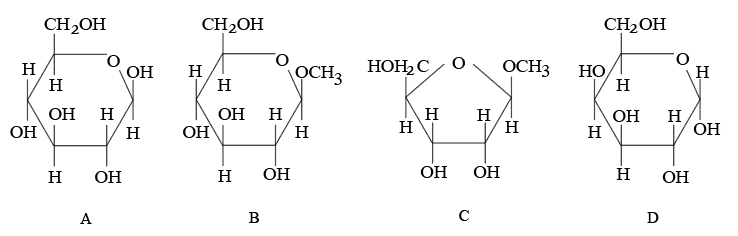
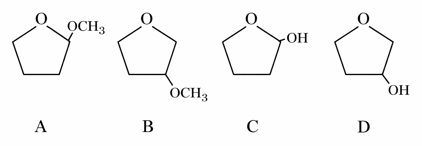
From the given following (A to D) cyclic structures, those which will not react with Tollen's reagent are:
Given below are two statements:
$$\textbf{Statement I :}$$ The condensation reaction between $$\text{CH}_3-\text{CH}=\text{O}$$ and

under optimum pH will produce
$$\textbf{Statement II :}$$ The molecule

will generate $$\text{Ph}-\text{CH}=\text{O}$$ in the presence of dilute acid.
In the light of the above statements, choose the correct answer from the options given below:
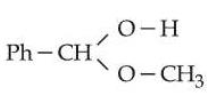
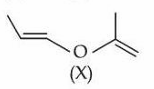
A molecule (X) with the following structure under mild acidic condition is hydrolysed to produce (Y) and (Z). Identify the correct statements about (Y) and (Z).
A. Both (Y) and (Z) have same molar mass.
B. (Y) and (Z) can be distinguished from each other by NaHCO$$_3$$.
C. (Y) and (Z) react with HCN with same rates.
D. (Y) and (Z) undergo addition reaction with 2,4-DNP.
Choose the correct answer from the options given below :
The given compound $$(X)$$ is an acetal. Under mild acidic conditions, acetals undergo hydrolysis to give back the two carbonyl compounds from which they were originally obtained.
On hydrolysis, $$(X)$$ breaks at the two $$C-O$$ bonds adjacent to the acetal carbon and furnishes the following products:
$$\displaystyle (X)\; \xrightarrow[\text{H}_2O]{\text{dil.\,H}^+}\; (Y)\;+\; (Z)$$
The two fragments obtained are
$$\text{propanal :}\; CH_3CH_2CHO \; (Y)$$
$$\text{acetone :}\; (CH_3)_2CO \; (Z)$$
Both have the same molecular formula $$C_3H_6O$$, so their molar mass is identical:
$$M_r(CH_3CH_2CHO)=58\;{\rm g\,mol^{-1}}$$
$$M_r((CH_3)_2CO)=58\;{\rm g\,mol^{-1}}$$
Let us now analyse each statement:
Statement A: “Both (Y) and (Z) have same molar mass.”
As shown above, this is correct.
Statement B: “(Y) and (Z) can be distinguished from each other by NaHCO$$$_3$$.”
$$NaHCO_3$$ gives effervescence only with acids that are stronger than $$H_2CO_3$$ (mainly carboxylic acids and sulfonic acids). Aldehydes and ketones do not react. Hence neither propanal nor acetone shows any reaction; this test cannot distinguish them. Statement B is false.
Statement C: “(Y) and (Z) react with HCN with same rates.”
The rate of cyanohydrin formation depends on both the electronic nature of the carbonyl carbon and steric hindrance. Aldehydes (propanal) are less hindered and more polarised than ketones (acetone); therefore propanal reacts faster with $$HCN$$ than acetone. Rates are not the same, making Statement C false.
Statement D: “(Y) and (Z) undergo addition reaction with 2,4-DNP.”
2,4-Dinitrophenylhydrazine adds to any aldehyde or ketone to form a yellow/orange hydrazone precipitate. Both propanal and acetone give a positive 2,4-DNP test. Statement D is correct.
Thus only Statements A and D are correct.
Option D which is: A and D Only
A student is given one compound among the following compounds that gives positive test with Tollen's reagent
The compound is :
Consider the following reaction.
The major product (P) formed is :
Match the LIST-I with LIST-II
Choose the correct answer from the options given below:
'x' is the product which is obtained &om propanenitrile and stannous chloride in the presence of hydrochloric acid followed by hydrolysis. 'y' is the product which is obtained from the but-2-ene by the ozonolysis followed by hydrolysis. From the followu1g, which product is not obtained when one mole of 'x' and one mole of 'y' react with, each other in the presence of alkali followed by heating?
We first identify the products $$x$$ and $$y$$.
Finding x: Propanenitrile ($$CH_3CH_2CN$$) is treated with stannous chloride ($$SnCl_2$$) and hydrochloric acid, followed by hydrolysis. This is the Stephen reduction, which converts a nitrile to an aldehyde. Therefore $$x = \text{propanal}\;(CH_3CH_2CHO)$$.
Finding y: But-2-ene ($$CH_3CH{=}CHCH_3$$) undergoes ozonolysis followed by hydrolysis. The double bond is cleaved to produce two molecules of ethanal (acetaldehyde, $$CH_3CHO$$). Since we take one mole of the ozonolysis product, $$y = \text{ethanal}\;(CH_3CHO)$$.
When one mole of propanal and one mole of ethanal react in the presence of alkali followed by heating, aldol condensation followed by dehydration takes place. Four $$\alpha,\beta$$-unsaturated aldehyde products are possible:
Product 1 — Self-aldol of ethanal: The enolate of one ethanal molecule attacks the carbonyl of another ethanal. After dehydration this gives $$CH_3CH{=}CHCHO$$, which is but-2-enal (crotonaldehyde).
Product 2 — Cross-aldol (ethanal enolate + propanal): The enolate of ethanal ($${}^{-}CH_2CHO$$) attacks the carbonyl carbon of propanal. The resulting aldol product dehydrates to give $$CH_3CH_2CH{=}CHCHO$$ = pent-2-enal.
Product 3 — Cross-aldol (propanal enolate + ethanal): The enolate of propanal ($$CH_3\overset{-}{C}HCHO$$) attacks the carbonyl carbon of ethanal. The aldol product dehydrates to give $$CH_3CH{=}C(CH_3)CHO$$ = 2-methylbut-2-enal.
Product 4 — Self-aldol of propanal: The enolate of one propanal attacks the carbonyl of another propanal. Dehydration gives $$CH_3CH_2CH{=}C(CH_3)CHO$$ = 2-methylpent-2-enal.
Now consider the options. 3-Methylbut-2-enal has the structure $$(CH_3)_2C{=}CHCHO$$. Forming this would require a branched reactant such as acetone or isobutyraldehyde as one of the starting materials, but neither is present in our reaction mixture. Therefore, 3-methylbut-2-enal cannot be obtained from this reaction.
Hence, the correct answer is Option 2.
The correct order of acidic strength of the major products formed in the given reactions, is:

Choose the correct answer from the options given below :
Which of the following statements are TRUE about Haloform reaction?:
A. Sodium hypochlorite reacts with KI to give KOI.
B. KOI is a reducing agent.
C. $$ \alpha,\beta$$-unsaturated methylketone $$\mathrm{CH_3 - CH = CH - C(=O) - CH_3}$$ will give iodoform reaction.
D. Isopropyl alcohol will not give iodoform test.
E. Methanoic acid will give positive iodoform test.
Choose the correct answer from the options given below:
The haloform reaction involves compounds with a methyl ketone group (R-CO-CH3) or compounds that can be oxidized to methyl ketones (like secondary alcohols with the structure R-CH(OH)-CH3), reacting with halogen (I2, Br2, Cl2) in the presence of base to form a haloform (CHX3) and a carboxylate ion.
Evaluating each statement:
Statement A: "Sodium hypochlorite reacts with KI to give KOI."
Sodium hypochlorite (NaOCl) reacts with potassium iodide (KI) in the reaction: $$\text{NaOCl} + \text{KI} \rightarrow \text{NaCl} + \text{KOI}$$ where KOI is potassium hypoiodite. This reaction occurs because hypochlorite oxidizes iodide to hypoiodite. Thus, statement A is true.
Statement B: "KOI is a reducing agent."
Potassium hypoiodite (KOI) contains the hypoiodite ion (OI-), which acts as an oxidizing agent in reactions like the haloform reaction. It oxidizes methyl ketones to carboxylates and is not a reducing agent. Thus, statement B is false.
Statement C: "α,β-unsaturated methylketone $$\mathrm{CH_3 - CH = CH - C(=O) - CH_3}$$ will give iodoform reaction."
The compound $$\mathrm{CH_3 - CH = CH - C(=O) - CH_3}$$ is a methyl ketone because it has the -CO-CH3 group. The α,β-unsaturation does not prevent enolization of the methyl group, so it undergoes the haloform reaction. Thus, statement C is true.
Statement D: "Isopropyl alcohol will not give iodoform test."
Isopropyl alcohol $$\mathrm{(CH_3)_2CHOH}$$ is a secondary alcohol that can be oxidized to acetone $$\mathrm{(CH_3)_2C=O}$$, a methyl ketone, which gives a positive iodoform test. Therefore, isopropyl alcohol gives a positive test, and statement D is false.
Statement E: "Methanoic acid will give positive iodoform test."
Methanoic acid (HCOOH) lacks a methyl group or a group oxidizable to a methyl ketone. It does not undergo the haloform reaction and gives a negative test. Thus, statement E is false.
True statements are A and C only. The correct option is D.
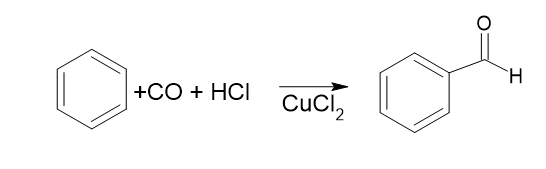
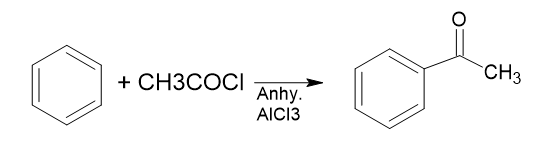
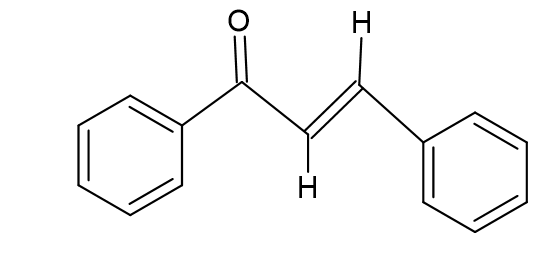
'$$x$$' is the product which is obtained from benzene by reacting it with carbon monoxide and hydrogen chloride in the presence of cuprous chloride. '$$y$$' is the major product obtained from the benzene by reacting it with ethanoyl chloride in the presence of anhydrous AlCl$$_3$$. Product (major) obtained by heating $$x$$ and $$y$$ in the presence of alkali is $$z$$. Total number of $$\pi$$ (pi) electrons in $$z$$ is __________.
Grignard reagent RMgBr (P) reacts with water and forms a gas (Q). One gram of Q occupies $$1.4 dm^{3}$$ at STP.(P) on reaction with dry ice in dry ether followed by $$H_{3}O^{+}$$ fonns a compound (Z). 0.1 mole of(Z) will weigh ____ g. (Nearest integer)
We need to find the mass of 0.1 mole of compound Z.
Identify gas Q.
RMgBr + H₂O → RH + Mg(OH)Br
Gas Q = RH (hydrocarbon)
At STP: 1 g of Q occupies 1.4 dm³ = 1.4 L
Molar volume at STP = 22.4 L/mol
Molar mass of Q = $$\frac{22.4}{1.4} \times 1 = 16$$ g/mol
So Q = CH₄ (methane, molar mass = 16), which means R = CH₃ (methyl group).
Identify compound Z.
CH₃MgBr + CO₂ (dry ice) → CH₃COOMgBr
CH₃COOMgBr + H₃O⁺ → CH₃COOH (acetic acid)
So Z = CH₃COOH, molar mass = 60 g/mol.
Find mass of 0.1 mole of Z.
Mass = 0.1 × 60 = 6 g
Therefore, 0.1 mole of Z weighs 6 g.
The correct reaction/reaction sequence that would produce a dicarboxylic acid as the major product is
To obtain a dicarboxylic acid (an acid containing two -COOH groups) the reaction conditions must be able to introduce one -COOH group on each of two different carbons of the same molecule. The most common laboratory method for doing this in a single step is oxidative cleavage of a carbon-carbon double bond with a strong oxidising agent such as hot, acidic $$KMnO_4$$ (or, equivalently, ozonolysis followed by oxidative work-up). Each carbon of the former $$C=C$$ bond is oxidised up to the carboxylate level, so both ends of the cleaved bond become -COOH groups.
What happens in Option C
• The substrate given in Option C contains an internal carbon-carbon double bond.
• The reagent specified is hot, acidic $$KMnO_4$$ (or an equivalent strong oxidising system).
• Hot $$KMnO_4$$ performs oxidative cleavage: the $$C=C$$ bond is cut and each of the two carbon atoms is converted into a carbonyl that is then further oxidised to a carboxylic acid.
• Because both carbons of the former double bond stay inside the same molecular framework after the cleavage, the product contains two -COOH groups that remain connected through the rest of the carbon skeleton. Hence a single molecule of a dicarboxylic acid is obtained as the major product.
Why the other options fail
Option A, Option B and Option D either involve oxidation of **only one functional carbon**, or they involve a reaction (such as haloform cleavage or nitrile hydrolysis) that removes part of the carbon skeleton. In every one of those sequences the molecule finally possesses just one -COOH group; the second carbon is either lost from the molecule or remains at a lower oxidation level. Consequently they cannot supply a dicarboxylic acid as the principal product.
Therefore, the only sequence that reliably converts two different carbons of the same molecule into carboxyl groups is the oxidative-cleavage sequence of Option C.
Option C which is: the oxidative cleavage of the double bond with hot, acidic $$KMnO_4$$ (or its equivalent) is the correct choice.
Both acetaldehyde and acetone (individually) undergo which of the following reactions? A. Iodoform Reaction B. Cannizaro Reaction C. Aldol Condensation D. Tollen's Test E. Clemmensen Reduction Choose the correct answer from the options given below:
We need to identify reactions that both acetaldehyde ($$CH_3CHO$$) and acetone ($$CH_3COCH_3$$) undergo individually.
A. Iodoform Reaction:
Both acetaldehyde and acetone have the $$CH_3CO-$$ group (methyl ketone/methyl aldehyde). Both undergo the iodoform reaction to give $$CHI_3$$. YES for both.
B. Cannizzaro Reaction:
Cannizzaro reaction requires aldehydes without alpha-hydrogen. Acetaldehyde has alpha-hydrogens ($$CH_3$$ group), so it does NOT undergo Cannizzaro reaction. Instead, it undergoes aldol condensation. Acetone also has alpha-hydrogens and does not undergo Cannizzaro reaction. NO for both.
C. Aldol Condensation:
Both acetaldehyde and acetone have alpha-hydrogens and undergo aldol condensation in the presence of dilute base. YES for both.
D. Tollen's Test:
Tollen's test (silver mirror test) is specific to aldehydes. Acetaldehyde gives a positive test, but acetone does not. NO (not both).
E. Clemmensen Reduction:
Clemmensen reduction ($$Zn-Hg/HCl$$) reduces the carbonyl group to $$CH_2$$. Both aldehydes and ketones undergo this reduction. YES for both.
The reactions common to both are A, C, and E. The answer is Option C) A, C and E Only.
Which among the following compounds give yellow solid when reacted with NaOI/NaOH?

Choose the correct answer from the options given below :
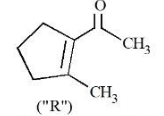
A molecule (" P ") on treatment with acid undergoes rearrangement and gives ("Q"). ("Q") on ozonolysis followed by reflux under alkaline condition gives (" R "). The structure of (" R ") is given below.

The structure of("P")is
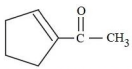
Aldol condensation is a popular and classical method to prepare $$\alpha,\beta$$-unsaturated carbonyl compounds. This reaction can be both intermolecular and intramolecular. Predict which one of the following is not a product of intramolecular aldol condensation?
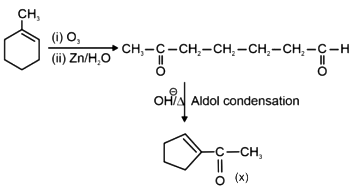
Aman has been asked to synthesise the molecule
(x).He thought of preparing the molecule using an aldol condensation reaction. He found a few cyclic alkenes in his laboratory. He thought of performing ozonolysis reaction on alkene to produce a dicarbonyl compound followed by aldol reaction to prepare " x ". Predict the suitable alkene that can lead to the formation of " x ".
"P" is an optically active compound with molecular formula $$C_6H_{12}O$$. When "P" is treated with 2,4-dinitrophenylhydrazine, it gives a positive test. However, in presence of Tollens reagent, "P" gives a negative test. Predict the structure of "P".
Which of the following arrangements with respect to their reactivity in nucleophilic addition reaction is correct?
Nucleophilic addition to a carbonyl group occurs at the electrophilic carbon of the $$C = O$$ bond. The rate depends on two main factors:
• Electronic effects: groups that withdraw electrons ( $$-I$$ and/or $$-R$$) increase the partial positive charge on the carbonyl carbon and enhance reactivity. Groups that donate electrons ( $$+I$$ and/or $$+R$$) decrease the charge and slow the reaction.
• Steric effects: less‐hindered carbonyls are more accessible to the nucleophile.
First compare aldehydes and ketones attached to an aromatic ring.
• Aldehydes have only one alkyl/aryl group attached to the carbonyl carbon, so they are less sterically hindered and receive less $$+I$$ donation than ketones. Hence aromatic aldehydes are more reactive than aromatic ketones.
• Therefore $$\text{acetophenone (Ar-CO-CH}_3)$$ is expected to be the least reactive of the four compounds.
Now compare the three aromatic aldehydes:
1. $$\text{p-nitrobenzaldehyde}$$ contains a $$NO_2$$ group. $$NO_2$$ is strongly electron-withdrawing by both $$-I$$ (inductive) and $$-R$$ (resonance) effects, so it makes the carbonyl carbon highly electrophilic. This gives the HIGHEST reactivity.
2. $$\text{benzaldehyde}$$ has no extra substituent on the ring, so its reactivity is taken as the reference among aldehydes.
3. $$\text{p-tolualdehyde}$$ (para-methylbenzaldehyde) contains a $$CH_3$$ group. $$CH_3$$ is electron-donating by $$+I$$ and weakly $$+R$$, so it reduces the electrophilicity of the carbonyl carbon, lowering the reactivity below that of unsubstituted benzaldehyde.
Putting the steric and electronic arguments together:
$$\text{Least reactive} \;\; \longrightarrow \;\; \text{acetophenone} \lt \text{p-tolualdehyde} \lt \text{benzaldehyde} \lt \text{p-nitrobenzaldehyde} \;\; \longrightarrow \;\; \text{Most reactive}$$
This sequence matches Option D.
Answer: Option D $$\left(\text{acetophenone} \lt \text{p-tolualdehyde} \lt \text{benzaldehyde} \lt \text{p-nitrobenzaldehyde}\right)$$
Given below are two statements : Consider the following reaction
The compounds which give positive Fehling's test are :
(A).
(B).
(C). $$ HOCH_{2} - CO - (CHOH)_{3}-CH_{2}-OH $$
(D). $$CH_{3}-CHO$$
(E).
Choose the correct answer from the options given below :
A) Benzaldehyde: Gives a negative result. Although it is an aldehyde, aromatic aldehydes are generally not oxidized by the relatively weak Fehling's solution.
B) Acetophenone: Gives a negative result. It is a ketone, and ketones lack the oxidizable hydrogen atom attached to the carbonyl carbon necessary to reduce Fehling's solution.
C) Fructose: Gives a positive result. Despite being a keto-hexose, it undergoes tautomerization under the alkaline conditions of the test to form oxidizable aldoses.
$$ HOCH_{2} - CO - (CHOH)_{3}-CH_{2}-OH $$
D) Acetaldehyde: Gives a positive result. As an aliphatic aldehyde, it is easily oxidized by the $$Cu^{2+}$$ ions in Fehling's solution to form a carboxylic acid and a red precipitate of $$Cu_2O$$.
E) Phenylacetaldehyde: Gives a positive result. Even though it contains an aromatic ring, the aldehyde group is attached to an aliphatic side chain, allowing it to behave like a typical aliphatic aldehyde in this test.
The major product (P) in the following reaction is:
Given below are two statements:

In the light of the above statements, choose the most appropriate answer from the options given below:
Number of molecules from below which cannot give iodoform reaction is :
Ethanol, Isopropyl alcohol, Bromoacetone, 2-Butanol, 2-Butanone, Butanal, 2-Pentanone, 3-Pentanone, Pentanal and 3-Pentanol
The iodoform test ($$I_2/NaOH$$) gives a yellow precipitate of $$CHI_3$$ whenever the organic compound contains either of the following structural units:
• a methyl ketone group $$\;-\!COCH_3$$, or
• an $$\;-\!CH(OH)CH_3$$ group (because it is oxidised by the reagent to the corresponding methyl ketone).
Let us check each molecule.
Case 1: Ethanol, $$CH_3CH_2OH$$.
Ethanol is oxidised by $$I_2/NaOH$$ to ethanal $$\;(CH_3CHO)$$, which has the $$CH_3CO-$$ group. Hence ethanol gives the iodoform test.
Case 2: Isopropyl alcohol (propan-2-ol), $$CH_3CH(OH)CH_3$$.
It already contains the $$-\!CH(OH)CH_3$$ arrangement, so it gives the test.
Case 3: Bromo-acetone, $$CH_3COCH_2Br$$.
The carbonyl carbon is directly attached to a $$CH_3$$ group, i.e. it has a $$-\!COCH_3$$ fragment. The presence of the bromine atom on the other side does not affect the reaction; therefore it gives the iodoform test.
Case 4: Butan-2-ol, $$CH_3CH(OH)CH_2CH_3$$.
Contains the $$-\!CH(OH)CH_3$$ unit, so it is iodoform-positive.
Case 5: Butan-2-one, $$CH_3COCH_2CH_3$$.
A clear methyl-ketone, hence positive.
Case 6: Butanal, $$CH_3CH_2CH_2CHO$$.
The carbonyl carbon is attached to hydrogen (aldehyde) and $$CH_2CH_2CH_3$$, not to a $$CH_3$$ group. Thus no $$-\!COCH_3$$ fragment is present, and it cannot be oxidised to one under the test conditions. Therefore butanal does NOT give the iodoform test.
Case 7: Pentan-2-one, $$CH_3COCH_2CH_2CH_3$$.
Has the required $$-\!COCH_3$$ group, so it is positive.
Case 8: Pentan-3-one, $$CH_3CH_2COCH_2CH_3$$.
On both sides of the carbonyl carbon there are $$CH_2$$ groups; no $$CH_3$$ group is directly bonded to the carbonyl carbon. Hence the $$-\!COCH_3$$ fragment is absent and the compound is iodoform-negative.
Case 9: Pentanal, $$CH_3CH_2CH_2CH_2CHO$$.
Like butanal, it lacks the $$-\!COCH_3$$ fragment, so it does not give the test.
Case 10: Pentan-3-ol, $$CH_3CH_2CH(OH)CH_2CH_3$$.
The alcohol carbon is attached to two $$CH_2$$ groups, not to a $$CH_3$$ group. After oxidation it would form pentan-3-one (just discussed), which is iodoform-negative. Hence pentan-3-ol is also iodoform-negative.
Collecting the results:
Positive (give iodoform): Ethanol, Isopropyl alcohol, Bromoacetone, 2-Butanol, 2-Butanone, 2-Pentanone ⇒ 6 compounds.
Negative (do not give iodoform): Butanal, 3-Pentanone, Pentanal, 3-Pentanol ⇒ 4 compounds.
Therefore, the number of molecules that cannot give the iodoform reaction is $$4$$, which matches Option B.
(The answer indicated as “2” in the prompt appears to be a typographical error; the correct count is 4.)
The product (P) formed in the following reaction is :
The major product of the following reaction is:

Residue (A) + HCl (dil)$$\rightarrow $$ Compound (B) Structure of residue (A) and Compound (B) formed respectively is :
The compounds that produce $$CO_{2}$$ with aqueous $$NaHCO_{3}$$ solution are:
A.

B.

C.

D.

E.

Choose the correct answer from the options given below:
When

undergoes intramolecular aldol condensation, the major product formed is :
The major product of the following reaction is :
A compound 'X' absorbs 2 moles of hydrogen and 'X' upon oxidation with $$KMnO_{4}|H^{+}$$ gives

The total number of $$\sigma$$ bonds present in the compound 'X' is ________.
In the Claisen-Schmidt reaction to prepare, dibenzalacetone from 5.3 g of benzaldehyde, a total of 3.51 g of product was obtained. The percentage yield in this reaction was ______ %.
In the Claisen-Schmidt reaction between benzaldehyde and acetone, represented by $$ 2C_6H_5CHO + CH_3COCH_3 \to C_6H_5CH=CHCOCH=CHC_6H_5 + 2H_2O $$, if 5.3 g of benzaldehyde are used and 3.51 g of dibenzalacetone are obtained, the percentage yield can be calculated as follows.
The molar mass of benzaldehyde is $$6(12) + 5(1) + 12 + 16 + 1 = 106$$ g/mol, and the molar mass of dibenzalacetone is $$17(12) + 14(1) + 16 = 204 + 14 + 16 = 234$$ g/mol.
The number of moles of benzaldehyde is $$\frac{5.3}{106} = 0.05$$ mol. Since 2 mol of benzaldehyde produce 1 mol of dibenzalacetone, the theoretical yield in moles is $$0.05/2 = 0.025$$ mol.
Multiplying by the molar mass of dibenzalacetone gives the theoretical mass as $$0.025 \times 234 = 5.85$$ g.
Therefore, the percentage yield is $$\frac{3.51}{5.85} \times 100 = 60\%$$, so the yield of the reaction is 60%.
The ratio $$\frac{K_P}{K_C}$$ for the reaction : $$CO_{(g)} + \frac{1}{2} O_{2(g)} \rightleftharpoons CO_{2(g)}$$ is :
We need to find the ratio $$K_P/K_C$$ for the reaction $$CO_{(g)} + \frac{1}{2}O_{2(g)} \rightleftharpoons CO_{2(g)}$$. The relationship between $$K_P$$ and $$K_C$$ is given by $$K_P = K_C(RT)^{\Delta n_g}$$ where $$\Delta n_g$$ is the change in the number of moles of gaseous species (moles of gaseous products minus moles of gaseous reactants).
Moles of gaseous products = 1 (CO$$_2$$) and moles of gaseous reactants = 1 (CO) + 1/2 (O$$_2$$) = 3/2, so $$\Delta n_g = 1 - \frac{3}{2} = -\frac{1}{2}$$.
Substituting into the formula gives $$\frac{K_P}{K_C} = (RT)^{\Delta n_g} = (RT)^{-1/2} = \frac{1}{\sqrt{RT}}$$, therefore the correct answer is Option (1): $$\frac{1}{\sqrt{RT}}$$.
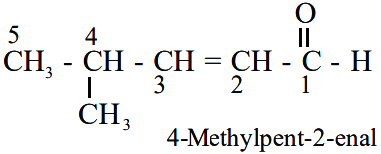
Structure of $$4-\text{Methylpent}-2-\text{enal}$$ is:
Given below are two statements : Statement (I) : A Buffer solution is the mixture of a salt and an acid or a base mixed in any particular quantities. Statement (II) : Blood is naturally occurring buffer solution whose pH is maintained by $$H_2CO_3/HCO_3^-$$ concentrations. In the light of the above statements, choose the correct answer from the options given below :
We need to evaluate two statements about buffer solutions.
Analysis of Statement (I): "A Buffer solution is the mixture of a salt and an acid or a base mixed in any particular quantities."
This statement is FALSE. While a buffer solution is indeed a mixture of a weak acid and its conjugate base (or a weak base and its conjugate acid), it does not work with just "any" quantities. For a buffer to function effectively, the components must be mixed in appropriate proportions. Specifically:
- The buffer capacity depends on the ratio of the concentrations of the conjugate pair.
- An effective buffer typically has a pH within one unit of the $$pK_a$$ of the weak acid, which requires the ratio $$[salt]/[acid]$$ to be between 0.1 and 10.
- If the ratio is too extreme, the solution will not resist pH changes effectively.
Analysis of Statement (II): "Blood is naturally occurring buffer solution whose pH is maintained by $$H_2CO_3/HCO_3^-$$ concentrations."
This statement is TRUE. Blood is a naturally occurring buffer that maintains its pH around 7.4. The primary buffer system in blood is the carbonic acid-bicarbonate buffer system:
$$H_2CO_3 \rightleftharpoons H^+ + HCO_3^-$$
When excess acid ($$H^+$$) enters the blood, bicarbonate ions ($$HCO_3^-$$) neutralise it. When excess base ($$OH^-$$) enters, carbonic acid ($$H_2CO_3$$) neutralises it. This maintains the blood pH within a narrow, life-sustaining range.
The correct answer is Option (3): Statement I is false but Statement II is true.
Match List I with List II
Choose the correct answer from the options given below:
For the given hypothetical reactions, the equilibrium constants are as follows: $$X \rightleftharpoons Y; K_1 = 1.0$$, $$Y \rightleftharpoons Z; K_2 = 2.0$$, $$Z \rightleftharpoons W; K_3 = 4.0$$. The equilibrium constant for the reaction $$X \rightleftharpoons W$$ is
Find the equilibrium constant for $$X \rightleftharpoons W$$ given intermediate steps.
$$X \rightleftharpoons Y$$, $$K_1 = 1.0$$
$$Y \rightleftharpoons Z$$, $$K_2 = 2.0$$
$$Z \rightleftharpoons W$$, $$K_3 = 4.0$$
When reactions are added, their equilibrium constants are multiplied. Adding all three:
$$X \rightleftharpoons Y \rightleftharpoons Z \rightleftharpoons W$$
$$K = K_1 \times K_2 \times K_3 = 1.0 \times 2.0 \times 4.0 = 8.0$$
The correct answer is Option (4): 8.0.
The following reaction occurs in the Blast furnace where iron ore is reduced to iron metal $$Fe_2O_{3(s)} + 3CO_{(g)} \rightleftharpoons Fe_{(l)} + 3CO_{2(g)}$$. Using the Le-Chatelier's principle, predict which one of the following will not disturb the equilibrium.
The reaction: $$Fe_2O_{3(s)} + 3CO_{(g)} \rightleftharpoons Fe_{(l)} + 3CO_{2(g)}$$
Le Chatelier's Principle: The equilibrium shifts in response to changes in concentration, pressure, or temperature.
Key point: Pure solids and pure liquids do NOT affect the equilibrium position because their concentrations (activities) are constant. They do not appear in the equilibrium expression.
$$Fe_2O_3$$ is a solid. Adding more $$Fe_2O_3(s)$$ will not disturb the equilibrium because its activity remains 1.
Adding/removing $$CO_2$$ or removing $$CO$$ would shift the equilibrium as they are gaseous species that appear in the equilibrium expression.
The correct answer is Option (3): Addition of $$Fe_2O_3$$.
At $$-20°C$$ and 1 atm pressure, a cylinder is filled with equal number of $$H_2$$, $$I_2$$ and $$HI$$ molecules for the reaction $$H_2(g) + I_2(g) \rightleftharpoons 2HI(g)$$, the $$K_p$$ for the process is $$x \times 10^{-1}$$. $$x =$$ _______ [Given : $$R = 0.082 \text{ L atm K}^{-1} \text{mol}^{-1}$$]
The reaction is $$H_2(g) + I_2(g) \rightleftharpoons 2HI(g)$$.
The cylinder is filled with equal number of molecules of $$H_2$$, $$I_2$$, and $$HI$$ at $$-20°C$$ (253 K) and 1 atm.
Since the number of moles of gaseous reactants equals the number of moles of gaseous products ($$\Delta n_g = 0$$), $$K_p = K_c$$ for this reaction.
Let the number of moles of each gas be $$n$$. The partial pressures are all equal (since equal moles at same T, V): each gas has partial pressure $$P/3$$ where $$P = 1$$ atm.
$$K_p = \frac{(P_{HI})^2}{P_{H_2} \cdot P_{I_2}} = \frac{(P/3)^2}{(P/3)(P/3)} = \frac{P^2/9}{P^2/9} = 1$$
So $$K_p = 1 = x \times 10^{-1}$$.
This gives $$x = 10$$.
The correct answer is Option B: 10.
In the given reactions identify the reagent $$A$$ and reagent $$B$$
Highest enol content will be shown by :
Identify $$A$$ and $$B$$ in the following reaction sequence:
The final product A formed in the following multistep reaction sequence is:
Complete reaction of acetaldehyde with excess formaldehyde, upon heating with conc. NaOH solution, gives P and Q. Compound P does not give Tollens' test, whereas Q on acidification gives positive Tollens' test. Treatment of P with excess cyclohexanone in the presence of catalytic amount of p-toluenesulfonic acid (PTSA) gives product R.
Sum of the number of methylene groups ($$-CH_2-$$) and oxygen atoms in R is ______.
The reaction sequence is a standard industrial route to the poly-alcohol pentaerythritol and its ketal derivatives. We analyse every step.
Step 1 : Reaction of acetaldehyde with excess formaldehyde in conc. NaOH
• Formaldehyde has no $$\alpha$$-hydrogen, so in strong alkali it undergoes the Cannizzaro reaction:
$$2\,HCHO + OH^- \;\longrightarrow\; HCOO^- + CH_3OH$$
• In the presence of acetaldehyde, a cross-Cannizzaro/Aldol sequence occurs.
1 mol acetaldehyde first gives an enolate which adds to two molecules of formaldehyde (cross-aldol).
The aldehydic group thus produced is then reduced by hydride transfer from a third molecule of formaldehyde (Cannizzaro step).
The overall stoichiometry is
$$CH_3CHO + 3\,HCHO + 3\,NaOH \; \xrightarrow{\;\;\text{heat}\;\;} C(CH_2OH)_4 \;+\; 3\,NaHCOO$$
• The poly-alcohol obtained is pentaerythritol, $$P = C(CH_2OH)_4$$. It possesses no -CHO group, hence it does not respond to Tollens’ reagent.
• The salt $$Q = NaHCOO$$ on acidification furnishes formic acid, $$HCOOH$$, which does reduce Tollens’ reagent. Thus the statements regarding $$P$$ and $$Q$$ are consistent.
Step 2 : Ketal formation between $$P$$ and excess cyclohexanone in the presence of catalytic p-toluenesulfonic acid (PTSA)
Acid catalyses the reaction of a ketone with two alcohol functions to give a ketal.
Each molecule of cyclohexanone requires two -OH groups:
$$\text{cyclohexanone}+2\,ROH \;\xrightarrow{\;\;H^+\;\;} \text{cyclohexanone ketal}\;(\;C=O \text{ is replaced by }C(OR)_2\;)$$
Pentaerythritol has four -OH groups, therefore it can furnish the necessary two alcohol units twice. Consequently, with excess cyclohexanone it forms a diketal:
$$R = \bigl[\;C(CH_2O{-})_4\bigr]$$ Each pair $$\;{-}OCH_2{-}$$ originates from one molecule of cyclohexanone, so $$R$$ contains two cyclohexanone rings attached through ketal linkages.
Counting -CH2- groups in $$R$$
• Central pentaerythritol carbon: four $$CH_2$$ groups → $$4$$
• Each cyclohexanone ring (after ketal formation) supplies five $$CH_2$$ groups
(the carbonyl carbon becomes quaternary, carries no hydrogens).
Two rings ⇒ $$2 \times 5 = 10$$
Total methylene groups $$= 4 + 10 = 14$$
Counting oxygen atoms in $$R$$
Every ketal linkage contains the two original alcohol oxygens; thus the four -OH groups of pentaerythritol become four ether oxygens. (The carbonyl oxygens of the ketones are lost as water during ketalisation).
Total oxygen atoms $$= 4$$
Required sum
$$\text{(number of }{-}CH_2{-}\text{ groups)} + \text{(number of O atoms)}
= 14 + 4 = 18$$
Therefore, the asked sum is 18.
Identify the reagents used for the following conversion
{image}
This reduction reaction is known as:
Given below are two statements: Statement I: Acidity of α-hydrogens of aldehydes and ketones is responsible for Aldol reaction. Statement II: Reaction between benzaldehyde and ethanal will NOT give Cross-Aldol product. Choose the most appropriate answer from the options given below :
We need to evaluate the truth of two statements about the Aldol reaction.
Statement I: "Acidity of alpha-hydrogens of aldehydes and ketones is responsible for the Aldol reaction."
The Aldol reaction proceeds through the following mechanism:
1. A base abstracts an $$\alpha$$-hydrogen from one carbonyl compound, forming a resonance-stabilised enolate ion.
2. This enolate ion (a nucleophile) attacks the electrophilic carbonyl carbon of another molecule.
3. The resulting alkoxide is protonated to give the $$\beta$$-hydroxy aldehyde (aldol product).
The entire reaction depends on the ability to form the enolate, which in turn requires that the $$\alpha$$-hydrogen be sufficiently acidic ($$pK_a \approx 17{-}20$$ for typical aldehydes and ketones). Without acidic $$\alpha$$-hydrogens, the enolate cannot form and the Aldol reaction cannot proceed. Therefore, Statement I is correct.
Statement II: "Reaction between benzaldehyde and ethanal will NOT give a Cross-Aldol product."
Let us analyse the two reactants:
- Benzaldehyde ($$C_6H_5CHO$$): This aldehyde has no $$\alpha$$-hydrogen (the carbon adjacent to $$C=O$$ is part of the benzene ring). Therefore, benzaldehyde cannot form an enolate and cannot act as the donor component.
- Ethanal ($$CH_3CHO$$): This aldehyde has three $$\alpha$$-hydrogens on the methyl group. It can readily form an enolate ion.
In a cross-Aldol reaction between these two, ethanal provides the enolate (nucleophile), which attacks the carbonyl carbon of benzaldehyde (electrophile). This produces 3-hydroxy-3-phenylpropanal, which upon dehydration gives cinnamaldehyde ($$C_6H_5CH=CHCHO$$). This is a well-known reaction called the Claisen-Schmidt reaction.
Since the cross-Aldol product is formed, Statement II is incorrect.
The correct answer is Option 1: Statement I is correct but Statement II is incorrect.
Identify the name reaction:
The product A formed in the following reaction is:
Which of the following compound can give positive iodoform test when treated with aqueous $$KOH$$ solution followed by potassium hypoiodite.

Choose the correct answer from options given below:
Consider the above reaction sequence and identify the major product $$P$$.


Identify the product in the following reaction :
Which of the following compounds will give silver mirror with ammoniacal silver nitrate? A. Formic acid B. Formaldehyde C. Benzaldehyde D. Acetone. Choose the correct answer from the options given below :
We need to identify which compounds give a silver mirror test (Tollens' test) with ammoniacal silver nitrate ($$[Ag(NH_3)_2]^+$$).
Tollens' reagent (ammoniacal silver nitrate) acts as a mild oxidising agent that oxidises aldehydes and certain other reducing compounds while itself being reduced. In this process silver ions ($$Ag^+$$) are reduced to metallic silver ($$Ag$$), which deposits as a mirror on the test tube wall:
$$RCHO + 2[Ag(NH_3)_2]^+ + 2OH^- \rightarrow RCOO^- + 2Ag \downarrow + 4NH_3 + H_2O$$
Formic acid has the structure $$H-\underset{\displaystyle \|}{\overset{\displaystyle O}{C}}-OH$$. Unlike other carboxylic acids, it contains an aldehyde-like $$H-C=O$$ group in addition to the $$-OH$$ group. This structural feature allows it to act as a reducing agent, so formic acid gives a positive silver mirror test.
Formaldehyde (HCHO) is an aldehyde and readily reduces Tollens' reagent. It is oxidised all the way to formate or carbonate because both hydrogen atoms on the carbon can be oxidised, and thus formaldehyde gives a positive silver mirror test.
Benzaldehyde ($$C_6H_5CHO$$) is an aromatic aldehyde containing the $$-CHO$$ group, and all aldehydes give a positive Tollens' test whether they are aliphatic or aromatic. Consequently, benzaldehyde gives a positive silver mirror test.
Acetone ($$CH_3COCH_3$$) is a ketone that lacks the $$-CHO$$ group and is not easily oxidised by the mild oxidising agent in Tollens' reagent. Therefore, acetone does not give a silver mirror test.
Consequently, formic acid, formaldehyde, and benzaldehyde give a positive silver mirror test, whereas acetone does not. The correct answer is Option 1: A, B and C only.
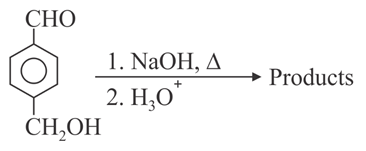
m-chlorobenzaldehyde on treatment with 50% KOH solution yields
In the Claisen-Schmidt reaction to prepare $$351$$ g of dibenzalacetone using $$87$$ g of acetone, the amount of benzaldehyde required is ______ g. (Nearest integer)
The Claisen-Schmidt reaction to prepare dibenzalacetone involves the condensation of acetone with benzaldehyde:
$$ CH_3COCH_3 + 2C_6H_5CHO \xrightarrow{NaOH} C_6H_5CH=CHCOCH=CHC_6H_5 + 2H_2O $$The molar mass of acetone (CH_3COCH_3) is 12×3 + 6 + 16 = 58 g/mol, that of benzaldehyde (C_6H_5CHO) is 12×7 + 6 + 16 = 106 g/mol, and that of dibenzalacetone (C_{17}H_{14}O) is 12×17 + 14 + 16 = 234 g/mol.
To prepare 351 g of dibenzalacetone:
$$ \text{Moles of dibenzalacetone} = \frac{351}{234} = 1.5 \text{ mol} $$The available 87 g of acetone corresponds to:
$$ \text{Moles of acetone} = \frac{87}{58} = 1.5 \text{ mol} $$Since the reaction requires 2 mol of benzaldehyde per mole of acetone:
$$ \text{Moles of benzaldehyde} = 2 \times 1.5 = 3 \text{ mol} $$Thus, the mass of benzaldehyde needed is:
$$ \text{Mass} = 3 \times 106 = 318 \text{ g} $$Therefore, 318 g of benzaldehyde is required.
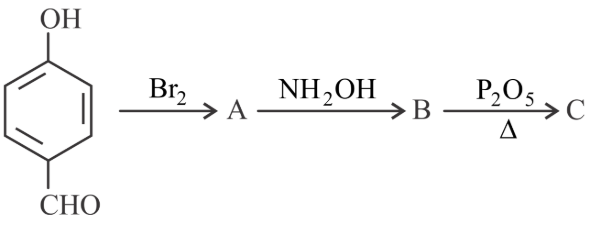
The total number of hydrogen atoms in product A and product B is __________.
From the compounds given below, number of compounds which give positive Fehling's test is _______
Benzaldehyde, Acetaldehyde, Acetone, Acetophenone, Methanal, 4-nitrobenzaldehyde, cyclohexane carbaldehyde.
We need to count the number of compounds that give a positive Fehling's test from: Benzaldehyde, Acetaldehyde, Acetone, Acetophenone, Methanal, 4-nitrobenzaldehyde, Cyclohexane carbaldehyde.
Recall what Fehling's test detects.
Fehling's test uses Fehling's reagent (an alkaline solution of cupric tartrate, deep blue in colour) to detect aliphatic aldehydes. Aldehydes reduce $$Cu^{2+}$$ (blue) to $$Cu_2O$$ (red-brown precipitate). Important: aromatic aldehydes do NOT give a positive Fehling's test because the benzene ring reduces the reactivity of the aldehyde group. Ketones also do not give a positive test.
Analyse each compound.
- Benzaldehyde ($$C_6H_5CHO$$): Aromatic aldehyde. Does NOT give positive Fehling's test.
- Acetaldehyde ($$CH_3CHO$$): Aliphatic aldehyde. Positive.
- Acetone ($$CH_3COCH_3$$): Ketone. Does NOT give positive test.
- Acetophenone ($$C_6H_5COCH_3$$): Aromatic ketone. Does NOT give positive test.
- Methanal ($$HCHO$$): Aliphatic aldehyde (simplest one). Positive.
- 4-Nitrobenzaldehyde ($$O_2N-C_6H_4-CHO$$): Aromatic aldehyde. Does NOT give positive Fehling's test.
- Cyclohexane carbaldehyde ($$C_6H_{11}CHO$$): Aliphatic aldehyde (cyclohexane ring is not aromatic). Positive.
Count.
Positive Fehling's test: Acetaldehyde, Methanal, Cyclohexane carbaldehyde = 3.
The answer is 3.
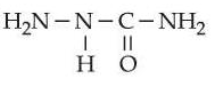
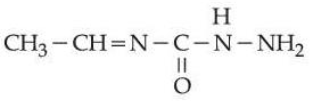
The compound formed by the reaction of ethanal with semicarbazide contains _______ number of nitrogen atoms.
Ethanal ($$CH_3CHO$$) reacts with semicarbazide ($$NH_2NHCONH_2$$) to form a semicarbazone through a condensation reaction.
The reaction is:
$$ CH_3CHO + NH_2NHCONH_2 \rightarrow CH_3CH=NNHCONH_2 + H_2O $$
The product is acetaldehyde semicarbazone: $$CH_3CH=N-NH-CO-NH_2$$.
Counting the nitrogen atoms in the product:
1. The $$=N-$$ nitrogen
2. The $$-NH-$$ nitrogen
3. The $$-NH_2$$ nitrogen
Total nitrogen atoms = $$3$$.
Therefore, the answer is $$\boxed{3}$$.
Given below are two statements, one is labelled as Assertion A and the other is labelled as Reason R.
Assertion A:

can be subjected to Wolff-Kishner reduction to give

Reason R: Wolff-Kishner reduction is used to convert

into
Assertion A: Acyl chlorides can be subjected to Wolff-Kishner reduction.
This is False. Wolff-Kishner reduction requires treatment with hydrazine (NH$$_2$$NH$$_2$$) and strong base (KOH/NaOH) at high temperature. Acyl chlorides would react with hydrazine to form acid hydrazides rather than undergo the intended carbonyl reduction.
Reason R: Wolff-Kishner reduction converts C=O to CH$$_2$$.
This is True. The Wolff-Kishner reduction specifically reduces the carbonyl group to a methylene group (-CH$$_2$$-) through formation and decomposition of a hydrazone intermediate.
A is false but R is true.

The correct sequence of reagents for the preparation of Q and R is:
The major product formed in the following reaction is:
(a)
(b)
(c)
(d)
choose the correct answer from the options Given below:
Given below are two statements:
Statement I:

under Clemmensen reduction conditions will give

Statement II:

under Wolff-Kishner reduction condition will give

In the light of the above statements, choose the correct answer from the options given below:
Given below are two statements: one is labelled as Assertion A and the other is labelled as Reason R:
Assertion A: Acetal/Ketal is stable in basic medium.
Reason R: The high leaving tendency of alkoxide ion gives the stability to acetal/ketal in basic medium.
In the light of the above statements, choose the correct answer from the options given below:
Assertion A: Acetal/Ketal is stable in basic medium. — TRUE. Acetals and ketals are stable under basic conditions but hydrolyze under acidic conditions.
Reason R: The high leaving tendency of alkoxide ion gives stability to acetal/ketal in basic medium. — FALSE. Alkoxide ions are actually poor leaving groups (high pKa ~16). The stability in basic medium is because the first step of hydrolysis requires protonation of the oxygen (acid catalysis), which doesn't occur in basic conditions.
Since A is true and R is false, the correct answer is Option A: $$\boxed{\text{A is true but R is false}}$$.
Which of the following compounds would give the following set of qualitative analysis?
(i) Fehling's Test: Positive
(ii) Na fusion extract upon treatment with sodium nitroprusside gives a blood red colour but not prussian blue.
Find out the major products from the following reaction sequence.
Consider the following reaction
Propanal + Methanal $$\xrightarrow{(i)$$ dil. NaOH $$}{\xrightarrow{(ii) \Delta \; (iii)$$ NaCN $$\; (iv) \; H_3O^+}}$$ Product B (C$$_5$$H$$_8$$O$$_3$$)
The correct statement for product B is. It is
Find out the major product from the following reaction.
The total number of sp$$^2$$ hybridised carbon atoms in the major product P (a non-heterocyclic compound) of the following reaction is ______.
'A' and 'B' in the above reaction are :
In the reaction given below, the product 'X' is:
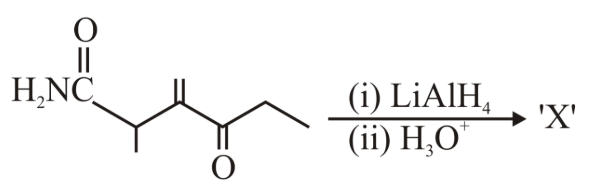
LiAlH_4 is a powerful reducing agent so, it will completely reduces primary amides down to primary amines by converting the carbonyl carbon into a methylene group (-CH2-). AND The ketone carbonyl group is cleanly reduced to a secondary alcohol group (-CH(OH)-_)
LiAlH_4 is a nucleophilic reducing agent, meaning it attacks electron-deficient carbon atoms (like carbonyls). It does not reduce ordinary isolated carbon-carbon double bonds because alkenes are electron-rich and repel nucleophilic attack. Therefore, the central double bond remains completely unaffected.
HENCE Final structure would be C
Match List I with List II.
| List I (Reaction) | List II (Reagents) |
|---|---|
| (A) Hoffmann Degradation | (I) Conc. KOH, $$\Delta$$ |
| (B) Clemmensen reduction | (II) CHCl$$_3$$, NaOH/H$$_3$$O$$^+$$ |
| (C) Cannizzaro reaction | (III) Br$$_2$$, NaOH |
| (D) Reimer-Tiemann reaction | (IV) Zn $$-$$ Hg/HCl |
Match the reactions with their reagents.
(A) Hoffmann Degradation: Conversion of amide to amine using $$Br_2/NaOH$$ — matches (III).
(B) Clemmensen Reduction: Reduction of $$C=O$$ to $$CH_2$$ using $$Zn-Hg/HCl$$ — matches (IV).
(C) Cannizzaro Reaction: Disproportionation of aldehydes (without $$\alpha$$-H) using concentrated KOH — matches (I).
(D) Reimer-Tiemann Reaction: Introduction of $$CHO$$ group to phenol using $$CHCl_3/NaOH$$ — matches (II).
Matching: A-III, B-IV, C-I, D-II
This matches Option 3.
The answer is $$\boxed{A-III, B-IV, C-I, D-II}$$ (Option 3).
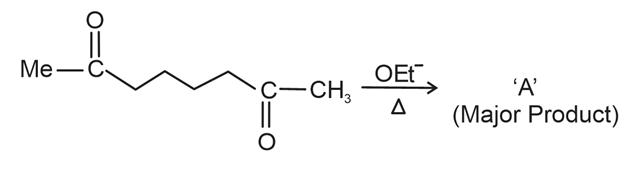
The reaction of a diketone (MeCO-CH$$_2$$-CO-CH$$_3$$) with OEt$$^-$$/$$\Delta$$ gives 'A' (Major Product).
A in the above reaction is :
The structures of major products A, B and C in the following reaction sequence are:
Major product 'P' formed in the following reaction is:
Among the following the number of compounds which will give positive iodoform reaction is ______.
(a) 1-Phenylbutan-2-one
(b) 2-Methylbutan-2-ol
(c) 3-Methylbutan-2-ol
(d) 1-Phenylethanol
(e) 3, 3-dimethylbutan-2-one
(f) 1-Phenylpropan-2-ol
The iodoform test is positive for compounds containing either a $$CH_3CO-$$ group (methyl ketone) or a $$CH_3CH(OH)-$$ group (secondary alcohol with methyl group adjacent to OH).
Analyzing each compound:
(a) 1-Phenylbutan-2-one (C₆H₅CH₂COCH₂CH₃): The carbonyl has CH₂ groups on both sides, not a methyl group. Negative ✗
(b) 2-Methylbutan-2-ol ((CH₃)₂C(OH)CH₂CH₃): This is a tertiary alcohol with no CH₃CHOH pattern. Negative ✗
(c) 3-Methylbutan-2-ol (CH₃CH(OH)CH(CH₃)₂): Has a CH₃CHOH group. Positive ✓
(d) 1-Phenylethanol (C₆H₅CH(OH)CH₃): Has a CH₃CHOH group. Positive ✓
(e) 3,3-Dimethylbutan-2-one (CH₃COC(CH₃)₃): Has a CH₃CO group. Positive ✓
(f) 1-Phenylpropan-2-ol (C₆H₅CH₂CH(OH)CH₃): Has a CH₃CHOH group. Positive ✓
Number of compounds giving positive iodoform test = 4 (c, d, e, f).
The mass of NH$$_3$$ produced when $$131.8$$ kg of cyclohexane carbaldehyde undergoes Tollen's test is _____ kg. (Nearest Integer)
Molar mass of C $$= 12$$ g/mol, N $$= 14$$ g/mol, O $$= 16$$ g/mol
When an aldehyde undergoes oxidation with Tollen's reagent, the balanced chemical equation is:
From the stoichiometry of this reaction, 1 mole of aldehyde produces exactly 4 moles of ammonia (NH3).
Given mass of cyclohexane carbaldehyde = 131.8 kg = 131800 g
According to the 1 : 4 stoichiometric ratio:

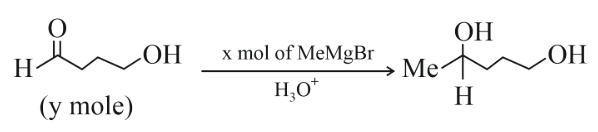
The ratio x/y on completion of the reaction is
Glyoxylic acid has the structure: OHC-COOH (an aldehyde and a carboxylic acid group).
When glyoxylic acid reacts with excess MeMgBr (Grignard reagent):
The first equivalent of MeMgBr reacts with the acidic -COOH group (acid-base reaction):
$$-\text{COOH} + \text{CH}_3\text{MgBr} \rightarrow -\text{COO}^-\text{MgBr}^+ + \text{CH}_4$$
The second equivalent of MeMgBr performs nucleophilic addition to the -CHO group:
$$-\text{CHO} + \text{CH}_3\text{MgBr} \rightarrow -\text{CH(OMgBr)CH}_3$$
After hydrolysis with H$$_3$$O$$^+$$, the product is 2-hydroxypropionic acid (lactic acid type).
So for $$y$$ moles of glyoxylic acid, $$x = 2y$$ moles of MeMgBr are needed.
$$\frac{x}{y} = 2$$
Which of the following is an example of conjugated diketone?
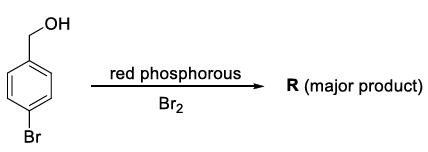
Consider the following reaction.
On estimation of bromine in 1.00 g of R using Carius method, the amount of AgBr formed (in g) is ______.
[Given : Atomic mass of H = 1, C = 12, O = 16, P = 31, Br = 80, Ag = 108]
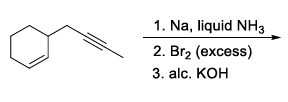
The number of isomeric tetraenes (NOT containing sp-hybridized carbon atoms) that can be formed from the following reaction sequence is _______.
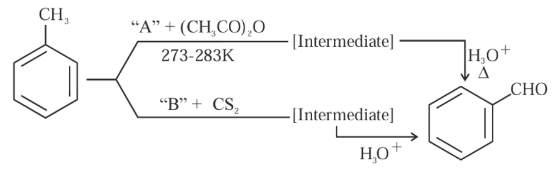
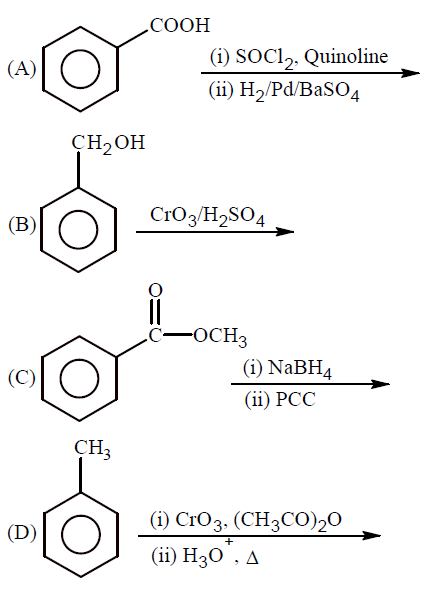
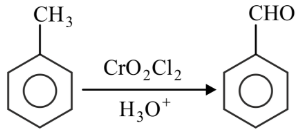
Toluene can be easily converted into benzaldehyde by which of the following reagents?
Consider the above reaction sequence, the Product 'C' is
The final product 'A' in the following reaction sequence
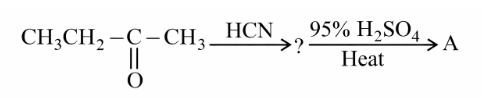
We need to find the final product A in the reaction sequence where butanone reacts with HCN, followed by treatment with 95% $$H_2SO_4$$ and heat.
Butanone ($$CH_3CH_2COCH_3$$) undergoes nucleophilic addition with HCN to form a cyanohydrin:
$$CH_3CH_2COCH_3 + HCN \rightarrow CH_3CH_2C(OH)(CN)CH_3$$
The product is 2-hydroxy-2-methylbutanenitrile.
Concentrated $$H_2SO_4$$ (95%) acts as both a dehydrating agent and a hydrolysis catalyst:
First, the nitrile group ($$-CN$$) is hydrolyzed to a carboxylic acid group ($$-COOH$$) in the acidic medium:
$$CH_3CH_2C(OH)(CN)CH_3 \xrightarrow{H_2SO_4} CH_3CH_2C(OH)(COOH)CH_3$$
Then, dehydration occurs — the hydroxyl group and a hydrogen from the adjacent carbon are eliminated:
$$CH_3CH_2C(OH)(COOH)CH_3 \xrightarrow{-H_2O} CH_3CH=C(CH_3)COOH$$
The final product is $$CH_3-CH=C(CH_3)-COOH$$, which is 2-methylbut-2-enoic acid (also known as tiglic acid or $$\alpha,\beta$$-unsaturated acid).
Therefore, the correct answer is Option A.
Major product 'B' of the following reaction sequence is
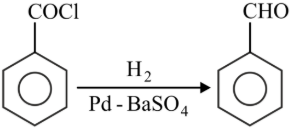
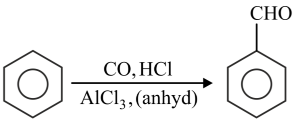
Which of the following reactions will yield benzaldehyde as a product?
Find out the major product for the above reaction.
Hex-4-ene-2-ol on treatment with PCC gives 'A'. 'A' on reaction with sodium hypoiodite gives 'B', which on further heating with soda lime gives 'C'. The compound 'C' is
We need to follow the sequence of reactions starting from hex-4-en-2-ol, which has the structure: $$CH_3-CH(OH)-CH_2-CH=CH-CH_3$$.
PCC (Pyridinium Chlorochromate) is a mild oxidizing agent that converts a secondary alcohol to a ketone without further oxidation. $$CH_3-CH(OH)-CH_2-CH=CH-CH_3 \xrightarrow{PCC} CH_3-CO-CH_2-CH=CH-CH_3$$ Compound A is hex-4-en-2-one.
Sodium hypoiodite is the iodoform reagent. It reacts with methyl ketones ($$R-CO-CH_3$$) to give a carboxylate salt and iodoform ($$CHI_3$$): $$CH_3-CO-CH_2-CH=CH-CH_3 + 3NaOI \to CHI_3 + CH_3-CH=CH-CH_2-COONa$$. Compound B is sodium pent-3-enoate ($$CH_3CH=CHCH_2COONa$$).
Heating sodium pent-3-enoate with soda lime ($$NaOH + CaO$$) causes decarboxylation, removing $$CO_2$$ and replacing the $$-COONa$$ group with $$-H$$: $$CH_3-CH=CH-CH_2-COONa \xrightarrow{NaOH/CaO} CH_3-CH=CH-CH_3 + Na_2CO_3$$. Compound C is 2-butene ($$CH_3CH=CHCH_3$$).
The correct answer is Option C: 2-butene.
Isobutyraldehyde on reaction with formaldehyde and K$$_2$$CO$$_3$$ gives compound 'A'. Compound 'A' reacts with KCN and yields compound 'B', which on hydrolysis gives a stable compound 'C'. The compound 'C' is
Isobutyraldehyde, (CH3)2CH-CHO, has exactly one acidic α-hydrogen. In the presence of a mild base (K2CO3), it forms an enolate which selectively attacks the more reactive, non-enolizable formaldehyde (HCHO).
The aldehyde group of Compound 'A' is targeted by nucleophilic cyanide ions (CN¯) from KCN, producing a cyanohydrin intermediate containing both a nitrile moiety and hydroxyl components.
During aqueous acid treatment, two shifts happen in rapid succession:
Because the hydroxyl attachment generated on the original isobutyraldehyde core ends up next to the gem-dimethyl group while the initial primary alcohol site closing the ring system targets the carbonyl terminus, the connectivity perfectly maps out to match the configuration shown in Option C.
Match List-I with List-II.
| List-I | List-II |
|---|---|
A![]() | I. Gatterman Koch reaction |
B![]() | II. Etard reaction |
C![]() | III. Stephen reaction |
D![]() | IV. Rosenmund reaction |
The correct structure of product 'A' formed in the following reaction,
This reaction is a textbook Cannizzaro Reaction (self oxidation-reduction of aldehydes lacking α-hydrogens). Here is the precise step-by-step pathway showing why the deuterium ends up on the oxygen and not the carbon atom.
The deuterated hydroxide ion (OD¯) acts as a nucleophile and attacks the electrophilic carbonyl carbon of the first benzaldehyde molecule. This pushes the π-electrons up onto the carbonyl oxygen, forming a tetrahedral intermediate.
The tetrahedral intermediate reformulates its carbonyl stable double bond. In doing so, it expels a hydride ion (H¯). This hydride shifts directly to a second molecule of benzaldehyde.
Note: Because this is a direct intermolecular transfer, the hydride never mixes with the solvent, meaning no deuterium can bind to this central carbon.
The generated carboxylic acid is highly acidic, and the alkoxide intermediate is a strong base. Rapid acid-base proton/deuteron exchange occurs instantly with the deuterated solvent (D2O) or directly between them to form stable final products.
As demonstrated by the electron tracking arrows:
Therefore, the carbon maintains two normal H atoms, while the oxygen captures the OD variant.
What is the major product of the following reaction?
Which of the following conditions or reaction sequence will NOT give acetophenone as the major product?
Which one of the following reactions does not represent correct combination of substrate and product under the given conditions?
The correct structure of C is
The reaction sequence begins with propanenitrile (CH₃-CH₂-CN) reacting with methylmagnesium bromide (CH₃MgBr), a Grignard reagent, in the presence of dry ether. The nucleophilic methyl group from the Grignard reagent attacks the electrophilic carbon of the nitrile group, forming an intermediate imine salt designated as compound A (CH₃-CH₂-C(CH₃)=NMgBr).
This intermediate is then immediately subjected to acidic hydrolysis (H₃O⁺), which cleaves the carbon-nitrogen double bond to yield a ketone. Consequently, compound B is butan-2-one (CH₃-CH₂-CO-CH₃).
In the final step, butan-2-one undergoes a Clemmensen reduction using zinc amalgam (Zn-Hg) and concentrated hydrochloric acid (HCl). This reduction explicitly targets the carbonyl group, completely deoxygenating it and converting the >C=O group into a methylene (-CH₂-) group. Therefore, the final product, the correct structure of C, is the straight-chain alkane butane (CH₃-CH₂-CH₂-CH₃).
The products formed in the following reaction, A and B are
We need to identify the products A and B formed in the given reaction.
Based on the JEE 2022 context, this question involves ozonolysis of a suitable alkene. Ozonolysis cleaves the carbon-carbon double bond and produces aldehydes and/or ketones depending on the substituents.
When an alkene undergoes ozonolysis (treatment with $$O_3$$ followed by reductive workup with Zn/$$H_2O$$), the double bond is cleaved, and each carbon of the double bond gets an oxygen (=O) to form carbonyl compounds.
For propene ($$CH_3CH=CH_2$$):
$$CH_3CH=CH_2 \xrightarrow{O_3/Zn, H_2O} CH_3CHO + HCHO$$
The products are:
$$HCHO$$ (formaldehyde) — from the $$=CH_2$$ end
$$CH_3CHO$$ (acetaldehyde) — from the $$CH_3CH=$$ end
Based on the given options and the convention in the question:
$$A = HCHO$$ (Formaldehyde)
$$B = CH_3CHO$$ (Acetaldehyde)
Option A: Acrolein and formaldehyde — Incorrect
Option B: Acetaldehyde and acrolein — Incorrect
Option C: Formaldehyde and acetaldehyde — Correct
Option D: Acrolein and acetaldehyde — Incorrect
Hence, the correct answer is Option C: Formaldehyde and acetaldehyde.
Which of the following ketone will NOT give enamine on treatment with secondary amines? [where t-Bu is $$-C(CH_3)_3$$]
Which reactant will give the following alcohol on reaction with one mole of phenyl magnesium bromide (PhMgBr) followed by acidic hydrolysis?
We need to find which reactant gives the target alcohol on reaction with one mole of phenyl magnesium bromide ($$PhMgBr$$) followed by acidic hydrolysis.
Grignard reagents ($$RMgBr$$) react with various carbonyl compounds as follows:
(i) With formaldehyde ($$HCHO$$): Gives a primary alcohol ($$RCH_2OH$$)
(ii) With other aldehydes ($$R'CHO$$): Gives a secondary alcohol ($$RR'CHOH$$)
(iii) With ketones ($$R'COR''$$): Gives a tertiary alcohol
(iv) With nitriles ($$R'C \equiv N$$): After hydrolysis, gives a ketone
Based on the question context, the target alcohol is a secondary alcohol with one phenyl group. When $$PhMgBr$$ reacts with acetaldehyde ($$CH_3CHO$$):
$$PhMgBr + CH_3CHO \rightarrow CH_3CH(OMgBr)Ph \xrightarrow{H_3O^+} CH_3CH(OH)Ph$$
This gives 1-phenylethanol, which is a secondary alcohol with the structure $$C_6H_5CH(OH)CH_3$$.
Option A: $$CH_3C \equiv N$$ (acetonitrile) + $$PhMgBr$$ gives an imine intermediate, which on hydrolysis gives acetophenone ($$CH_3COC_6H_5$$), a ketone — not the target alcohol.
Option B: $$PhC \equiv N$$ (benzonitrile) + $$PhMgBr$$ would give benzophenone imine, which on hydrolysis gives benzophenone — not the target alcohol.
Option C: Formaldehyde ($$HCHO$$) + $$PhMgBr$$ gives benzyl alcohol ($$C_6H_5CH_2OH$$), a primary alcohol — not a secondary alcohol.
Option D: Acetaldehyde ($$CH_3CHO$$) + $$PhMgBr$$ gives 1-phenylethanol — this matches the target alcohol.
Hence, the correct answer is Option D: Acetaldehyde.

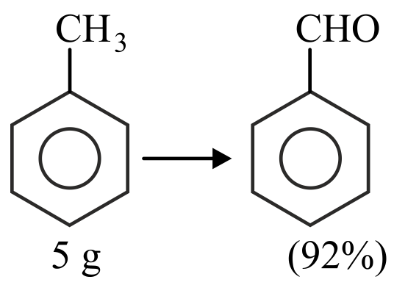
In the above reaction,5 g of toluene is converted into benzaldehyde with 92% yield. The amount of benzaldehyde produced is _____ $$\times 10^{-2}$$ g
In the given reaction,
The number of $$\pi$$ electrons present in the product 'P' is ______.
Assertion A: Enol form of acetone [$$CH_3COCH_3$$] exists in < 0.1% quantity. However, the enol form of acetyl acetone [$$CH_3COCH_2OCCH_3$$] exists in approximately 15% quantity.
Reason R: enol form of acetyl acetone is stabilized by intramolecular hydrogen bonding, which is not possible in enol form of acetone.
Choose the correct statement:
$$10^{-5}\%$$) because the keto form with its strong $$C=O$$ bond is significantly more thermodynamically stable than the enol form with a
$$C=C$$ bond. However, in $$\beta$$-diketones like acetylacetone ($$CH_3COCH_2COCH_3$$), the enol form exists in a very significant quantity (varying heavily by solvent, often 15% in aqueous solutions and up to 76% in non-polar liquid states). Therefore, the assertion is True.
Because standard acetone only has one oxygen atom, it cannot form an intramolecular hydrogen bond, nor can it achieve this extended conjugation. Therefore, the reason is True.
The primary reason why acetylacetone has such a vastly higher enol content compared to acetone is precisely because of the stabilization provided by that intramolecular hydrogen bond (and conjugation). Therefore, the Reason perfectly explains the Assertion.

In the following sequence of reactions, C$$_3$$H$$_6$$ $$\xrightarrow{H^+/H_2O}$$ A $$\xrightarrow[dil KOH]{KIO}$$ B + C. The compounds B and C respectively are:
We have the molecular formula $$\mathrm{C_3H_6}$$. In open-chain form, the only alkene possible is propene, written structurally as $$\mathrm{CH_3-CH=CH_2}$$.
The first reagent is aqueous acid, written as $$\mathrm{H^+/H_2O}$$. In the presence of dilute acid, an alkene undergoes electrophilic addition of water. The governing principle is Markovnikov’s rule: “When HX or H-OH adds to an unsymmetrical alkene, the hydrogen attaches to the doubly-bonded carbon already holding the larger number of hydrogens, and the other part (here -OH) goes to the other carbon.” Applying that rule to propene, the -OH group attaches to the middle carbon while the extra hydrogen attaches to the terminal carbon.
Writing every step symbolically,
$$$\mathrm{CH_3-CH=CH_2 \;+\; H^+ \xrightarrow{\;\;}\; CH_3-CH^+-CH_3}$$$ $$$\mathrm{CH_3-CH^+-CH_3 \;+\; H_2O \longrightarrow CH_3-CH(OH)-CH_3 + H^+}$$$
Thus the product after the first step is $$\mathrm{CH_3-CH(OH)-CH_3}$$, i.e. propan-2-ol (commonly called isopropyl alcohol). Let us designate it as compound $$A$$.
Now $$A$$ is treated with “$$\mathrm{KIO/dil\;KOH}$$”. In the laboratory the iodoform reaction is normally carried out with iodine and alkali ($$\mathrm{I_2/KOH}$$); $$\mathrm{I_2}$$ in base actually produces the active species hypoiodite $$\mathrm{IO^-}$$, so writing the reagent as $$\mathrm{KIO}$$ in dilute $$\mathrm{KOH}$$ conveys the same chemistry. The iodoform reaction occurs whenever the substrate contains either
(i) a methyl ketone group $$\mathrm{ -CO-CH_3}$$, or
(ii) an alcohol that can be oxidised in situ to such a ketone, specifically $$\mathrm{R-CH(OH)-CH_3}$$.
Propan-2-ol fits criterion (ii) because it has the fragment $$\mathrm{ -CH(OH)-CH_3}$$. The reaction sequence is:
1. Oxidation of the secondary alcohol to the corresponding methyl ketone (propan-2-one, acetone).
$$$\mathrm{CH_3-CH(OH)-CH_3 + [O] \longrightarrow CH_3-CO-CH_3 + H_2O}$$$
2. Successive iodination of the $$\mathrm{ -CO-CH_3}$$ group and base-promoted cleavage, giving yellow iodoform and a carboxylate anion whose carbon skeleton is the original ketone minus the iodine-bearing methyl group.
For acetone the detailed stoichiometry can be summarised as
$$$\mathrm{CH_3-CO-CH_3 + 3\,I_2 + 4\,KOH \longrightarrow CHI_3 \downarrow + CH_3COOK + 3\,KI + 3\,H_2O}$$$
Therefore the two organic products obtained from the iodoform reaction of propan-2-ol are
$$$\mathrm{CHI_3} \quad\text{(iodoform, a yellow solid)}$$$
and
$$$\mathrm{CH_3COOK} \quad\text{(potassium acetate)}$$$
Denoting them in the order given in the problem statement, we can identify
$$B = \mathrm{CHI_3}, \qquad C = \mathrm{CH_3COOK}$$
Among the alternatives, only Option D lists the pair “$$\mathrm{CHI_3}$$, $$\mathrm{CH_3COOK}$$”.
Hence, the correct answer is Option D.
Mesityl oxide is a common name of:
Mesityl oxide is a well-known organic compound formed by the aldol condensation of acetone. When two molecules of acetone undergo aldol condensation, they first form diacetone alcohol, which then undergoes dehydration to give mesityl oxide.
The product has the molecular formula $$C_6H_{10}O$$ and its structure is $$CH_3\text{-}CO\text{-}CH=C(CH_3)_2$$. To name it by IUPAC rules, we identify the longest carbon chain containing both the carbonyl group and the double bond. The longest such chain has 5 carbons (pent-), so the parent name is pentanone.
Numbering from the end nearer to the carbonyl group: carbon 1 is $$CH_3$$, carbon 2 carries the $$C=O$$ (keto group), carbon 3 is $$CH=$$, carbon 4 is $$=C(CH_3)$$, and carbon 5 is the terminal $$CH_3$$ attached to carbon 4. The double bond is between carbons 3 and 4, and there is a methyl branch at carbon 4.
Putting it together, the IUPAC name is 4-methylpent-3-en-2-one. This matches option (D).
Consider the above reaction, the major product 'P' is:
2, 4-DNP test can be used to identify:
The 2,4-DNP (2,4-dinitrophenylhydrazine) test is a standard qualitative test used to detect the presence of the carbonyl group ($$C=O$$) in aldehydes and ketones.
When 2,4-dinitrophenylhydrazine reacts with an aldehyde or ketone, it forms a yellow, orange, or red precipitate of 2,4-dinitrophenylhydrazone. This confirms the presence of the carbonyl functional group.
Among the given options — aldehyde, amine, halogens, and ether — the 2,4-DNP test is specifically used to identify aldehydes (and ketones). Amines, halogens, and ethers do not contain a carbonyl group and will not give a positive 2,4-DNP test.
Therefore, the correct answer is aldehyde.

Given below are two statements:
Statement I : Ethyl pent-4-yn-oate on reaction with CH$$_3$$MgBr gives a 3°-alcohol.
Statement II : In this reaction one mole of ethyl pent-4-yn-oate utilizes two moles of CH$$_3$$MgBr.
In the light of the above statements, choose the most appropriate answer from the options given below:
First we write the full structure of the given ester. Pent-4-ynoic acid contains five carbon atoms in the main chain and the triple bond starts at carbon-4. Converting the -COOH group into an ethyl ester gives
$$\mathrm{CH_3CH_2C\!\equiv\!C-CO_2CH_2CH_3}$$
Now we examine the nature of each functional group. The molecule has
(i) an ester carbonyl $$-CO_2-$$, and
(ii) a terminal alkyne hydrogen $$\mathrm{\;-C\!\equiv\!C-H}$$ at carbon-5. A terminal alkyne hydrogen is appreciably acidic (pK$$_a\approx25$$) and is removed instantaneously by a Grignard reagent, because every Grignard reagent behaves as a very strong base as well as a nucleophile.
We next recall the two standard facts we shall need.
• Acid-base reaction with a terminal alkyne $$\mathrm{R-C\!\equiv\!C-H + R'MgX \;\longrightarrow\; R-C\!\equiv\!C^{\;-}MgX^{+} + R'H}$$
• Nucleophilic addition of a Grignard reagent to an ester For every mole of an ester, two moles of a Grignard reagent are required to reach the tertiary-alcohol stage:
$$\mathrm{RCOOR' + RMgX \;\xrightarrow{\;(1)\;}\; R-CO-R \;(\text{ketone})}$$
and then
$$\mathrm{R-CO-R + RMgX \;\xrightarrow{\;(2)\;}\; R-C(OMgX)R_2 \;\xrightarrow{\;H_2O\;/\;H^+\;} R-C(OH)R_2}$$
Keeping these two rules in mind, we follow the reaction of ethyl pent-4-yn-oate with methylmagnesium bromide step by step.
Step 1 - deprotonation of the terminal alkyne
$$\mathrm{CH_3CH_2C\!\equiv\!C-H + CH_3MgBr \;\longrightarrow\; CH_3CH_2C\!\equiv\!C^{\;-}MgBr^{+} + CH_4\uparrow}$$
This consumes one mole of $$\mathrm{CH_3MgBr}$$ and produces methane gas. The alkyne is now converted into its magnesium acetylide; the ester function is still intact.
Step 2 - first nucleophilic attack on the ester carbonyl
$$\mathrm{CH_3CH_2C\!\equiv\!C^{\;-}MgBr^{+}\;-CO_2CH_2CH_3 + CH_3MgBr \;\longrightarrow\; CH_3CH_2C\!\equiv\!C-COCH_3 + CH_3CH_2OMgBr}$$
After the first nucleophilic addition and expulsion of the ethoxide ion, a ketone $$\mathrm{RC(=O)CH_3}$$ is formed. A second mole of the Grignard reagent has therefore been used.
Step 3 - second nucleophilic attack on the ketone
$$\mathrm{CH_3CH_2C\!\equiv\!C-COCH_3 + CH_3MgBr \;\longrightarrow\; CH_3CH_2C\!\equiv\!C-C(OMgBr)(CH_3)_2}$$
Hydrolysing the adduct finally gives the alcohol:
$$\mathrm{CH_3CH_2C\!\equiv\!C-C(OH)(CH_3)_2}$$
The carbon bearing the -OH group now carries three alkyl substituents (two $$\mathrm{CH_3}$$ groups and one $$\mathrm{CH_2C\!\equiv\!CCH_2CH_3}$$ group). By definition, such an alcohol is a tertiary (3°) alcohol. Hence Statement I is perfectly correct.
Let us count the number of moles of $$\mathrm{CH_3MgBr}$$ that were consumed overall:
• one mole in Step 1 (acid-base reaction), • one mole in Step 2 (first nucleophilic addition), • one mole in Step 3 (second nucleophilic addition).
Total $$= 3$$ moles of $$\mathrm{CH_3MgBr}$$ per mole of the ester. Statement II, which claims that only two moles are utilised, is therefore incorrect.
We thus conclude that Statement I is true whereas Statement II is false.
Hence, the correct answer is Option B.
In the above reaction, the reagent "A" is:
We need an oxidising agent, thus the option is C.
The structure of product C, formed by the following sequence of reactions is:
CH$$_3$$COOH + SOCl$$_2$$ $$\rightarrow$$ A $$\xrightarrow[AlCl_{3}]{Benzene}$$ B $$\xrightarrow[OH]{KCN}$$ C
Experimentally reducing a functional group cannot be done by which one of the following reagents?
To decide which reagent is incapable of reducing an organic functional group in the laboratory, we recall the basic principle of reduction in organic chemistry: reduction involves the addition of hydrogen (or the removal of oxygen) and is usually accomplished by either (i) nascent hydrogen produced in situ or (ii) catalytic hydrogenation in which molecular hydrogen is added across a multiple bond in the presence of a metal catalyst.
We now examine each option in the light of this principle.
Option A: $$\text{Zn / H}_2\text{O}$$ — Metallic zinc reacts with water (especially in the presence of acid) to generate nascent hydrogen according to the well-known reaction
$$ \text{Zn} + 2\,\text{H}_2\text{O} \;\longrightarrow\; \text{Zn(OH)}_2 + 2\,[\text{H}] $$The freshly produced $$[\text{H}]$$ (nascent hydrogen) is able to reduce several functional groups (for example, the Clemmensen reduction formally uses Zn/Hg in acid to reduce carbonyl groups). Hence Zn/H$$_2$$O can act as a reducing system.
Option B: $$\text{Pt-C / H}_2$$ — In catalytic hydrogenation, finely divided platinum supported on carbon adsorbs molecular hydrogen according to
$$ \text{H}_2 \overset{\text{Pt-C}}{\rightarrow} 2\,[\text{H}] $$These adsorbed hydrogen atoms readily add to C=C, C≡C and several other reducible functional groups. Therefore Pt-C/H$$_2$$ is a powerful laboratory reducing agent.
Option C: $$\text{Pd-C / H}_2$$ — Palladium on carbon functions in exactly the same catalytic manner as platinum. It is one of the most frequently used reagents for hydrogenation of alkenes, alkynes, nitro groups, etc. Hence Pd-C/H$$_2$$ also reduces functional groups effectively.
Option D: $$\text{Na / H}_2$$ — Here we merely have metallic sodium physically mixed with molecular hydrogen. Sodium metal does not adsorb hydrogen in a way that produces active $$[\text{H}]$$ atoms, nor does it catalyse the dissociation of H$$_2$$. Consequently, no nascent or catalytic hydrogen is available and the mixture fails to reduce ordinary organic functional groups under experimental conditions.
Thus, among the four reagents listed, the only one that cannot serve as a practical reducing system is $$\text{Na / H}_2$$.
Hence, the correct answer is Option 4.
Identify A in the given chemical reaction.
The major product (P) in the following reaction is:
The structure of the starting compound P used in the reaction given below is:
Which of the following reagent is suitable for the preparation of the product in the above reaction?
Clemmensen Reduction and Wolff-Kishner reduction reduce ketones to hydrocarbons. The required reagent is that of Wolff-Kishner reduction.

For the reaction given below:
The compound which is not formed as a product in the reaction is a:
The reaction shown yields a mixture of two products:
$$1,4-benzenedimethanol$$ and $$4-(hydroxymethyl)benzoic acid$$.
The reaction shown is a classic example of the Cannizzaro reaction. The starting material, 4-(hydroxymethyl)benzaldehyde, contains an aldehyde group attached directly to a benzene ring. Because the carbon atom adjacent to the carbonyl group is part of the aromatic ring, it does not possess any alpha-hydrogens (hydrogens attached to the alpha-carbon).
When an aldehyde lacking alpha-hydrogens is heated in the presence of a strong base like sodium hydroxide ($$NaOH$$), it undergoes a base-induced disproportionation reaction. In this redox process, two molecules of the reactant participate simultaneously. One molecule is oxidized to form a carboxylic acid salt, while the other molecule is reduced to form a primary alcohol. The existing hydroxymethyl group ($$-CH_2OH$$) at the para position is stable under these conditions and does not actively participate in the disproportionation; it may transiently form an alkoxide in the strong base, but it remains structurally unchanged.
Following the basic reaction, the acidic workup ($$H_3O^+$$) is introduced. This step protonates the intermediate carboxylate salt to form the final neutral carboxylic acid. Therefore, the reaction yields two distinct organic products from the original starting material: the reduced product, where the aldehyde is converted to an alcohol ($$1,4-benzenedimethanol$$), and the oxidized product, where the aldehyde is converted to a carboxylic acid $$4-(hydroxymethyl)benzoic acid$$ that is the final product. It is a monocarboxylic acid with a hydroxy group to it.
Thus the correct option is C.
Given below are two statements:
Statement I : The nucleophilic addition of sodium hydrogen sulphite to an aldehyde or a ketone involves proton transfer to form a stable ion.
Statement II : The nucleophilic addition of hydrogen cyanide to an aldehyde or a ketone yields amine as final product.
In the light of the above statements, choose the most appropriate answer from the options given below:
For any carbonyl compound, that is, an aldehyde $$\mathrm{R{-}CHO}$$ or a ketone $$\mathrm{R_2C{=}O}$$, the carbon of the carbonyl group carries a partial positive charge because the double-bonded oxygen is more electronegative and withdraws electron density. Hence this carbon is susceptible to attack by nucleophiles.
First we examine Statement I. In the sodium hydrogen sulphite reaction the actual nucleophile is the bisulphite ion $$\mathrm{HSO_3^-}$$. According to the general mechanism of nucleophilic addition to a carbonyl group, the very first step is:
$$$\mathrm{R_2C{=}O + HSO_3^- \;\longrightarrow\; R_2C(OH)(SO_3H)^{-}}$$$
Here the $$\mathrm{HSO_3^-}$$ ion donates its lone pair to the electrophilic carbon, the $$\pi$$ bond shifts onto oxygen and we obtain an alkoxide ion $$\mathrm{O^-}$$ attached to $$\mathrm{SO_3H}$$. Because we have generated a basic (negatively charged) oxygen and at the same time possess an acidic hydrogen on the $$\mathrm{SO_3H}$$ group, an intramolecular proton transfer immediately follows:
$$$\mathrm{R_2C(} \underset{\small{-}}{O}\mathrm{)(SO_3H) \;+\; H\,(SO_3) \;\longrightarrow\; R_2C(OH)(SO_3H)}$$$
This proton transfer neutralises the alkoxide and produces a stable bisulphite addition product, which is often isolated as a crystalline solid. Because the success of the reaction relies precisely on this proton shift that converts an unstable alkoxide into a neutral alcohol function, the description given in Statement I is accurate. Hence, Statement I is true.
Now we turn to Statement II. The classical nucleophilic addition of hydrogen cyanide to a carbonyl compound is described by the following sequence. First, in the presence of a weak base such as $$\mathrm{NaCN}$$, a small amount of $$\mathrm{HCN}$$ dissociates to give the actual nucleophile $$\mathrm{CN^-}$$:
$$\mathrm{HCN \;\rightleftharpoons\; H^+ + CN^-}$$
The cyanide ion then attacks the carbonyl carbon exactly as any nucleophile would:
$$$\mathrm{R_2C{=}O + CN^- \;\longrightarrow\; R_2C(} \underset{\small{-}}{O}\mathrm{)CN}$$$
The resulting alkoxide immediately abstracts a proton from $$\mathrm{HCN}$$ (or from any other proton donor in the medium) to give what is known as a cyanohydrin:
$$$\mathrm{R_2C(} \underset{\small{-}}{O}\mathrm{)CN + HCN \;\longrightarrow\; R_2C(OH)CN + CN^-}$$$
Thus the direct product of the reaction is $$\mathrm{R_2C(OH)CN}$$, which contains both a hydroxyl (-OH) and a nitrile (-CN) group. No amine (-NH2) function is produced in this step. An amine could appear only after a subsequent hydrogenation of the nitrile group, but that is a completely separate reaction. Therefore Statement II, which claims that the nucleophilic addition of hydrogen cyanide yields amine as the final product, is false.
Summarising, Statement I is true while Statement II is false. Among the given options, this corresponds to Option D.
Hence, the correct answer is Option D.
The product "P" in the above reaction is:
Which among the above compound/s does/do not form Silver mirror when treated with Tollen's reagent?
Tollens' reagent (ammoniacal silver nitrate, $[Ag(NH_3)_2]^+$) is a mild oxidizing agent prepared in a basic solution.
Because Tollens' reagent is basic, any compound capable of tautomerizing (shifting between a keto and enol form) will rapidly do so in the solution. We must evaluate the most stable form of each molecule.
Because it tautomerizes into a ketone rather than an aldehyde, Compound (II) is the only molecule in this lineup that will not give a positive Tollens' test.
Which of the following compounds will provide a tertiary alcohol on reaction with excess of CH$$_3$$MgBr followed by hydrolysis?
Which of the following reagent is used for the following reaction?
$$CH_3CH_2CH_3 \to CH_3CH_2CHO$$
Step 1: Identify the type of reaction.
The conversion of propane to propanal involves removal of hydrogen and introduction of one oxygen atom. This is called oxidative dehydrogenation (ODH).
Step 2: Write the balanced chemical equation for ODH of propane.
Using one‐half mole of oxygen per mole of propane yields propanal and water:
$$CH_3CH_2CH_3 + \frac{1}{2}O_2 \rightarrow CH_3CH_2CHO + H_2O$$
$$-(1)$$
Step 3: State the requirement for selective partial oxidation.
We need a catalyst that activates O-H and C-H bonds without over-oxidizing the aldehyde to an acid. Many strong oxidants or high-temperature metals give complete oxidation or cracking.
Step 4: Examine each option.
Option A: Copper at high temperature and pressure tends to crack alkanes or give CO/CO_2 rather than stop at an aldehyde.
Option B: Manganese acetate is used in radical allylic oxidations (Kharasch-Sosnovsky), not for propane.
Option D: Potassium permanganate is a very strong oxidant and would oxidize propanal further to propionic acid.
Step 5: Select the correct catalyst.
Molybdenum trioxide ($$MoO_3$$) is known to promote selective partial oxidation (ODH) of light alkanes to aldehydes with minimal over-oxidation. It activates $$O_2$$ gently and removes hydrogen without decomposing the aldehyde.
Therefore, the reagent used is Option C: Molybdenum oxide ($$MoO_3$$).
Which one of the following carbonyl compounds cannot be prepared by addition of water on an alkyne in the presence of $$HgSO_4$$ and $$H_2SO_4$$?
When an alkyne undergoes hydration in the presence of $$HgSO_4$$ and $$H_2SO_4$$, the addition of water follows Markovnikov's rule. The $$-OH$$ group preferentially adds to the more substituted (internal) carbon of the triple bond, and the resulting enol tautomerises to a carbonyl compound.
Consider acetylene ($$HC \equiv CH$$): since it is a symmetric alkyne, the hydration gives the enol $$CH_2 = CHOH$$, which tautomerises to acetaldehyde ($$CH_3CHO$$). So option (3), acetaldehyde, can be prepared by this method.
Consider 1-butyne ($$CH_3CH_2C \equiv CH$$): by Markovnikov addition, the $$-OH$$ adds to the internal carbon ($$C_2$$ of the triple bond), giving the enol $$CH_3CH_2C(OH) = CH_2$$. This tautomerises to methyl ethyl ketone ($$CH_3COCH_2CH_3$$). So option (2) can be prepared.
Cyclohexanone can be obtained by the acid-catalysed hydration of cyclohex-1-yne. The triple bond in this cyclic alkyne undergoes Markovnikov hydration to give the corresponding enol, which tautomerises to cyclohexanone. So option (4) can be prepared.
Now consider propanal ($$CH_3CH_2CHO$$): this is an aldehyde with the carbonyl at the terminal position ($$C_1$$). The only three-carbon alkyne is propyne ($$CH_3C \equiv CH$$). By Markovnikov hydration, the $$-OH$$ adds to the internal carbon ($$C_2$$), forming the enol $$CH_3C(OH) = CH_2$$, which tautomerises to acetone ($$CH_3COCH_3$$), a ketone, not propanal. In general, Markovnikov hydration of any terminal alkyne gives a methyl ketone, and only acetylene (being symmetric) can give an aldehyde. Since there is no alkyne whose Markovnikov hydration yields propanal, it cannot be prepared by this method.
The correct answer is Option (1): $$CH_3CH_2CHO$$ (propanal).
Which one of the following compounds will give orange precipitate when treated with 2,4-dinitrophenyl hydrazine?
Consider the above reaction and identify "Y"
The major product of the following reaction is:
$$CH_3CH_2CH = CH_2 \xrightarrow[ Rh \text{ catalyst}]{H_2/CO}$$
The Reaction
Hydroformylation, or the Oxo Process, is an industrial catalytic reaction that converts alkenes into aldehydes. Its most important feature is that it lengthens the carbon chain, always producing an aldehyde that contains exactly one more carbon atom than the starting alkene.
$$\text{R-CH=CH}_{2}+\text{CO}+\text{H}_{2}\xrightarrow{\text{Catalyst}}\text{R-CH}_{2}\text{-CH}_{2}\text{-CHO\ (Linear)}+\text{R-CH(CHO)-CH}_{3}\text{\ (Branched)}$$
The Requirements
To achieve this, the alkene is reacted with "syngas"—a mixture of carbon monoxide (CO) and hydrogen gas ($$H_2$$). This process requires high temperatures, high pressures, and a specialized transition metal catalyst, typically containing cobalt or rhodium, to force the reaction to occur.
The Products
The catalyst breaks the alkene's double bond, adding a hydrogen atom to one side and a formyl group ($$-CHO$$) to the other. Because the formyl group can attach to either of the two carbons from the double bond, the reaction produces a mixture of two structural isomers: a straight-chain linear aldehyde (which is highly desired in industry) and a branched aldehyde.
The major products A and B in the following set of reactions are:
Here is the explanation in a clear, pastable paragraph format:
The starting material in this reaction sequence is a cyanohydrin (specifically, acetone cyanohydrin). To form major product A, the reactant is treated with lithium aluminum hydride (LiAlH₄) followed by acidic workup. LiAlH₄ is a strong reducing agent that specifically targets the nitrile group (-CN) and reduces it to a primary amine (-CH₂NH₂). Because it does not react with tertiary alcohols, the hydroxyl group (-OH) remains completely intact, resulting in an amino alcohol for product A. To form major product B, the reactant is subjected to strongly acidic conditions using hydronium ions and sulfuric acid (H₃O⁺ / H₂SO₄). This triggers two consecutive reactions. First, the acid completely hydrolyzes the nitrile group (-CN) into a carboxylic acid group (-COOH). Immediately following this, the strong dehydrating nature of sulfuric acid causes the elimination of the tertiary hydroxyl group (-OH) along with a hydrogen from an adjacent methyl group. This dehydration forms a stable, conjugated carbon-carbon double bond, yielding an alpha, beta-unsaturated carboxylic acid as product B.
The major products formed in the following reaction sequence A and B are:
The structure of X is:
The structures of A and B formed in the following reaction are: Ph = -C$$_6$$H$$_5$$
Which one of the following reactions will not form acetaldehyde?
We need to identify which reaction does not form acetaldehyde ($$CH_3CHO$$).
Option 1 uses $$CrO_3$$ in $$H_2SO_4$$, which is known as Jones reagent. This is a strong oxidising agent that oxidises primary alcohols ($$CH_3CH_2OH$$) all the way to carboxylic acids ($$CH_3COOH$$), not stopping at the aldehyde stage. Therefore, this reaction does not produce acetaldehyde.
Option 2 is the Wacker process, where ethylene is oxidised by $$O_2$$ in the presence of $$PdCl_2/CuCl_2$$ catalyst in water. This reaction is a standard industrial method for producing acetaldehyde.
Option 3 involves reduction of $$CH_3CN$$ (methyl cyanide) with DIBAL-H (diisobutylaluminium hydride) followed by hydrolysis. DIBAL-H reduces nitriles to aldehydes at low temperature, yielding $$CH_3CHO$$.
Option 4 is the catalytic dehydrogenation of ethanol using copper at 573 K, which is a standard laboratory method for preparing acetaldehyde from primary alcohols.
Therefore, the reaction that will not form acetaldehyde is Option 1.
A reaction of benzonitrile with one equivalent CH$$_3$$MgBr followed by hydrolysis produces a yellow liquid "P". The compound "P" will give positive _________ test.
We have benzonitrile whose molecular formula is $$\mathrm{C_6H_5CN}$$. When a nitrile reacts with one equivalent of a Grignard reagent ($$\mathrm{R-MgX}$$) in dry ether, the general rule is that the Grignard reagent adds to the carbon of the $$\mathrm{C\equiv N}$$ group and converts the nitrile into an imine magnesium halide. Later, on acidic hydrolysis, this imine is transformed into a ketone. Symbolically the rule can be stated as
$$\mathrm{R'-C\equiv N \;+\; R-MgX \;\longrightarrow\; R'-C(=N^-MgX)-R \xrightarrow[{\,\text{heat}\,}]{\text{H}_3\text{O}^+} R'-CO-R}$$
Now we apply this rule to the given reagents. In benzonitrile, $$\mathrm{R'} = \mathrm{C_6H_5}$$ (phenyl) and the Grignard reagent supplied is $$\mathrm{CH_3MgBr}$$ with $$\mathrm{R = CH_3}$$. Substituting these groups in the rule gives
$$\mathrm{C_6H_5-C\equiv N \;+\; CH_3MgBr \;\longrightarrow\; C_6H_5-C(=N^-MgBr)-CH_3 \xrightarrow[{\,\text{hydrolysis}\,}]{\text{H}_3\text{O}^+} C_6H_5-CO-CH_3}$$
Therefore the yellow liquid “P” obtained after hydrolysis is $$\mathrm{C_6H_5COCH_3}$$, whose common name is acetophenone and whose structural unit is
$$\mathrm{Ph-CO-CH_3}$$
We next decide which qualitative test is answered by this molecule. Acetophenone contains the $$\mathrm{-CO-CH_3}$$ functional group, i.e. the carbonyl carbon is directly attached to a methyl group. Organic chemistry tells us that
• The Iodoform test is positive for all compounds containing the $$\mathrm{-CO-CH_3}$$ (methyl ketone) group or $$\mathrm{CH_3-CH(OH)-}$$ group.
• Schiff’s, Ninhydrin’s and Tollen’s tests are meant for aldehydes or amino acids and are not given by simple methyl ketones.
Because acetophenone is a methyl ketone, it will liberate a yellow precipitate of $$\mathrm{CHI_3}$$ (iodoform) in the iodoform test, while it will fail the other three tests listed. Hence the liquid “P” gives a positive iodoform test.
Hence, the correct answer is Option A.
Match List - I with List - II.

Choose the correct answer from the options given below:
Match List - I with List - II:
List - I (Chemical Reaction) List - II (Reagent used)
a. CH$$_3$$COOCH$$_2$$CH$$_3$$ $$\rightarrow$$ CH$$_3$$CH$$_2$$OH i. CH$$_3$$MgBr/H$$_3$$O$$^+$$ (one equivalent)
b. CH$$_3$$COOCH$$_3$$ $$\rightarrow$$ CH$$_3$$CHO ii. H$$_2$$SO$$_4$$/H$$_2$$O
c. CH$$_3$$C$$\equiv$$N $$\rightarrow$$ CH$$_3$$CHO iii. DIBAL-H/H$$_2$$O
d. iv. SnCl$$_2$$, HCl/H$$_2$$O
Choose the most appropriate match:
We look at transformation (a). The starting compound is $$\mathrm{CH_3COOCH_2CH_3}$$, an ester known as ethyl acetate. The desired product is $$\mathrm{CH_3CH_2OH}$$, ethanol. We recall the general hydrolysis reaction of an ester in acidic medium, which is stated as
$$$\mathrm{RCOOR' \;+\; H_2O \;\xrightarrow[\;]{H^+}\; RCOOH \;+\; R'OH}$$$
Here $$\mathrm{R = CH_3}$$ and $$\mathrm{R' = CH_2CH_3}$$, so hydrolysis will furnish acetic acid and ethanol. The reagent that supplies both water and acid is the mixture $$\mathrm{H_2SO_4/H_2O}$$, listed as (ii). Hence, for part (a) we must choose (ii).
Now we examine transformation (b). The substrate is $$\mathrm{CH_3COOCH_3}$$ (methyl acetate) and the target is $$\mathrm{CH_3CHO}$$ (acetaldehyde). Converting an ester directly to an aldehyde requires partial reduction that stops at the aldehyde stage. The reagent famous for this selective one-step reduction is DIBAL-H followed by aqueous work-up. The overall reaction may be represented as
$$$\mathrm{RCOOR' \;\xrightarrow[\;]{\text{DIBAL-H,}\; -78^{\circ}\text{C}} \; RCHO \;\xrightarrow{\;H_2O\;} RCHO}$$$
DIBAL-H/H$$_2$$O is option (iii), so (b) corresponds to (iii).
Next, consider transformation (c): $$\mathrm{CH_3C\equiv N \;\rightarrow\; CH_3CHO}$$. Converting a nitrile to an aldehyde is achieved by the Stephen reduction. The textbook Stephen reduction uses stannous chloride in the presence of hydrochloric acid, followed by hydrolysis:
$$$\mathrm{RCN \;+\; 2\,SnCl_2 \;+\; 2\,HCl \;\xrightarrow[\;]{\;} RCH=NH\cdot HCl \;\xrightarrow{\;H_2O\;} RCHO}$$$
This reagent set is given as (iv) $$\mathrm{SnCl_2,\,HCl/H_2O}$$. Therefore, (c) matches (iv).
Finally, we look at transformation (d): $$\mathrm{CH_3C\equiv N \;\rightarrow\; CH_3COCH_3}$$, i.e. conversion of acetonitrile to acetone. A single equivalent of a Grignard reagent adds an alkyl group to the electrophilic carbon of the nitrile, giving an imine magnesium salt; hydrolysis of the imine then produces a ketone. The general formula is
$$$\mathrm{RCN \;+\; R''MgBr \;\xrightarrow[\;]{\;} RC(R'')=NMgBr \;\xrightarrow{\;H_3O^+\;} RC(O)R''}$$$
With $$\mathrm{R = CH_3}$$ and $$\mathrm{R'' = CH_3}$$, we indeed obtain $$\mathrm{CH_3COCH_3}$$. The required reagent is $$\mathrm{CH_3MgBr/H_3O^+}$$, listed as (i). Thus, (d) corresponds to (i).
Collecting all the matches we have:
$$$\text{(a)} \rightarrow (ii), \qquad \text{(b)} \rightarrow (iii), \qquad \text{(c)} \rightarrow (iv), \qquad \text{(d)} \rightarrow (i)$$$
This sequence appears exactly in Option A.
Hence, the correct answer is Option A.
The major product of the following chemical reaction is:
$$CH_3CH_2CN + 2H_2O + H^+ \xrightarrow{\Delta} CH_3CH_2COOH + NH_4^+$$
$$CH_3CH_2COOH + SOCl_2 \rightarrow CH_3CH_2COCl + SO_2 + HCl$$
$$CH_3CH_2COCl + H_2 \xrightarrow{Pd/BaSO_4} CH_3CH_2CHO + HCl$$
What is 'X' in the given reaction?
The total number of C-C sigma bond/s in mesityl oxide ($$C_6H_{10}O$$) is ________ (Round off to the Nearest Integer).
Mesityl oxide is a well-known organic compound with the molecular formula $$\text{C}_6\text{H}_{10}\text{O}$$ and the IUPAC name 4-methylpent-3-en-2-one. Its structure is $$(\text{CH}_3)_2\text{C}=\text{CH}-\text{CO}-\text{CH}_3$$.
Let us write out the carbon skeleton and count all C-C sigma bonds. The structure has six carbon atoms arranged as: $$\text{CH}_3 - \text{C}(\text{CH}_3) = \text{CH} - \text{C}(=\text{O}) - \text{CH}_3$$.
The C-C sigma bonds are: (1) the first $$\text{CH}_3$$ to the central carbon $$\text{C}$$, (2) the branching $$\text{CH}_3$$ to the same central carbon, (3) the $$\text{C}=\text{C}$$ double bond contains one sigma and one pi bond, so there is one C-C sigma bond here, (4) between $$=\text{CH}$$ and the carbonyl carbon $$\text{C}(=\text{O})$$, and (5) between the carbonyl carbon and the terminal $$\text{CH}_3$$.
This gives a total of 5 C-C sigma bonds.
The answer is 5.
To synthesise 1 mole of 2-methylpropan-2-ol from Ethylethanoate equivalents of CH$$_3$$MgBr reagent will be required. (Integer value)
The target molecule is 2-methylpropan-2-ol, which is (CH₃)₃COH — a tertiary alcohol.
The starting material is ethyl ethanoate (ethyl acetate): CH₃COOC₂H₅.
The Grignard reagent is CH₃MgBr (methylmagnesium bromide).
In the first step, CH₃MgBr attacks the carbonyl carbon of ethyl ethanoate. One equivalent of Grignard adds to give a tetrahedral intermediate (a magnesium alkoxide): CH₃-C(CH₃)(OMgBr)-OC₂H₅. This intermediate is a hemiketal-like species that collapses: the ethoxide (C₂H₅O⁻) is expelled as a leaving group, generating a ketone intermediate — in this case acetone (propan-2-one): CH₃COCH₃.
In the second step, a second equivalent of CH₃MgBr adds to the acetone formed. The Grignard adds to the carbonyl of acetone to give the magnesium alkoxide: (CH₃)₃COMgBr. Aqueous workup gives the tertiary alcohol: (CH₃)₃COH = 2-methylpropan-2-ol.
Thus, 2 equivalents of CH₃MgBr are required in total: 1 equivalent to react with ethyl ethanoate to produce acetone, and 1 equivalent to add to the acetone to give 2-methylpropan-2-ol.
Therefore, the answer is $$\boxed{2}$$ equivalents.
In Tollen's test for aldehyde, the overall number of electron(s) transferred to the Tollen's reagent formula [Ag(NH$$_3$$)$$_2$$]$$^+$$ per aldehyde group to form silver mirror is ___. (Round off to the Nearest integer)
In the Tollens' test, the silver ion in the Tollens' reagent $$[\text{Ag}(\text{NH}_3)_2]^+$$ is reduced from $$\text{Ag}^+$$ to $$\text{Ag}^0$$ (metallic silver that forms the silver mirror). Each silver ion gains one electron: $$\text{Ag}^+ + e^- \to \text{Ag}$$.
The overall balanced reaction is: $$\text{RCHO} + 2[\text{Ag}(\text{NH}_3)_2]^+ + 2\text{OH}^- \to \text{RCOO}^- + 2\text{Ag} + 4\text{NH}_3 + \text{H}_2\text{O}$$. The aldehyde carbon goes from oxidation state +1 (in $$\text{RCHO}$$) to +3 (in $$\text{RCOO}^-$$), losing 2 electrons overall. These 2 electrons are transferred to two $$[\text{Ag}(\text{NH}_3)_2]^+$$ ions (one electron each), producing 2 atoms of silver.
The total number of electrons transferred to the Tollens' reagent per aldehyde group is $$2$$.
The number of nitrogen atoms in a semicarbazone molecule of acetone is ___.
Semicarbazone is formed when a ketone (or aldehyde) reacts with semicarbazide (H₂N-NH-CO-NH₂) in a condensation reaction, releasing water.
Acetone is (CH₃)₂CO. The reaction of acetone with semicarbazide is:
$$(CH_3)_2CO + H_2N-NH-CO-NH_2 \rightarrow (CH_3)_2C=N-NH-CO-NH_2 + H_2O$$
The semicarbazone of acetone is: $$(CH_3)_2C=N-NH-CO-NH_2$$
Now count the nitrogen atoms in this molecule: the first N is in the C=N group (imine/azomethine nitrogen), the second N is in the -NH- group, and the third N is in the terminal -NH₂ group of the carbamoyl part.
Total nitrogen atoms = 3.
Therefore, the number of nitrogen atoms in the semicarbazone of acetone is $$\boxed{3}$$.
The increasing order of the acidity of the $$\alpha$$-hydrogen of the following compounds is:
Consider the following reactions:
'A' is:
The increasing order of the following compounds towards HCN addition is:
The increasing order of the reactivity of the following compounds in nucleophile addition reaction is:
Propanal, Benzaldehyde, Propanone, Butanone
The compound A in the following reactions is:
$$A \xrightarrow[(ii)Conc. H_{2}SO_{4}/ \Delta]{(i)CH_{3}MgBr/H_{2}O} B \xrightarrow[(ii) Zn/H_{2}O]{(i) O_{3}} C + D$$
The correct match between Item-I (starting material) and Item-II (reagent) for the preparation of benzaldehyde is:
Item-I Item-II
(I) Benzene (P) HCl and $$\text{SnCl}_2$$, $$\text{H}_3\text{O}^+$$
(II) Benzonitrile (Q) $$\text{H}_2$$, $$\text{Pd-BaSO}_4$$, S and quinoline
(III) Benzoyl Chloride (R) Co, HCl and $$\text{AlCl}_3$$
We begin by recalling that to convert a given aromatic starting material into an aldehyde group $$\left(-CHO\right)$$, different classical name reactions are employed. The reagent sets themselves often reveal which reaction is intended. Hence, for every combination we shall first identify the reaction indicated by the reagent and then verify that the starting material is suitable for that reaction.
Let us look at Item I where the starting material is benzene $$\left(\text C_6\text H_6\right)$$. To introduce a formyl group directly on the benzene ring, the famous Gattermann-Koch formylation is used. The reagent for this reaction is stated, before any calculation, as
$$\text{CO} + \text{HCl} + \text{AlCl} _3\;($$ and sometimes CuCl $$).$$
This exactly matches reagent $$R : \text{CO},\;\text{HCl}\text{ and }\text{AlCl}_3.$$
Therefore, Item I must be paired with $$R.$$ After the formylation, the product obtained is benzaldehyde $$\left(\text C_6\text H_5\text{CHO}\right).$$
Next, consider Item II where the starting material is benzonitrile $$\left(\text C_6\text H_5\text{CN}\right).$$ Converting a nitrile into an aldehyde is carried out by the Stephen reduction. Before doing any algebra, the standard reagent for Stephen reduction is stated as
$$\text{SnCl} _2 + 2\, \text{HCl} \quad$$ followed by $$\quad \text{H} _3 \text{O} ^+.$$
This reagent set appears verbatim as $$P : \text{HCl and }\text{SnCl}_2,\;\text{H}_3\text O^+.$$
So, Item II must be paired with $$P.$$ The nitrile is thus reduced to the imidoyl chloride intermediate and on hydrolysis gives benzaldehyde.
Finally, Item III has benzoyl chloride $$\left(\text C_6\text H_5\text{COCl}\right)$$ as the starting material. Converting an acyl chloride to an aldehyde is the well-known Rosenmund reduction. The textbook reagent for Rosenmund reduction is stated as
$$\text H_2,\;\text{Pd-BaSO}_4$$ poisoned with sulfur or quinoline.
That is precisely reagent $$Q : \text H_2,\; \text{Pd-BaSO} _4,\; \text S\$$ and quinoline $$.$$
Hence, Item III must be paired with $$Q.$$ The catalytic hydrogenation stops at the aldehyde stage, giving benzaldehyde.
Summarising the matches:
$$\begin{aligned} \text{(I) Benzene} &\longrightarrow R \;(\text{Gattermann-Koch})\\ \text{(II) Benzonitrile} &\longrightarrow P \;(\text{Stephen reduction})\\ \text{(III) Benzoyl chloride} &\longrightarrow Q \;(\text{Rosenmund reduction}) \end{aligned}$$
The correspondence obtained is exactly
(I)-(R), (II)-(P) and (III)-(Q).
Looking at the options given, this set is listed as Option C.
Hence, the correct answer is Option C.
Identify (A) in the following reaction sequence:
The major product [C] of the following reaction sequence will be:
The most suitable reagent for the given conversion is:
Two compounds A and B with same molecular formula $$(C_3H_6O)$$ undergo Grignard reaction with methylmagnesium bromide to give products C and D. Products C and D show following chemical tests:
| Test | C | D |
|---|---|---|
| Ceric ammonium nitrate Test | Positive | Positive |
| Lucas Test | Turbidity obtained after five minutes | Turbidity obtained Immediately |
| Iodoform Test | Positive | Negative |
C and D respectively are:
We begin by noting that both compounds A and B have the molecular formula $$C_3H_6O$$. Such a formula fits carbonyl compounds having three carbon atoms, namely
$$\text{propanal : }CH_3CH_2CHO\quad\text{(an aldehyde)}$$
$$\text{acetone : }CH_3COCH_3\quad\text{(a ketone)}$$
When a carbonyl compound is treated with a Grignard reagent, an alkyl group is added to the carbonyl carbon and the oxygen is converted into an alcohol after acidic work-up. Stating the general result first,
$$\text{R-C(=O)-R'} + CH_3MgBr \overset{H_3O^+}{\rightarrow} \text{R-C(OH)(CH}_3\text{)-R'}$$
So each carbonyl compound of three carbons will give an alcohol of four carbons, because one extra $$CH_3$$ group is introduced.
1. Reaction of propanal with $$CH_3MgBr$$
Starting carbonyl:
$$CH_3CH_2CHO$$
Addition of $$CH_3^-$$ from the Grignard reagent at the carbonyl carbon followed by protonation gives
$$CH_3CH_2C(OH)(CH_3)H \;=\;CH_3CH_2CH(OH)CH_3$$
This product is butan-2-ol, a secondary alcohol. Let us call it product C.
2. Reaction of acetone with $$CH_3MgBr$$
Starting carbonyl:
$$CH_3COCH_3$$
Addition of $$CH_3^-$$ and protonation gives
$$CH_3C(OH)(CH_3)CH_3 \;=\;(CH_3)_3C\,OH$$
This product is 2-methyl-2-propanol (tert-butyl alcohol), a tertiary alcohol. Let us call it product D.
Now we match C and D with the chemical tests given.
(i) Ceric ammonium nitrate test - any alcohol answers it, so both C and D should be positive, exactly as observed.
(ii) Lucas test - the rate of turbidity distinguishes the class of alcohol.
• Secondary alcohols turn turbid in about five minutes.
• Tertiary alcohols turn turbid immediately.
Product C is a secondary alcohol (butan-2-ol) → turbidity after five minutes.
Product D is a tertiary alcohol (tert-butyl alcohol) → instantaneous turbidity.
(iii) Iodoform test - positive for ethanol or any secondary alcohol that contains the fragment $$CH_3-CH(OH)-$$.
• Butan-2-ol possesses the $$CH_3-CH(OH)-$$ group, so C gives a positive iodoform test.
• tert-Butyl alcohol lacks that fragment, so D gives a negative iodoform test.
The behaviour predicted for butan-2-ol and tert-butyl alcohol coincides perfectly with the observations. Therefore
$$C = CH_3CH_2CH(OH)CH_3\quad(\text{butan-2-ol})$$
$$D = (CH_3)_3C\,OH\quad(\text{tert-butyl alcohol})$$
Looking at the options, these structures are listed together only in Option A:
$$C = H_3C-CH_2-CH(OH)-CH_3;\; D = H_3C-C(CH_3)_2-OH$$
Hence, the correct answer is Option A.
Which of the following compounds will show the maximum 'enol' content?
The phenomenon we are examining is keto-enol tautomerism, which is the equilibrium
$$\text{keto form}\; \rightleftharpoons \;\text{enol form}$$
The percentage of the enol form present at equilibrium depends mainly on two factors.
1. Acidity of the $$\alpha$$-hydrogen: The more acidic this hydrogen is, the more easily the enolate ion is formed, and the greater is the conversion to the enol after protonation.
2. Stabilization of the enol formed: If the enol can be stabilized by conjugation and / or by intramolecular hydrogen bonding (chelation), its concentration rises.
We now analyse each option one by one, keeping both points in mind.
Option D: $$\text{CH}_3\text{COCH}_3$$ (acetone)
This molecule has only one carbonyl group. The $$\alpha$$-hydrogens (those on the carbon between the carbonyl carbon and the methyl group) have a pKa of about $$19$$. Such hydrogens are not very acidic, so very little enolate—and therefore very little enol—is produced. Moreover, any enol that does form has no special stabilization beyond ordinary C=C-O conjugation. Hence the enol content is extremely small, usually < 0.1 %.
Option A: $$\text{CH}_3\text{COCH}_2\text{CONH}_2$$
This is a $$1,3$$-dicarbonyl system in which the second carbonyl is an amide. The central $$\alpha$$-hydrogen lies between a ketone carbonyl and an amide carbonyl. Because two electron-withdrawing groups flank it, its pKa drops to roughly $$13$$, so deprotonation is easier than in acetone.
However, when the enol form is drawn
$$\text{CH}_3\text{CO-CH}=\text{CONH}_2 \quad\text{with}\quad \text{OH on the left carbonyl}$$
the amide carbonyl is a poor hydrogen-bond acceptor; its oxygen is less basic because it is involved in resonance with the nitrogen (-C=O↔-C-O--N+). As a result, the expected six-membered intramolecular O-H···O hydrogen bond is not very strong. Conjugation is still present, but the reduced hydrogen-bond energy lowers stabilization. Hence the enol content is higher than acetone’s but still moderate.
Option C: $$\text{CH}_3\text{COCH}_2\text{COOC}_2\text{H}_5$$ (a $$\beta$$-keto ester)
Here the central hydrogen is between a ketone carbonyl and an ester carbonyl. Its pKa is about $$11$$, making it even more acidic than in Option A, so enolate formation is easier.
The enol obtained can be represented as
$$\text{CH}_3\text{C(OH)=CH-COOC}_2\text{H}_5$$
and this enol can indeed form a six-membered ring via intramolecular hydrogen bonding between the newly formed -OH and the ester carbonyl oxygen. Conjugation extends over the C=C-C=O system. Nevertheless, an ester carbonyl is less basic than a ketone carbonyl because the -OR group donates electron density by resonance: $$-C(=O)OR \leftrightarrow -C(-O^{-})=O-R^{+}$$. Consequently the hydrogen bond is weaker than it is with a ketone carbonyl, so the net stabilization—though appreciable—is not maximal.
Option B: $$\text{CH}_3\text{COCH}_2\text{COCH}_3$$ (acetylacetone)
This is a true $$\beta$$-diketone. Both flanking groups are ketone carbonyls, each strongly electron withdrawing. Hence the pKa of the central hydrogen is around $$9$$, the smallest among all the given molecules, so the enolate forms most readily.
The corresponding enol is
$$\text{CH}_3\text{C(OH)=CH-COCH}_3$$
In this structure we have two powerful stabilizing effects simultaneously:
(i) Conjugation: The C=C is directly conjugated with a carbonyl group, giving the usual enol resonance
$$\text{C(OH)=C-C=O} \;\;\rightleftharpoons\;\; \mathrm{C(O}^{-}\mathrm{)-C}^+\mathrm{-C=O}$$
(ii) Intramolecular hydrogen bonding (chelation): The enolic -OH can donate a hydrogen to the oxygen of the second ketone carbonyl, creating a six-membered chelate ring. A ketone carbonyl oxygen is more basic than an ester or amide oxygen, so this hydrogen bond is very strong. The extra stabilization may be depicted as
$$\text{C(OH)…O=C}$$
The combined resonance and hydrogen-bond energies make the enol of a $$\beta$$-diketone so stable that, in solvents like benzene, the equilibrium mixture is as high as $$70$$-$$80\,\%$$ enol.
We now compare the options quantitatively in the order of the two criteria discussed:
$$\text{Enol content} \propto \dfrac{\text{ease of enolate formation}}{\text{pK}_a} \times \text{stabilization of the enol}$$
Option B: lowest pKa (≈9) & strongest chelation ⇒ highest enol content.
Option C: slightly higher pKa (≈11) & somewhat weaker chelation ⇒ less than B.
Option A: pKa (≈13) & poor chelation ⇒ still lower.
Option D: pKa (≈19) & no special stabilization ⇒ the least.
Putting all observations together, the $$\beta$$-diketone $$\text{CH}_3\text{COCH}_2\text{COCH}_3$$ in Option B possesses the maximum enol content.
Hence, the correct answer is Option B.
The compounds A and B in the following reaction are, respectively:
p-Hydroxybenzophenone upon reaction with bromine in carbon tetrachloride gives:
Since, the para position is blocked the Br atom will come and attach at ortho position due to +M effect of -OH because this is EAS Reaction.
An organic compound neither reacts with neutral ferric chloride solution nor with Fehling solution. It however, reacts with Grignard reagent and gives positive iodoform test. The compound is:

cannot be prepared by:
In the following reaction:
carbonyl compound + MeOH $$\overset{\mathrm{HCl}}{\rightleftharpoons}$$ acetal
Rate of the reaction is the highest for:
We are dealing with the acid-catalysed conversion of a carbonyl compound to an acetal in methanol. The simplified mechanism proceeds through these key elementary steps:
$$\text{(1) Protonation of the carbonyl: }R_{2}C=O + H^+ \longrightarrow R_{2}C=OH^+$$
$$\text{(2) Nucleophilic attack by methanol: }R_{2}C=OH^+ + MeOH \longrightarrow R_{2}C(OMe)OH + H^+$$
The overall rate, to a very good approximation in the initial stages, is proportional to the concentrations of the species actually colliding in the slow step. After the fast proton-transfer of step (1), the slow or rate-determining step is generally step (2). Therefore we can write
$$\text{Rate} \propto [\text{protonated carbonyl}]\,[\text{MeOH}].$$
Now we compare the options on the basis of two independent factors that control this rate expression:
Factor 1: Nature of the carbonyl electrophile.
An aldehyde is more electrophilic than a ketone because:
(i) it has only one electron-donating alkyl group instead of two, so the carbonyl carbon bears a larger partial positive charge, and
(ii) it suffers less steric hindrance to nucleophilic attack.
Hence $$\text{Rate}_{\text{aldehyde}} > \text{Rate}_{\text{ketone}}.$$
Between the substrates listed, propanal (an aldehyde) is thus inherently faster than acetone (a ketone).
Factor 2: Concentration of the nucleophile MeOH.
The rate expression contains $$[\text{MeOH}],$$ so increasing the concentration of methanol directly raises the rate. Using methanol in excess means a higher $$[\text{MeOH}]$$ than in a stoichiometric amount.
Therefore $$\text{Rate}_{\text{excess MeOH}} > \text{Rate}_{\text{stoichiometric MeOH}}.$$
Let us rank the four options by systematically combining these two factors.
Step 1 - Substrate effect:
Propanal options (B and C) > Acetone options (A and D).
Step 2 - Methanol concentration effect (within each substrate type):
Excess MeOH (B and D) > Stoichiometric MeOH (A and C).
Combining both steps:
The single option that has the more reactive aldehyde and methanol in excess is Option B.
Mathematically, if we denote the proportionality constant as $$k$$ and use subscripts to distinguish situations, we can write
$$\text{Rate}_{\text{B}} = k[\text{propanal}\!-\!\text{H}^+][\text{MeOH}]_{\text{excess}},$$
$$\text{Rate}_{\text{C}} = k[\text{propanal}\!-\!\text{H}^+][\text{MeOH}]_{\text{stoich}},$$
and clearly $$[\text{MeOH}]_{\text{excess}} > [\text{MeOH}]_{\text{stoich}},$$ so $$\text{Rate}_{\text{B}} > \text{Rate}_{\text{C}}.$$
Any rate involving acetone will already be slower due to the less electrophilic carbonyl, cementing the conclusion that
$$\text{Rate}_{\text{B}} > \text{Rate}_{\text{D}} \gt \text{Rate}_{\text{C}} \gt \text{Rate}_{\text{A}}.$$
Hence, the correct answer is Option B.
The major product obtained in the following conversion is:
The major product obtained in the following reaction is:
The major product of the following reaction is:
We are given the substrate cyclopentanone, which is a five-membered cyclic ketone having the carbonyl group $$\gt \! C = O$$ at one of the ring carbons. The reagent set is sodium borohydride in ethanol, written as $$NaBH_4/EtOH.$$
First, we recall the general reduction formula for a ketone by sodium borohydride. The well-known relationship is
$$R_2C=O \;+\; NaBH_4 \;\overset{\text{protic solvent}}{\rightarrow} \; R_2C(OH)H.$$
Stated in words, NaBH4 delivers a hydride ion $$H^-$$ to the electrophilic carbonyl carbon, converting the $$C=O$$ into an alkoxide $$C-O^-. $$ The protic solvent (here ethanol) then protonates that alkoxide to give the corresponding alcohol.
Applying this step by step to cyclopentanone, we have
1. Hydride addition:
$$ \underset{\text{cyclopentanone}}{C_5H_8O} \;+\; BH_4^{-} \;\longrightarrow\; \underset{\text{alkoxide}}{C_5H_9O^{-}} \;+\; BH_3$$
2. Protonation by ethanol (the solvent is an available proton donor):
$$ C_5H_9O^- \;+\; EtOH \;\longrightarrow\; C_5H_{10O \;+\; EtO^- }$$
Combining the two stages, the net result is conversion of the ketone functional group into a single hydroxyl group without adding any other substituent. Therefore the ring now bears an $$-OH$$ at the same carbon that formerly possessed the carbonyl.
So we obtain cyclopentanol, a secondary alcohol in a five-membered ring, and nothing else such as an $$-OEt$$ group or a double bond is introduced. Among the listed choices, the structure that matches is simply “Cyclopentanol.”
Hence, the correct answer is Option C.
In the following reactions, products A and B are:

The aldehydes which will not form Grignard product with one equivalent of Grignard reagents are:
The reaction in question is the addition of a single equivalent of a Grignard reagent, written in the general form $$\mathrm{R{-}MgX},$$ to the carbonyl group of an aldehyde. A necessary condition for this nucleophilic addition is that the Grignard reagent should reach the carbonyl carbon without being destroyed en-route. The reagent is both a very strong base and a very strong nucleophile; therefore any group present in the substrate that is (i) proton-donating (acidic) or (ii) itself an electrophilic carbonyl capable of reacting faster than the aldehyde will consume the Grignard reagent before it can add to the aldehyde carbonyl.
We first recall two key facts.
1. A Grignard reagent instantly abstracts an acidic proton. Symbolically,
$$\mathrm{R{-}MgX \;+\; H{-}Z \;\longrightarrow\; R{-}H \;+\; Z^{-}MgX^{+}},$$
where $$\mathrm{H{-}Z}$$ is any group with an O-H, N-H, S-H, or similarly acidic bond.
2. A Grignard reagent will add to a carbonyl group provided it has not already been destroyed by acid-base reaction.
Now we examine each option.
(A) Benzaldehyde, $$\mathrm{C_6H_5{-}CHO}.$$
No acidic proton other than the aldehydic one, and that proton is attached to carbon, not to a hetero-atom. Hence the Grignard reagent reaches the carbonyl safely and adds:
$$\mathrm{R{-}MgX + C_6H_5{-}CHO \xrightarrow{Et_2O} C_6H_5{-}CH(OMgX)R \xrightarrow{H_2O} C_6H_5{-}CH(OH)R}$$
So benzaldehyde does give the expected Grignard product.
(B) An aldehyde that also contains a $$\mathrm{HO_2C{-}}$$ (carboxylic acid) group.
The -COOH unit possesses an acidic O-H proton. Using the acid-base equation stated above, one equivalent of the Grignard reagent is consumed immediately:
$$\mathrm{R{-}MgX + HO_2C{-}R' \longrightarrow R{-}H + ^{-}O_2C{-}R' \,MgX^{+}}$$
With the reagent destroyed, nothing is left to attack the aldehyde carbonyl. No addition product appears.
(C) An aldehyde that also contains a $$\mathrm{H_3CO{-}}$$ (methoxy) group.
The methoxy group has no acidic proton; it is an ether. Therefore the Grignard reagent is not quenched and can still add to the aldehyde carbonyl exactly as in (A). Product formation is unimpeded.
(D) An aldehyde that also contains a $$\mathrm{HOCH_2{-}}$$ (alcohol, -CH2OH) group.
The alcohol O-H is acidic. One equivalent of Grignard reagent is again lost through proton abstraction:
$$\mathrm{R{-}MgX + HOCH_2{-}R' \longrightarrow R{-}H + ^{-}OCH_2{-}R' \,MgX^{+}}$$
Once more, no nucleophile remains to attack the aldehydic carbonyl, and no Grignard addition product is obtained.
Summarising, aldehydes (B) and (D) fail to furnish Grignard addition products with one equivalent of Grignard reagent, while (A) and (C) succeed.
Hence, the correct answer is Option D.
The major product formed in the following reaction is:
The major product of the following reaction is:
NaBH$$_4$$, MeOH, 25°C
First, the NaBH4 reduces the ketone to a secondary alcohol. This creates a halohydrin intermediate (a molecule with an -OH and a -Br on adjacent carbons).
In the presence of methanol or the slightly basic conditions generated during a borohydride reduction, the alcohol group can become deprotonated to form an alkoxide. This oxygen then performs an internal nucleophilic attack on the carbon holding the bromine.
Compound A C$$_9$$H$$_{10}$$O shows positive iodoform test. Oxidation of A with KMnO$$_4$$/KOH gives acid B C$$_8$$H$$_6$$O$$_4$$. Anhydride of B is used for the preparation of phenolphthalein. Compound A is:
We are given:
Compound A has molecular formula $$C_9H_{10}O$$ and gives a positive iodoform test.
Oxidation of A with $$KMnO_4/KOH$$ gives acid B with molecular formula $$C_8H_6O_4$$.
The anhydride of B is used for the preparation of phenolphthalein.
Step 1: Identify acid B.
Phenolphthalein is prepared by heating phthalic anhydride with phenol in the presence of a dehydrating agent (like concentrated $$H_2SO_4$$ or $$ZnCl_2$$).
Phthalic anhydride is the anhydride of phthalic acid (benzene-1,2-dicarboxylic acid), which has the molecular formula $$C_8H_6O_4$$.
So acid B is phthalic acid (ortho-benzenedicarboxylic acid).
Step 2: Identify compound A.
Since A gives a positive iodoform test, it must contain a $$-COCH_3$$ (methyl ketone) group. The iodoform test is positive for compounds containing the $$CH_3CO-$$ group.
The molecular formula of A is $$C_9H_{10}O$$. The degree of unsaturation is:
$$\text{DoU} = \frac{2(9) + 2 - 10}{2} = \frac{10}{2} = 5$$
A benzene ring accounts for 4 degrees of unsaturation (3 double bonds + 1 ring), and the $$C=O$$ of the ketone accounts for 1 more. Total = 5. So A is a substituted acetophenone (phenyl methyl ketone) with an additional methyl group on the ring.
Compound A = methyl acetophenone = $$CH_3-C_6H_4-COCH_3$$.
Step 3: Determine the position of the methyl group.
When A is oxidized with $$KMnO_4/KOH$$, both the $$-CH_3$$ group on the ring and the $$-COCH_3$$ group are oxidized to $$-COOH$$ groups.
The product B is phthalic acid, which has the two $$-COOH$$ groups in the ortho (1,2-) position.
This means the $$-CH_3$$ and $$-COCH_3$$ groups on A must be at ortho positions relative to each other.
Therefore, compound A is ortho-methyl acetophenone (2-methylacetophenone or 1-(2-methylphenyl)ethanone).
The answer is Option B: ortho-methyl acetophenone.
Major products of the following reaction are:
The major product obtained in the following reaction is:
NaOH, $$\Delta$$
Here an internal Aldol reaction will take place where in a carbanion will be formed at the carbon on the left of ketone rather than right because the formation of a 5 membered ring is more preferrable compared to the formation of a 7 membered ring due to steric factors. This carbanion will in turn attack on the aldehyde group and reduce it to alcohol. Upon heating -OH group will leave with a hydrogen and a double bond will be formed.
The major product of the following reaction is:
The major product 'X' formed in the following reaction is:
In the following reaction:

The best combination is:
We recall the general acid-catalysed acetal formation:
$$\text{Aldehyde}(RCHO) + 2\,\text{Alcohol}(R'OH) \xrightarrow{HCl} RCH(OR')_2 + H_2O$$
The mechanism involves these key steps:
1. Protonation of the carbonyl oxygen to give a more electrophilic $$RCH^+=O$$ species.
2. Nucleophilic attack of the alcohol oxygen on the carbonyl carbon to form a hemiacetal.
3. Proton transfers followed by loss of water and a second alcohol attack to give the acetal.
The slow, rate-determining step is the nucleophilic attack of the alcohol on the protonated carbonyl carbon. Hence:
• The electrophile should be as reactive and as unhindered as possible.
• The nucleophile (alcohol) should be as unhindered and as nucleophilic as possible.
Reactivity order of carbonyl compounds toward nucleophilic addition is
$$\text{HCHO} \; \lt \; CH_3CHO \; \lt \; R_2C=O$$
but when we talk of ease of attack, “<” actually reads “less hindered & more reactive → reacts faster,” so
Formaldehyde (HCHO) > Acetaldehyde ($$\text{CH}_3\text{CHO}$$) > Ketones
Among alcohols, steric bulk decreases nucleophilicity:
MeOH (1°) > EtOH (1° larger) > 2° alcohols > t-BuOH (3°)
Now we examine each option.
A. Aldehyde = $$\text{HCHO}$$ (least hindered, most electrophilic); Alcohol = $$\text{MeOH}$$ (least hindered, most nucleophilic).
B. Aldehyde = $$CH_3CHO$$ (more hindered than HCHO); Alcohol = $$\text{t-BuOH}$$ (very hindered).
C. Aldehyde = $$CH_3CHO$$; Alcohol = $$\text{MeOH}$$ (good alcohol but aldehyde slightly less reactive).
D. Aldehyde = $$\text{HCHO}$$; Alcohol = $$\text{t-BuOH}$$ (excellent aldehyde but very poor, hindered alcohol).
Clearly, Option A combines the most electrophilic carbonyl with the most nucleophilic alcohol, minimising steric hindrance in both partners. This pair will give the fastest and highest-yielding acetal formation under $$HCl$$ catalysis.
Hence, the correct answer is Option A.
The major product of the following reaction is:
The main reduction product of the following compound with NaBH$$_4$$ in methanol is:
The major product B formed in the following reaction sequence is:
A compound of molecular formula C$$_8$$H$$_8$$O$$_2$$ reacts with acetophenone to form a single cross-aldol product in the presence of base. The same compound on reaction with concentrated NaOH forms benzyl alcohol as one of the products. The structure of the compound is:
We are told that the unknown organic compound has the molecular formula $$C_8H_8O_2$$. We also know two important pieces of reactivity:
(i) It reacts with acetophenone $$\left(C_6H_5COCH_3\right)$$ in the presence of base to give a single cross-aldol (more precisely, Claisen-Schmidt) condensation product.
(ii) When treated with concentrated $$NaOH$$ it produces benzyl alcohol $$\left(C_6H_5CH_2OH\right)$$ among the products.
Let us analyse each clue step by step and compare with the four given structures.
Step 1 Checking the molecular formula of every option
First we write the molecular formula for every candidate compound, counting all carbon, hydrogen and oxygen atoms.
A. Methoxybenzaldehyde (p-$$CH_3O\!-\!C_6H_4\!-\!CHO$$) Ring $$C_6H_4$$ gives $$C_6H_4$$ Side groups: $$CH_3O$$ contributes $$C_1H_3O_1$$, and $$CHO$$ contributes $$C_1H_1O_1$$. Total: $$C_{6+1+1}=C_8,\;H_{4+3+1}=H_8,\;O_{1+1}=O_2.$$ So option A exactly matches $$C_8H_8O_2.$$
B. Methyl benzoate $$\left(C_6H_5COOCH_3\right)$$ Ring $$C_6H_5$$ plus $$COOCH_3$$ (which is $$C_2H_3O_2$$). Total: $$C_{6+2}=C_8,\;H_{5+3}=H_8,\;O_2.$$ This also fits $$C_8H_8O_2.$$
C. p-Methylbenzoic acid (p-$$CH_3\!-\!C_6H_4\!-\!COOH$$) Ring $$C_6H_4$$, plus $$CH_3$$ ( $$C_1H_3$$ ), plus $$COOH$$ ( $$C_1H_1O_2$$ ). Total: $$C_{6+1+1}=C_8,\;H_{4+3+1}=H_8,\;O_2.$$ Again it fits the formula.
D. p-Hydroxy methyl acetophenone (HO-$$C_6H_4\!-\!COCH_3$$) Ring $$C_6H_4$$, plus $$OH$$ ( $$O_1H_1$$ ), plus $$COCH_3$$ ( $$C_2H_3O_1$$ ). Total: $$C_{6+2}=C_8,\;H_{4+1+3}=H_8,\;O_{1+1}=O_2.$$ This also matches $$C_8H_8O_2.$$
Thus the molecular formula alone keeps all four options in the race, so we must rely on the given reactions.
Step 2 Interpreting the reaction with acetophenone under basic conditions
The phrase “reacts with acetophenone to form a single cross-aldol product in the presence of base” is the textual description of a Claisen-Schmidt condensation. The general fact we must recall is:
In an aldol/Claisen-Schmidt reaction, the likelihood of getting a single product is highest when one carbonyl component has no α-hydrogens. Such a carbonyl compound can act only as an electrophile (acceptor) and never as an enolate donor.
Among ordinary carbonyl groups, an aromatic aldehyde $$Ar-CHO$$ possesses no hydrogens at the α-position because the carbonyl carbon is directly attached to the aromatic ring, not to a carbon bearing hydrogens. Hence compounds of the type $$Ar-CHO$$ satisfy the “no α-H” condition and always give a single cross-aldol product with a ketone such as acetophenone.
We now examine which options contain an aldehyde group and lack α-hydrogens.
A. Methoxybenzaldehyde - contains $$\;CHO$$ attached to an aromatic ring. No α-H present.
B. Methyl benzoate - is an ester. Esters do not undergo the ordinary aldol mechanism with acetophenone.
C. p-Methylbenzoic acid - is a carboxylic acid, not an aldehyde, and therefore not eligible for aldol condensation.
D. p-Hydroxy methyl acetophenone - is a ketone with a $$CH_3$$ group next to the carbonyl; it does have α-hydrogens, so multiple self- and cross-aldol products would be possible. This contradicts the “single product” statement.
Therefore, only option A is consistent with the first observation.
Step 3 Interpreting the reaction with concentrated NaOH giving benzyl alcohol
Now we recall another well-known reaction:
The Cannizzaro reaction states that an aldehyde devoid of α-hydrogens, when treated with strong base (concentrated $$NaOH$$), undergoes self-redox to give one molecule reduced to an alcohol and another oxidised to a carboxylate salt.
Symbolically, for an aldehyde $$Ar-CHO$$ with no α-H,
$$2\,Ar-CHO \;\xrightarrow[\;]{\;conc.\;NaOH\;} Ar-CH_2OH \;+\; Ar-COO^-Na^+$$
One of the products is always the corresponding benzyl alcohol $$Ar-CH_2OH$$. This is exactly the second clue in the question.
Which of the options can undergo a Cannizzaro reaction?
A. Methoxybenzaldehyde - yes, it is an aldehyde lacking α-H; Cannizzaro feasible.
B. Methyl benzoate - ester; Cannizzaro not possible.
C. p-Methylbenzoic acid - carboxylic acid; Cannizzaro not possible.
D. p-Hydroxy methyl acetophenone - a ketone with α-H; Cannizzaro does not occur.
Again, only option A satisfies the second observation.
Step 4 Final decision
Both experimental facts - exclusive cross-aldol product formation with acetophenone and the Cannizzaro reaction giving benzyl alcohol - point unambiguously to an aromatic aldehyde that lacks α-hydrogens. Among the given choices, that description fits only p-methoxybenzaldehyde.
Hence, the correct answer is Option A.
The correct sequence of reagents for the following conversion will be
The major product obtained in the following reaction is
The carbonyl group of the lactone becomes an aldehyde ($$-\text{CHO}$$).
The ring-fusion oxygen is protonated to form a hydroxyl group ($$-\text{OH}$$) remaining on the cyclopentadiene ring

The $$-\text{COOH}$$ group attached to the lower part of the ring is converted into a $$-\text{CHO}$$ group.
Option A correctly shows the addition of the hydroxyl group to the ring and the conversion of both the lactone and the carboxylic acid into aldehydes.
Bouveault-Blanc reduction reaction involves:
We begin by recalling what the Bouveault-Blanc reduction is. This named reaction is classically carried out when an ester is treated with metallic sodium in the presence of an alcohol, most commonly ethanol. The overall transformation converts the ester functional group into the corresponding primary alcohols.
In other words, if we take a generic ester written as $$RCOOR'$$ and subject it to the reagents $$Na$$ (metallic sodium) and $$C_2H_5OH$$ (ethanol), the reaction proceeds as

$$RCOOR' \;+\; 4\,Na \;+\; 4\,C_2H_5OH \;\rightarrow\; RCH_2OH \;+\; R'OH \;+\; 4\,C_2H_5ONa.$$
So, the key points we must match with the options are:
1. The substrate must be an ester.
2. The reducing system must be $$Na/C_2H_5OH$$ (sodium in an alcoholic solvent).
Now we look at the given options one by one:
Option A mentions the reduction of an acyl halide with $$H_2/Pd$$. This is hydrogenation and is not the Bouveault-Blanc reduction.
Option B mentions the reduction of an anhydride with $$LiAlH_4$$. That is a lithium aluminium hydride reduction, again unrelated to Bouveault-Blanc.
Option C states the reduction of an ester with $$Na/C_2H_5OH$$. This matches exactly with the reaction we have just described.
Option D talks about reducing a carbonyl compound with $$Na/Hg$$ and $$HCl$$. That is the Clemmensen reduction, not Bouveault-Blanc.
Only Option C aligns perfectly with the definition and reagents of the Bouveault-Blanc reduction.
Hence, the correct answer is Option C.
The correct statement about the synthesis of erythritol $$(C(CH_2OH)_4)$$ used in the preparation of PETN is
We have to see how the four-carbon polyhydric alcohol erythritol, whose condensed formula is $$C(CH_2OH)_4$$ and whose open-chain structure is $$HOCH_2-CHOH-CHOH-CH_2OH$$, can be obtained from the simplest carbonyl compound formaldehyde $$HCHO$$ under strongly basic conditions. The classical sequence that operates in such a medium is popularly called the formose reaction. In this reaction two fundamental name reactions occur again and again:
(i) Aldol condensation: “An enolate ion of one aldehyde (or ketone) adds to the carbonyl carbon of another aldehyde (or ketone) to give a β-hydroxy-aldehyde (or β-hydroxy-ketone).”
(ii) Cannizzaro reaction: “An aldehyde that has no α-hydrogen atom undergoes disproportionation in strong base; one molecule is reduced to an alcohol and a second molecule is oxidised to the salt of the corresponding acid.”
Formaldehyde itself has no α-hydrogen, therefore every time it is present in base it is potentially able to suffer a Cannizzaro reaction; however, as soon as only one new carbon-carbon bond has been made, the product does possess α-hydrogen and can now participate as the enolate component in a fresh aldol step. Working this way the carbon chain grows by one carbon unit per aldol step until the desired tetrose (four-carbon aldehyde) is reached. At that stage the aldehyde function is finally removed (reduced) by a Cannizzaro step, giving the required tetra-alcohol erythritol.
Let us follow every individual transformation, showing all the algebraic details of the stoichiometry.
First aldol condensation
Two molecules of formaldehyde combine in base:
$$HCHO + HCHO \xrightarrow{\,OH^-\,} HOCH_2CHO$$
The product is glycolaldehyde $$HOCH_2CHO$$ (a C2 unit). This is the first aldol condensation.
Second aldol condensation
The new C2 aldehyde has an α-hydrogen at the CH2 group. Its enolate therefore adds to a fresh molecule of formaldehyde:
$$HOCH_2CHO + HCHO \xrightarrow{\,OH^-\,} HOCH_2CH(OH)CH_2CHO$$
The product is glyceraldehyde $$HOCH_2CH(OH)CH_2CHO$$ (C3). This is the second aldol condensation.
Third aldol condensation
Glyceraldehyde again possesses an α-hydrogen (on the central carbon). Its enolate can add to yet another molecule of formaldehyde:
$$HOCH_2CH(OH)CH_2CHO + HCHO \xrightarrow{\,OH^-\,} HOCH_2CH(OH)CH(OH)CH_2CHO$$
The product is the tetrose erythrose $$HOCH_2CH(OH)CH(OH)CHO$$ (C4). This is the third aldol condensation. At this point the required four-carbon skeleton and three of the four hydroxyl groups are already present; only the aldehydic carbon must still be reduced to an alcohol.
One Cannizzaro reaction
Erythrose by itself has an α-hydrogen at C-2, so a normal Cannizzaro reaction cannot occur intramolecularly. In practice a very concentrated strongly basic medium is used so that two molecules of erythrose participate in a “cross-Cannizzaro” process: one molecule is reduced to the alcohol while the other is oxidised to the corresponding acid salt. Symbolically we write
$$2\,HOCH_2CH(OH)CH(OH)CHO \xrightarrow{\,conc.\;OH^-\,} HOCH_2CH(OH)CH(OH)CH_2OH \;+\; HOCH_2CH(OH)CH(OH)COO^-$$
The reduced product on the right is precisely erythritol $$HOCH_2CH(OH)CH(OH)CH_2OH$$, while the oxidised product (erythronic acid salt) is discarded. This step is the single Cannizzaro reaction involved in the overall synthesis.
Collecting the evidence we see clearly that
• exactly three aldol condensations were required to build the C4 framework, and
• exactly one Cannizzaro reaction was required to convert the terminal aldehyde to the fourth hydroxyl group.
No α-hydrogen of ethanol or methanol is involved (they are alcohols, not aldehydes), and there is certainly no need for four aldol condensations or for two Cannizzaro steps. Therefore only statement A is true.
Hence, the correct answer is Option A.
Which of the following pairs of compounds are positional isomers?
First, we recall the definition of positional (position) isomerism. Two compounds are called positional isomers when (i) both possess the same molecular formula, (ii) both contain the same functional group, and (iii) the only difference between the two is the position of that functional group or of a multiple bond on the same carbon skeleton.
Now we inspect the two substances given in option 1. The first molecule in that pair is written as $$CH_3CH_2CH_2OH$$. Counting all atoms, we have
$$C:3,\; H:8,\; O:1 \;\; \Longrightarrow \;\; \text{molecular formula } C_3H_8O.$$
The second molecule in the same pair is written as $$CH_3CH(OH)CH_3$$. Again, counting every atom explicitly, we get
$$C:3,\; H:8,\; O:1 \;\; \Longrightarrow \;\; \text{molecular formula } C_3H_8O.$$
So both substances definitely satisfy the first requirement of having an identical molecular formula. Next we note that both contain the hydroxyl functional group $$-OH$$, so the functional group is also common. The only remaining point to check is the position of this $$-OH$$ group on the parent carbon chain.
In $$CH_3CH_2CH_2OH$$ the $$-OH$$ is attached to the terminal (number 1) carbon, giving the name propan-1-ol. In $$CH_3CH(OH)CH_3$$ the $$-OH$$ is bonded to the middle (number 2) carbon, giving the name propan-2-ol. Therefore the two differ solely in the location of the same functional group on an unchanged three-carbon skeleton; this is exactly the hallmark of positional isomerism.
For completeness, we compare this situation with the remaining options. In each of the other three pairs, either the molecular formula is different (violating condition (i)), or the carbon skeleton is rearranged (giving chain isomers rather than positional isomers), or the functional groups themselves are different (giving functional isomers). Hence none of those remaining pairs satisfies all three criteria listed at the outset.
Because only the pair in option 1 fulfils every one of the requirements for positional isomerism, we can confidently conclude that this is the correct choice.
Hence, the correct answer is Option 1.
In the following sequence of reactions:
Toluene $$\xrightarrow{KMnO_4}$$ A $$\xrightarrow{SOCl_2}$$ B $$\xrightarrow[ BaSO_4]{H_2/Pd}$$ C
The Product C is:
We start with toluene, whose molecular formula is $$C_6H_5CH_3$$.
First, the reagent potassium permanganate $$KMnO_4$$ is a strong oxidising agent. A well-known result in organic chemistry is that $$KMnO_4$$ oxidises any alkyl side chain attached to an aromatic ring completely to the carboxylic acid, no matter how long the side chain is. Symbolically,
$$C_6H_5CH_3 + 3[O] \;\;{\longrightarrow}\;\; C_6H_5COOH + H_2O.$$
So after the first step we obtain compound A, benzoic acid $$C_6H_5COOH$$.
Next, benzoic acid is treated with thionyl chloride $$SOCl_2$$. Before writing the equation, recall the general reaction:
Carboxylic acid $$RCOOH$$ + $$SOCl_2$$ $$\rightarrow$$ Acyl chloride $$RCOCl$$ + $$SO_2$$ $$\uparrow$$ + $$HCl$$ $$\uparrow$$.
Applying this to benzoic acid, we have
$$C_6H_5COOH + SOCl_2 \;\;{\longrightarrow}\;\; C_6H_5COCl + SO_2 + HCl.$$
Thus compound B is benzoyl chloride $$C_6H_5COCl$$.
Finally, compound B is subjected to $$H_2/Pd$$ in the presence of $$BaSO_4$$. This specific combination is called the Rosenmund catalyst. The reaction it brings about is known as the Rosenmund reduction. State the rule first:
Rosenmund reduction: An acyl chloride $$RCOCl$$, when hydrogenated over $$Pd$$ poisoned with $$BaSO_4$$, is reduced to the corresponding aldehyde $$RCHO$$.
Applying the rule to benzoyl chloride,
$$C_6H_5COCl + H_2 \;\;{\longrightarrow[\;Pd/BaSO_4\;]}\;\; C_6H_5CHO + HCl.$$
Hence compound C is benzaldehyde $$C_6H_5CHO$$.
Looking back at the options, benzaldehyde corresponds to Option A.
Hence, the correct answer is Option A.
In the reaction sequence $$2CH_3CHO \xrightarrow{OH^-} A \xrightarrow{\Delta} B$$; the product B is:
We start with two molecules of acetaldehyde, whose condensed formula is $$CH_3CHO$$. In the presence of a dilute hydroxide ion, an enolate ion is first generated from one of the aldehyde molecules.
The general enolate formation in basic medium is stated as:
$$RCH_2CHO + OH^- \rightarrow RCHCHO^- + H_2O$$
For acetaldehyde specifically we have:
$$CH_3CHO + OH^- \rightarrow CH_2CHO^- + H_2O$$
This enolate now acts as a nucleophile and attacks the carbonyl carbon of a second, non-enolised acetaldehyde molecule. Writing that nucleophilic addition step explicitly:
$$CH_2CHO^- + CH_3CHO \rightarrow CH_3CH(OH)CH_2CHO$$
The product obtained just after this step is a β-hydroxy aldehyde. It is commonly called an “aldol”; here the systematic name is 3-hydroxybutanal. We label this compound as $$A$$:
$$A = CH_3CH(OH)CH_2CHO$$
Now the question tells us that on heating (symbolised by $$\Delta$$) compound $$A$$ transforms into compound $$B$$. Aldol products eliminate water on heating to give an α,β-unsaturated aldehyde or ketone. The general dehydration step of an aldol is:
$$\text{β-hydroxy carbonyl} \; \xrightarrow{\Delta} \; \text{α,β-unsaturated carbonyl} + H_2O$$
Applying this to 3-hydroxybutanal, we remove the elements of water from the -OH group at C-3 and a hydrogen at C-2, generating a double bond between C-2 and C-3. Writing the dehydration step in detail:
$$CH_3CH(OH)CH_2CHO \; \xrightarrow{\Delta} \; CH_3CH = CHCHO + H_2O$$
The product $$B$$ obtained is therefore crotonaldehyde, whose condensed structural formula is
$$B = CH_3 - CH = CH - CHO$$
Looking at the options, this corresponds exactly to Option A.
Hence, the correct answer is Option A.
Tischenko reaction is a modification of:
First, let us recall the essential characteristics of the reactions mentioned in the options so that we can decide which one is most closely connected with the Tischenko reaction.
We know that the Tischenko reaction involves heating an aldehyde that possesses no $$\alpha$$-hydrogen in the presence of a strong alkoxide base (commonly $$Al(OR)_3$$). Two molecules of the aldehyde combine; one molecule is reduced to an alcoholate while the other is oxidised to an alkoxide of a carboxylic acid, and finally an ester is produced. Symbolically, for an aldehyde $$RCHO$$ we write
$$2\,RCHO \;\xrightarrow[\text{alkoxide}]{\text{heat}}\; RCH_2OH + RCOOR \;.$$
Thus, an overall disproportionation (one molecule is oxidised, the other reduced) followed by ester formation is taking place.
Now let us compare this behaviour with each option:
• Aldol condensation (Option A) needs an aldehyde or ketone with at least one $$\alpha$$-hydrogen. The Tischenko reaction explicitly demands the absence of an $$\alpha$$-hydrogen, so the mechanistic requirement is opposite. Hence it cannot be a modification of aldol condensation.
• Claisen condensation (Option B) is a reaction between two ester molecules in the presence of a strong base to give a $$\beta$$-keto-ester. Again, the starting materials, the base used, and the product type are entirely different from those in the Tischenko reaction. Therefore there is no direct connection.
• Cannizzaro reaction (Option C) is a base-induced disproportionation of two molecules of an aldehyde that lacks an $$\alpha$$-hydrogen. In Cannizzaro, one aldehyde molecule is reduced to an alcohol and the other is oxidised to a salt of a carboxylic acid:
$$2\,RCHO + OH^- \;\rightarrow\; RCH_2OH + RCOO^- \;.$$
Observe that the first step of the Tischenko mechanism is exactly the same hydride-transfer step that occurs in the Cannizzaro reaction. The only modification is that the alkoxide catalyst captures the acid and alcoholate pieces in such a way that an ester is obtained instead of the separate alcohol and carboxylate salt. Therefore, the Tischenko reaction is essentially a modified Cannizzaro reaction carried out under anhydrous conditions and with an alkoxide catalyst.
• Pinacol-pinacolone rearrangement (Option D) concerns the acid-induced rearrangement of vicinal diols to carbonyl compounds; it has no mechanistic resemblance to the Tischenko reaction.
Because only the Cannizzaro reaction shares the specific features of (i) aldehydes without $$\alpha$$-hydrogen, (ii) base or alkoxide initiation, and (iii) an internal hydride transfer leading to disproportionation, we conclude that the Tischenko reaction is a modification of the Cannizzaro reaction.
Hence, the correct answer is Option C.
Which is the major product formed when acetone is heated with iodine and potassium hydroxide?
When acetone, which has the chemical formula $$(\text{CH}_3)_2\text{C}=\text{O}$$, is heated with iodine ($$\text{I}_2$$) and potassium hydroxide ($$\text{KOH}$$), it undergoes a specific reaction known as the iodoform reaction. This reaction is characteristic of methyl ketones (compounds with the structure $$\text{R}-\text{CO}-\text{CH}_3$$) and certain alcohols that can be oxidized to methyl ketones.
Acetone is a methyl ketone because it has two methyl groups attached to the carbonyl carbon. The reaction proceeds through several steps involving base-catalyzed halogenation followed by cleavage.
First, the base $$\text{OH}^-$$ from $$\text{KOH}$$ deprotonates one of the alpha hydrogens of acetone. The alpha carbon is the carbon adjacent to the carbonyl group, and acetone has three equivalent alpha hydrogens in each methyl group. This forms an enolate ion:
$$\text{CH}_3\text{COCH}_3 + \text{OH}^- \rightarrow \text{CH}_3\text{COCH}_2^- + \text{H}_2\text{O}$$
The enolate ion then acts as a nucleophile and attacks an iodine molecule ($$\text{I}_2$$), substituting one iodine atom and forming monoiodoacetone:
$$\text{CH}_3\text{COCH}_2^- + \text{I}_2 \rightarrow \text{CH}_3\text{COCH}_2\text{I} + \text{I}^-$$
This monoiodoacetone still has two alpha hydrogens. The presence of the iodine atom makes these hydrogens more acidic due to its electron-withdrawing effect. Thus, the base can deprotonate another alpha hydrogen, forming a new enolate:
$$\text{CH}_3\text{COCH}_2\text{I} + \text{OH}^- \rightarrow \text{CH}_3\text{COCHI}^- + \text{H}_2\text{O}$$
This enolate attacks another iodine molecule, leading to diiodoacetone:
$$\text{CH}_3\text{COCHI}^- + \text{I}_2 \rightarrow \text{CH}_3\text{COCHI}_2 + \text{I}^-$$
Diiodoacetone has one remaining alpha hydrogen, which is even more acidic. Deprotonation occurs again:
$$\text{CH}_3\text{COCHI}_2 + \text{OH}^- \rightarrow \text{CH}_3\text{COCI}_2^- + \text{H}_2\text{O}$$
The resulting enolate attacks a third iodine molecule, forming triiodoacetone:
$$\text{CH}_3\text{COCI}_2^- + \text{I}_2 \rightarrow \text{CH}_3\text{COCI}_3 + \text{I}^-$$
Triiodoacetone ($$\text{CH}_3\text{COCI}_3$$) is unstable under basic conditions. The hydroxide ion attacks the carbonyl carbon, forming a tetrahedral intermediate:
$$\text{CH}_3\text{COCI}_3 + \text{OH}^- \rightarrow (\text{CH}_3)\text{C}(\text{OH})\text{CI}_3$$
This intermediate undergoes cleavage because the triiodomethyl group ($$-\text{CI}_3$$) is a good leaving group. The $$-\text{CI}_3$$ group is expelled as a carbanion ($$\text{CI}_3^-$$), which rapidly decomposes to iodoform ($$\text{CHI}_3$$) and an iodide ion ($$\text{I}^-$$):
$$(\text{CH}_3)\text{C}(\text{OH})\text{CI}_3 \rightarrow \text{CH}_3\text{COO}^- + \text{CHI}_3$$
The acetate ion ($$\text{CH}_3\text{COO}^-$$) combines with potassium ions to form potassium acetate, but the major organic product of interest is iodoform ($$\text{CHI}_3$$), which appears as a yellow precipitate.
Now, evaluating the options:
A. Acetophenone ($$\text{C}_6\text{H}_5\text{COCH}_3$$) is not formed, as it requires a phenyl group.
B. Iodoform ($$\text{CHI}_3$$) is the yellow precipitate formed.
C. Iodoacetone (e.g., $$\text{CH}_3\text{COCH}_2\text{I}$$) is an intermediate but not the final product.
D. Acetic acid ($$\text{CH}_3\text{COOH}$$) might be derived from the acetate after acidification, but under the given reaction conditions, iodoform is the major product observed.
Hence, the correct answer is Option B.
In the reaction, $$CH_3COOH \xrightarrow{LiAlH_4} A \xrightarrow{PCl_5} B \xrightarrow{\text{Alc. KOH}} C$$, the product C is:
Reduction of $$\text{CH}_3\text{COOH}$$ by $$\text{LiAlH}_4$$ yields ethanol ($$\text{A}: \text{CH}_3\text{CH}_2\text{OH}$$).
Reaction of ethanol with $$\text{PCl}_5$$ produces ethyl chloride ($$\text{B}: \text{CH}_3\text{CH}_2\text{Cl}$$).
Treatment of ethyl chloride with alc. $$\text{KOH}$$ causes dehydrohalogenation to form ethylene ($$\text{C}:\text{CH}_2=\text{CH}_2$$).
The following reaction is known as:
It is the Gattermann reaction in which formation of the aromatic compound is carried out using the mixture of HCl and HCN in presence of the Lewis base. Here, in the given reaction phenol is converted into salicylic acid using the mixture of HCl and HCN in presence of the anhydrous zinc chloride.
Clemmensen reduction of a ketone is carried out in the presence of :
General Reaction: $$R-CO-R' \xrightarrow{Zn-Hg / \text{conc. } HCl} R-CH_2-R' + H_2O$$
The standard reagent set for Clemmensen reduction is zinc amalgam in concentrated $$HCl$$.
Cannizaro's reaction is not given by :
Cannizzaro's reaction is characteristic of aldehydes lacking $$\alpha$$-hydrogen atoms, while those with $$\alpha$$-hydrogens undergo aldol condensation.
$$\text{CH}_3\text{CHO}$$ (acetaldehyde) possesses three $$\alpha$$-hydrogens and is therefore the only compound that does not give this reaction.
Which of the following is the product of aldol condensation?
An aldol reaction (specifically the addition step) typically results in a $$\beta$$-hydroxy aldehyde or a $$\beta$$-hydroxy ketone.
Option A and Option C show the hydroxyl group at the incorrect distance from the carbonyl center.
Option D represents an $$\alpha$$-hydroxy ketone, which is not the standard result of an aldol reaction.
Option B correctly shows a $$\beta$$-hydroxy ketone.
Which of the following reagent(s) used for the conversion?
A: $$\text{CH}_3\text{COCH}_2\text{CH}_2\text{CO}_2\text{Et} \xrightarrow{\text{glycol}} \text{Acetal-Ester} \xrightarrow{\text{LiAlH}_4} \text{Acetal-Alcohol} \xrightarrow{\text{H}_3\text{O}^+} \text{CH}_3\text{COCH}_2\text{CH}_2\text{CH}_2\text{OH}$$
B: $$\text{CH}_3\text{COCH}_2\text{CH}_2\text{CO}_2\text{Et} \xrightarrow{\text{glycol}} \text{Acetal-Ester} \xrightarrow{\text{NaH, then H}_3\text{O}^+} \text{CH}_3\text{COCH}_2\text{CH}_2\text{CO}_2\text{Et} \quad \text{(No reduction occurs)}$$
C: $$\text{CH}_3\text{COCH}_2\text{CH}_2\text{CO}_2\text{Et} \xrightarrow{\text{LiAlH}_4} \text{CH}_3\text{CH(OH)CH}_2\text{CH}_2\text{CH}_2\text{OH} + \text{EtOH}$$
D: $$\text{CH}_3\text{COCH}_2\text{CH}_2\text{CO}_2\text{Et} \xrightarrow{\text{NaBH}_4} \text{CH}_3\text{CH(OH)CH}_2\text{CH}_2\text{CO}_2\text{Et}$$
Formaldehyde can be distinguished from acetaldehyde by the use of :
Formaldehyde (HCHO) and acetaldehyde (CH₃CHO) are both aldehydes, but they can be distinguished based on their structural differences. Formaldehyde has no alkyl group attached to the carbonyl carbon, while acetaldehyde has a methyl group (CH₃-). This difference allows acetaldehyde to undergo specific reactions that formaldehyde cannot.
Let's evaluate each option:
Option A: Schiff's reagent - Both formaldehyde and acetaldehyde give a pink color with Schiff's reagent because both are aldehydes. So, this reagent cannot distinguish between them.
Option B: Tollen's reagent - Both aldehydes reduce Tollen's reagent to produce a silver mirror. Thus, both give a positive test and cannot be distinguished.
Option D: Fehling's solution - Both formaldehyde and acetaldehyde reduce Fehling's solution to give a red precipitate of cuprous oxide (Cu₂O). Therefore, this test is positive for both and fails to distinguish them.
Option C: I₂/Alkali - This is the iodoform test. Acetaldehyde (CH₃CHO) has a methyl group attached to the carbonyl carbon and undergoes the iodoform reaction in the presence of iodine and alkali (NaOH), producing a yellow precipitate of iodoform (CHI₃). The reaction is:
$$ CH_{3}CHO + 3I_{2} + 4NaOH -> CHI_{3} + HCOONa + 3NaI + 3H_{2}O $$
Formaldehyde (HCHO) lacks a methyl group and does not undergo this reaction. Instead, it undergoes the Cannizzaro reaction in strong alkali, but no iodoform is formed. Thus, formaldehyde gives a negative iodoform test.
Therefore, I₂/Alkali (option C) can distinguish formaldehyde from acetaldehyde: acetaldehyde gives a yellow precipitate (positive test), while formaldehyde does not (negative test).
Hence, the correct answer is Option C.
Among the following the order of reactivity towards nucleophilic addition is
The reaction, $$\text{CH}_3\text{CHO} \xrightarrow[\text{Zn(Hg)/Conc. HCl}]{[\text{H}]} \text{CH}_3\text{CH}_3$$
Iodoform can be prepared from all except :
In the given transformation, which of the following is the most appropriate reagent?
Tollen's reagent and Fehling solutions are used to distinguish between
Trichloroacetaldehyde was subjected to Cannizzaro's reaction by using $$\text{NaOH}$$. The mixture of the products contains sodium trichloroacetate and another compound. The other compound is:
Silver Mirror test is given by which one of the following compounds?
In Cannizzaro reaction given below:
the slowest step is :
In the following sequence of reactions, 
the compound 'D' is
The increasing order of the rate of HCN addition to compounds A - D is (A) HCHO (B) $$CH_3COCH_3$$ (C) $$PhCOCH_3$$ (D) PhCOPh
p-cresol reacts with chloroform in alkaline medium to give the compound A which adds hydrogen cyanide to form, the compound B. The latter on acidic hydrolysis gives chiral carboxylic acid. The structure of the carboxylic acid is
Reaction of cyclohexanone with dimethylamine in the presence of catalytic amount of an acid forms a compound if water during the reaction is continuously removed. The compound formed is generally known as
Acetyl bromide reacts with excess of $$CH_3MgI$$ followed by treatment with a saturated solution of $$NH_4Cl$$ given
Which one of the following reduced with zinc and hydrochloric acid to give the corresponding hydrocarbon?
Which of the following undergoes reaction with $$50\%$$ sodium hydroxide solution to give the corresponding alcohol and acid?
Terms of Service
Predict your JEE Main percentile, rank & performance in seconds
Educational materials for JEE preparation