Join WhatsApp Icon JEE WhatsApp Group
Question 48

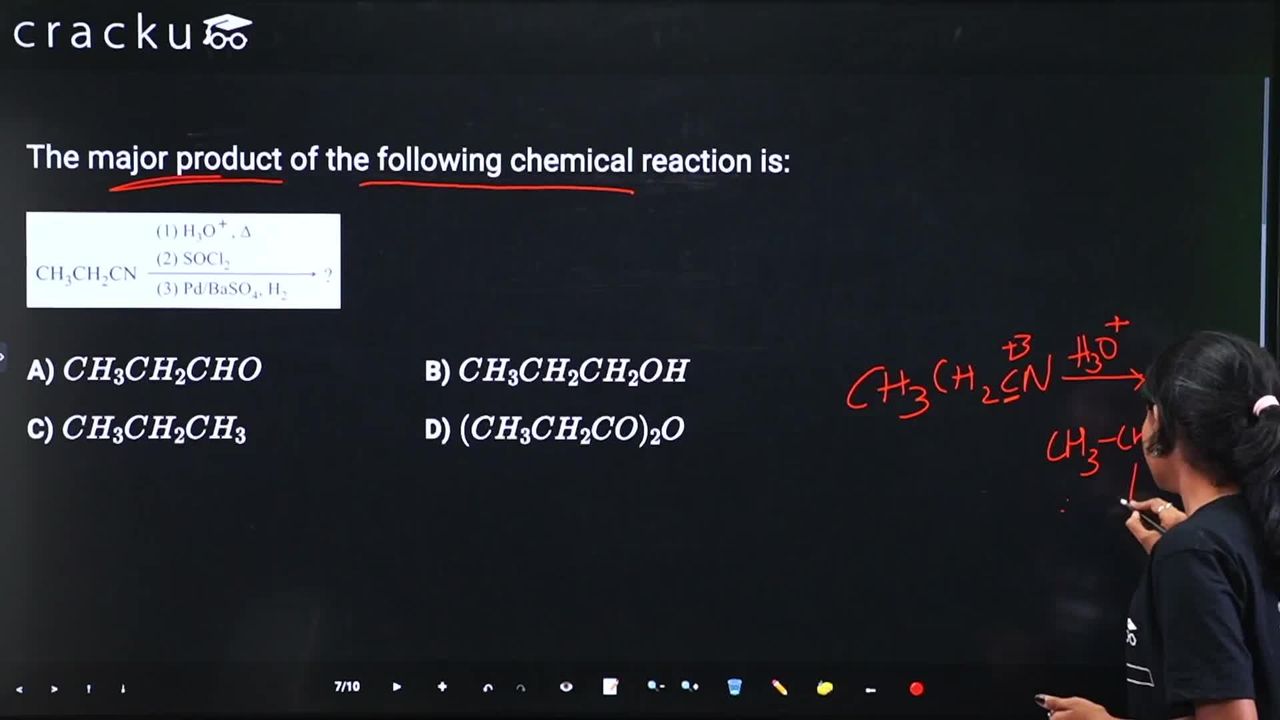
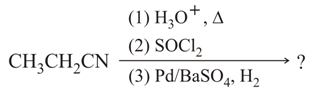
The major product of the following chemical reaction is:

  • The Starting Material: The reaction begins with propanenitrile ($CH_3CH_2CN$), a three-carbon molecule containing a cyano group.
  • Step 1 - Acidic Hydrolysis: When a nitrile is subjected to acidic water ($H_3O^+$) and heat ($\Delta$), it undergoes complete hydrolysis. The carbon-nitrogen triple bond is broken, the nitrogen leaves as an ammonium ion, and the cyano carbon is converted into a carboxylic acid group. This transforms propanenitrile into propanoic acid.
  • Equation for Step 1:

    $$CH_3CH_2CN + 2H_2O + H^+ \xrightarrow{\Delta} CH_3CH_2COOH + NH_4^+$$

  • Step 2 - Formation of Acyl Chloride: Treating a carboxylic acid with thionyl chloride ($SOCl_2$) is a classic way to convert it into an acyl chloride. The $-OH$ group of the acid is replaced by a $-Cl$ atom. This reaction is highly efficient because the byproducts ($SO_2$ and $HCl$) are gases that bubble out of the solution. This transforms propanoic acid into propanoyl chloride.
  • Equation for Step 2:

    $$CH_3CH_2COOH + SOCl_2 \rightarrow CH_3CH_2COCl + SO_2 + HCl$$

  • Step 3 - The Rosenmund Reduction: The final step involves reacting the acyl chloride with hydrogen gas ($H_2$) over a palladium catalyst supported on barium sulfate ($Pd/BaSO_4$). The barium sulfate acts as a "catalyst poison," intentionally weakening the palladium. This ensures the acyl chloride is only reduced one step down into an aldehyde, rather than "overshooting" and reducing all the way down to a primary alcohol.
  • Equation for Step 3:

    $$CH_3CH_2COCl + H_2 \xrightarrow{Pd/BaSO_4} CH_3CH_2CHO + HCl$$

  • The Final Product: Because the starting acyl chloride had three carbons, the resulting aldehyde also has three carbons. Therefore, the major product is propanal ($CH_3CH_2CHO$).
  • Get AI Help

    Video Solution

    video

    Create a FREE account and get:

    • Free JEE Mains Previous Papers PDF
    • Take JEE Mains paper tests
    Ask AI