
Join Our JEE Preparation Group
Prep with like-minded aspirants; Get access to free daily tests and study material.
Sign in
Please select an account to continue using cracku.in
↓ →
Join Our JEE Preparation Group
Prep with like-minded aspirants; Get access to free daily tests and study material.
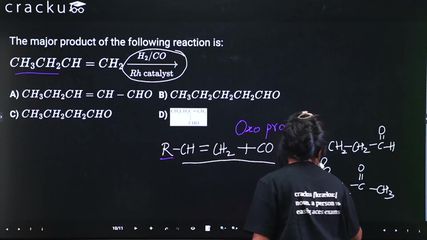
The major product of the following reaction is:
$$CH_3CH_2CH = CH_2 \xrightarrow[ Rh \text{ catalyst}]{H_2/CO}$$
The Reaction
Hydroformylation, or the Oxo Process, is an industrial catalytic reaction that converts alkenes into aldehydes. Its most important feature is that it lengthens the carbon chain, always producing an aldehyde that contains exactly one more carbon atom than the starting alkene.
$$\text{R-CH=CH}_{2}+\text{CO}+\text{H}_{2}\xrightarrow{\text{Catalyst}}\text{R-CH}_{2}\text{-CH}_{2}\text{-CHO\ (Linear)}+\text{R-CH(CHO)-CH}_{3}\text{\ (Branched)}$$
The Requirements
To achieve this, the alkene is reacted with "syngas"—a mixture of carbon monoxide (CO) and hydrogen gas ($$H_2$$). This process requires high temperatures, high pressures, and a specialized transition metal catalyst, typically containing cobalt or rhodium, to force the reaction to occur.
The Products
The catalyst breaks the alkene's double bond, adding a hydrogen atom to one side and a formyl group ($$-CHO$$) to the other. Because the formyl group can attach to either of the two carbons from the double bond, the reaction produces a mixture of two structural isomers: a straight-chain linear aldehyde (which is highly desired in industry) and a branched aldehyde.
Was this solution helpful?
Click on the Email ☝️ to Watch the Video Solution
Create a FREE account and get:
_1.webp)

Educational materials for JEE preparation

Ask our AI anything

AI can make mistakes. Please verify important information.
AI can make mistakes. Please verify important information.
