
Join Our JEE Preparation Group
Prep with like-minded aspirants; Get access to free daily tests and study material.
Sign in
Please select an account to continue using cracku.in
↓ →
Join Our JEE Preparation Group
Prep with like-minded aspirants; Get access to free daily tests and study material.
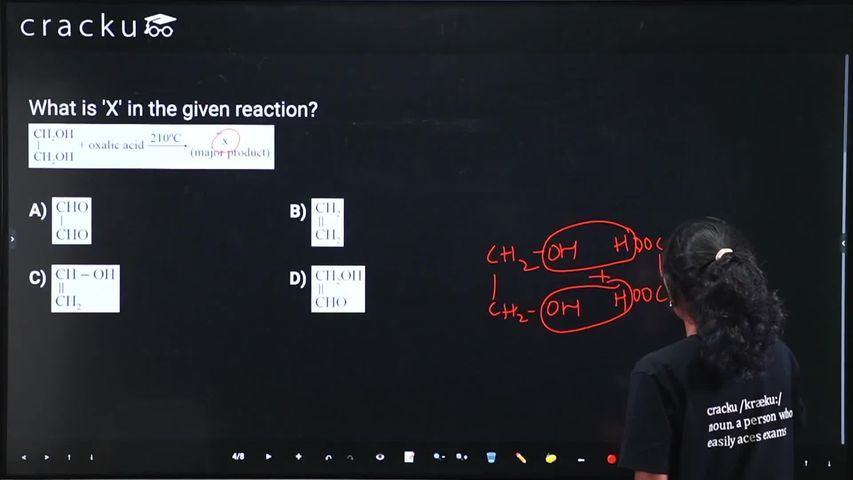
The reaction between ethylene glycol and oxalic acid at $$210^\circ \mathrm{C}$$ yields ethene as the major product.
Initially, the two hydroxyl groups of ethylene glycol undergo double esterification with the two carboxylic acid groups of oxalic acid. Two molecules of water are eliminated, forming a five-membered cyclic diester intermediate known as ethylene oxalate.
$$\mathrm{HO-CH_2-CH_2-OH + HOOC-COOH \xrightarrow[\ ]{210^\circ C} \text{Ethylene Oxalate} + 2H_2O}$$
Due to the high temperature condition, the cyclic intermediate becomes unstable and undergoes rapid thermal decarboxylation. During this process, the ring breaks apart and releases two molecules of carbon dioxide gas.
The remaining electrons rearrange to form a carbon-carbon double bond between the two carbon atoms of the original ethylene glycol chain, producing ethene as the final product.
$$\mathrm{\text{Ethylene Oxalate} \xrightarrow{\Delta} CH_2=CH_2 + 2CO_2}$$
Overall reaction:
$$\mathrm{HO-CH_2-CH_2-OH + HOOC-COOH \xrightarrow[\ ]{210^\circ C} CH_2=CH_2 + 2CO_2 + 2H_2O}$$
Was this solution helpful?
Click on the Email ☝️ to Watch the Video Solution
Create a FREE account and get:
_1.webp)

Educational materials for JEE preparation

Ask our AI anything

AI can make mistakes. Please verify important information.
AI can make mistakes. Please verify important information.

