
Join Our JEE Preparation Group
Prep with like-minded aspirants; Get access to free daily tests and study material.
Sign in
Please select an account to continue using cracku.in
↓ →
Join Our JEE Preparation Group
Prep with like-minded aspirants; Get access to free daily tests and study material.
From the given following (A to D) cyclic structures, those which will not react with Tollen's reagent are:
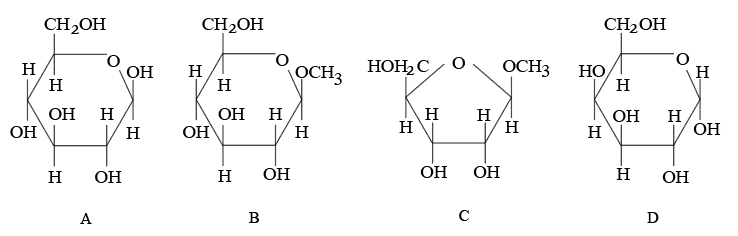
Key Concept: Tollen's reagent is a mild oxidizing agent that reacts with reducing sugars. A cyclic carbohydrate acts as a reducing sugar if it contains a hemiacetal or hemiketal group at its anomeric carbon (a carbon atom bonded directly to an $$-\text{OH}$$ group and an internal ring oxygen atom). In solution, hemiacetals can readily open up to expose a free, reactive aldehyde group. Conversely, if the anomeric carbon is bonded to an ether group ($$-\text{OCH}_3$$ or another sugar unit) instead of a free $$-\text{OH}$$ group, it forms an acetal or ketal, which is stable in neutral/alkaline conditions, cannot open into a free carbonyl group, and will not react with Tollen's reagent.
Structure A: Let's examine the rightmost anomeric carbon in this six-membered pyranose ring. The anomeric carbon is directly bonded to a free hydroxyl group ($$-\text{OH}$$) and a hydrogen atom ($$-\text{H}$$). Because it forms a hemiacetal linkage, it can undergo ring-opening to generate a free formyl group. Therefore, it acts as a reducing sugar and will react with Tollen's reagent. This statement is FALSE.
Structure B: Let's look closely at the anomeric position on the right side of this pyranose ring. The anomeric carbon is bonded to a methoxy group ($$-\text{OCH}_3$$) rather than an $$-\text{OH}$$ group. This configuration represents a non-reactive methyl glycoside with an acetal linkage. Since it cannot open to form a free aldehyde group under basic Tollen's conditions, it will not react with Tollen's reagent. This statement is TRUE.
Structure C: Let's inspect the anomeric carbon on the right side of this five-membered furanose ring. This carbon atom is directly attached to a methoxy group ($$-\text{OCH}_3$$) and a hydrogen atom ($$-\text{H}$$). Similar to Structure B, this represents a stable acetal (glycoside) structure that cannot undergo ring-opening to yield a free reducing sugar intermediate. Consequently, it will not react with Tollen's reagent. This statement is TRUE.
Structure D: Let's check the anomeric position on the rightmost carbon of this pyranose ring. This carbon is directly bonded to an alpha/beta hydroxyl group ($$-\text{OH}$$) and a hydrogen atom ($$-\text{H}$$). This forms a classic hemiacetal functionality, permitting ring-opening to expose a free aldehyde group. Thus, it acts as a reducing sugar and will react with Tollen's reagent. This statement is FALSE.
Therefore, the cyclic structures that will not react with Tollen's reagent are B and C.
Answer: Option C — B and C
Was this solution helpful?
Create a FREE account and get:
_1.webp)

Educational materials for JEE preparation

Ask our AI anything

AI can make mistakes. Please verify important information.
AI can make mistakes. Please verify important information.
