
Join Our JEE Preparation Group
Prep with like-minded aspirants; Get access to free daily tests and study material.
Sign in
Please select an account to continue using cracku.in
↓ →
Join Our JEE Preparation Group
Prep with like-minded aspirants; Get access to free daily tests and study material.
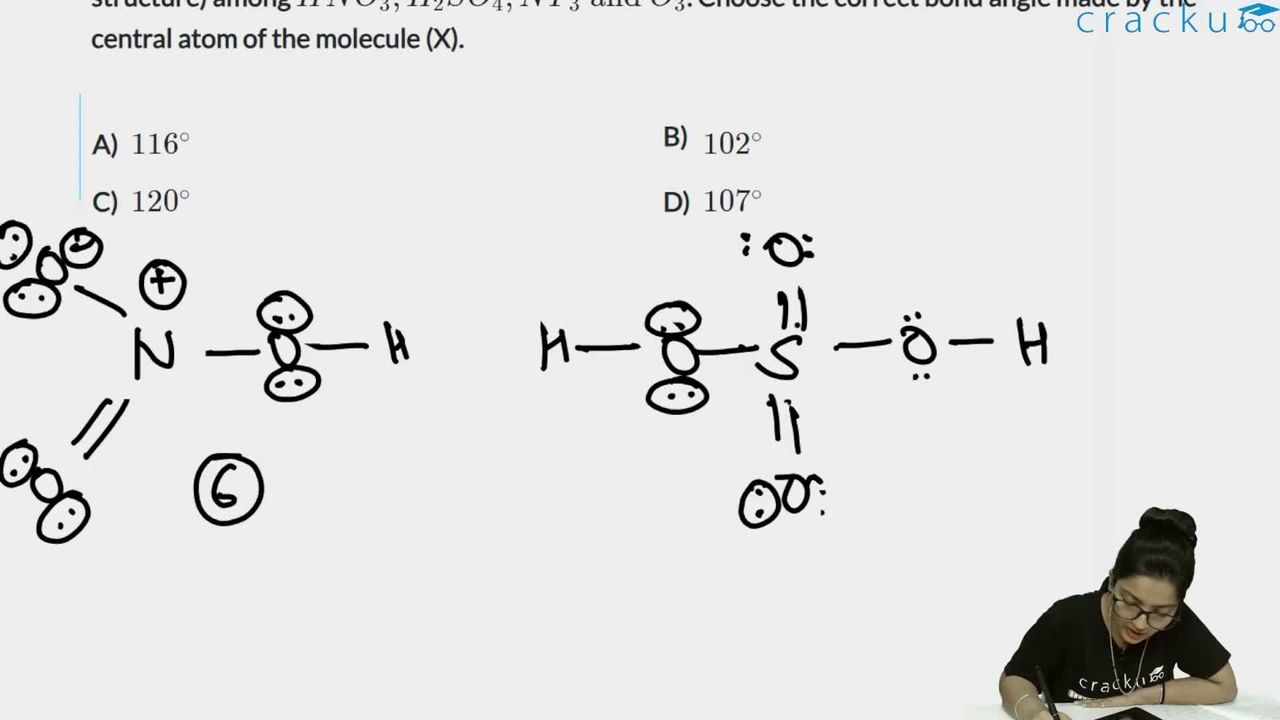
ldentify the molecule (X) with maximum number of lone pairs of electrons (obtained using Lewis dot structure) among $$HNO_{3},H_{2}SO_{4},NF_{3}\text{ and }O_{3}$$. Choose the correct bond angle made by the central atom of the molecule (X).
Count lone pairs on all atoms in each molecule using Lewis dot structures:
$$HNO_3$$: Nitrogen forms one N=O double bond, one N-O single bond, and one N-OH bond. N has 0 lone pairs. The =O has 2 lone pairs, the -O- (bridging to H) has 2 lone pairs, and the -OH oxygen has 2 lone pairs. Total = $$0 + 2 + 2 + 2 = 6$$.
$$H_2SO_4$$: Sulfur forms two S=O double bonds and two S-OH bonds. S has 0 lone pairs. Each of the 2 terminal =O atoms has 2 lone pairs, and each of the 2 -OH oxygens has 2 lone pairs. Total = $$0 + 2(2) + 2(2) = 8$$.
$$NF_3$$: Nitrogen has 1 lone pair and forms three N-F bonds. Each F has 3 lone pairs. Total = $$1 + 3(3) = 10$$.
$$O_3$$: Central O has 1 lone pair. The double-bonded terminal O has 2 lone pairs. The single-bonded terminal O (with formal charge -1) has 3 lone pairs. Total = $$1 + 2 + 3 = 6$$.
$$NF_3$$ has the maximum number of lone pairs (10), so molecule X = $$NF_3$$ with central atom nitrogen.
In $$NF_3$$, nitrogen is $$sp^3$$ hybridized with trigonal pyramidal geometry. The highly electronegative F atoms draw bonding electron density away from N, reducing bond pair-bond pair repulsion. Combined with the lone pair compression, the F-N-F bond angle is reduced to approximately $$102°$$.
The answer is Option B: $$102°$$.
Was this solution helpful?
Click on the Email ☝️ to Watch the Video Solution
Create a FREE account and get:
_1.webp)

Educational materials for JEE preparation

Ask our AI anything

AI can make mistakes. Please verify important information.
AI can make mistakes. Please verify important information.
