
Join Our JEE Preparation Group
Prep with like-minded aspirants; Get access to free daily tests and study material.
Sign in
Please select an account to continue using cracku.in
↓ →
Join Our JEE Preparation Group
Prep with like-minded aspirants; Get access to free daily tests and study material.
The major product obtained in the following conversion is:
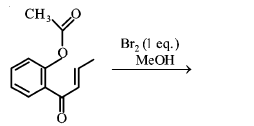
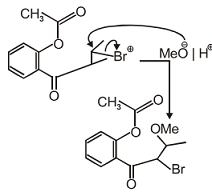
Step 1: Bromonium Ion Formation
When the molecule is treated, the alpha-bromo ketone portion or the neighboring groups interact to form a highly reactive three-membered cyclic bromonium ion ring intermediate across the carbon framework, stabilizing the leaving charge:
$$\text{Regioselective Internal Interaction} \rightarrow \text{3-membered Cyclic Bromonium Ion Intermediate}$$Step 2: Base-Mediated Cleavage / Rearrangement
The methoxide ion ($$\text{MeO}^\ominus$$) acts as a base/nucleophile to attack the carbonyl or coordinate with the ring system, prompting a ring-opening or Favorskii-type rearrangement of this three-membered intermediate. This directs the framework toward an ester-linked derivative rather than a simple substitution profile.
Accounting for the initial formation of the key three-membered bromonium ring intermediate, the rearranged framework delivers the ester configuration matching the structural transformation profile.
Was this solution helpful?
Click on the Email ☝️ to Watch the Video Solution
Create a FREE account and get:
_1.webp)

Educational materials for JEE preparation

Ask our AI anything

AI can make mistakes. Please verify important information.
AI can make mistakes. Please verify important information.


