Join Our JEE Preparation Group
Prep with like-minded aspirants; Get access to free daily tests and study material.
Sign in
Please select an account to continue using cracku.in
↓ →
Join Our JEE Preparation Group
Prep with like-minded aspirants; Get access to free daily tests and study material.
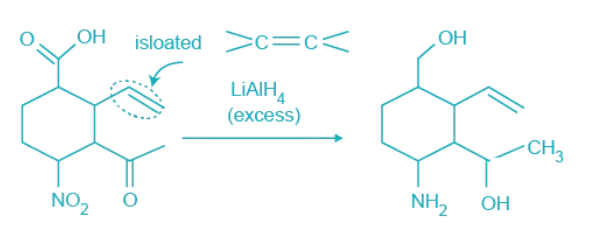
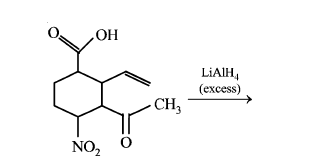
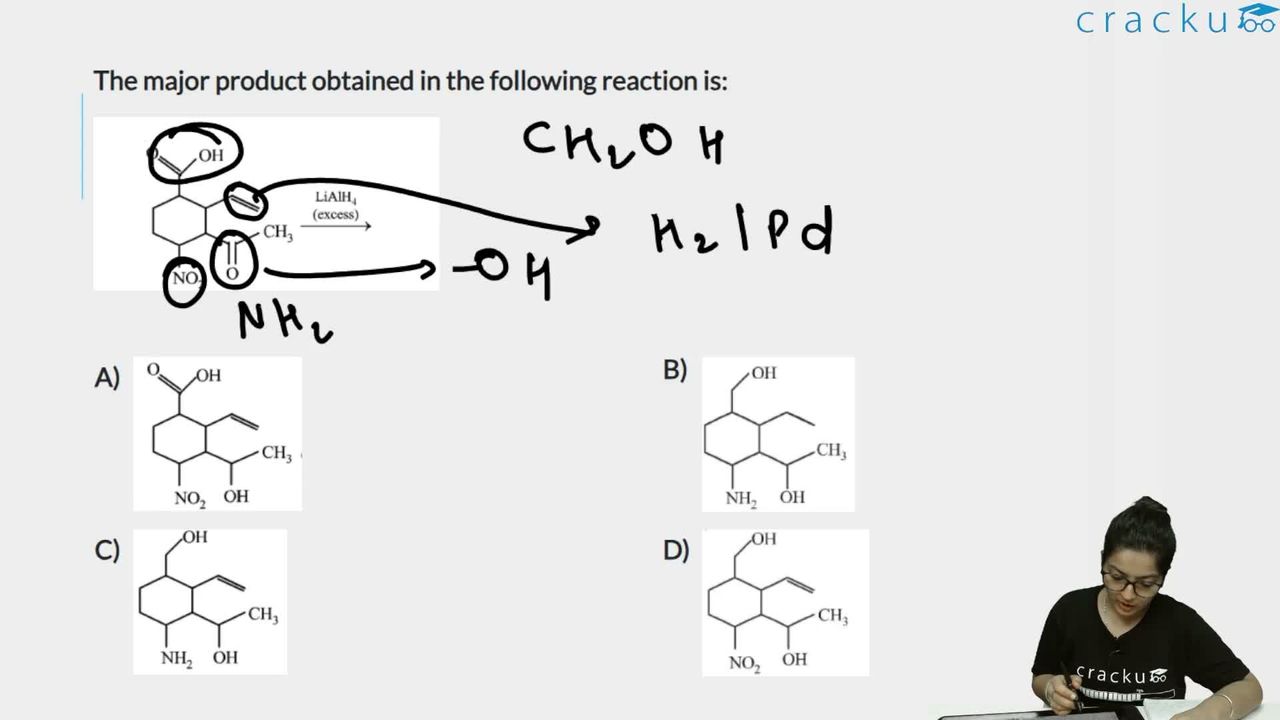
Lithium aluminum hydride ($$\text{LiAlH}_4$$) is an exceptionally powerful, non-selective reducing agent. When used in excess, it reduces a wide variety of carbonyl-containing and nitrogenous functional groups:
1. Carboxylic Acid Conversion:
$$\text{--COOH} \xrightarrow{\text{LiAlH}_4 \text{ (excess)}} \text{--CH}_2\text{OH}$$The top carboxylic acid group is transformed into a primary hydroxymethyl substituent.
2. Aliphatic Nitro Conversion:
$$\text{--NO}_2 \xrightarrow{\text{LiAlH}_4 \text{ (excess)}} \text{--NH}_2$$The nitro group attached to the bottom-left of the cyclohexane ring is reduced to an amino group.
3. Ketone Conversion:
$$\text{--C}(=\text{O})\text{CH}_3 \xrightarrow{\text{LiAlH}_4 \text{ (excess)}} \text{--CH}(\text{OH})\text{CH}_3$$The acetyl/ketone side chain at the bottom-right is reduced to a secondary alcohol.
4. Isolated Alkene Behaviour:
The isolated carbon-carbon double bond shown in the upper right arm of the ring lacks any strong electron-withdrawing conjugation. As a result, it remains completely untouched by the hydride reduction mechanism.
Was this solution helpful?
Click on the Email ☝️ to Watch the Video Solution
Create a FREE account and get:
_1.webp)

Educational materials for JEE preparation

Ask our AI anything

AI can make mistakes. Please verify important information.
AI can make mistakes. Please verify important information.