
Join Our JEE Preparation Group
Prep with like-minded aspirants; Get access to free daily tests and study material.
Sign in
Please select an account to continue using cracku.in
↓ →
Join Our JEE Preparation Group
Prep with like-minded aspirants; Get access to free daily tests and study material.
Match List-I with List-II.
| List-I | List-II |
|---|---|
A
 | I. Gatterman Koch reaction |
B
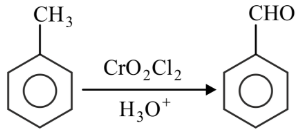 | II. Etard reaction |
C
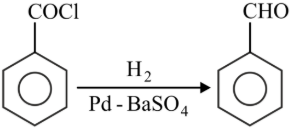 | III. Stephen reaction |
D
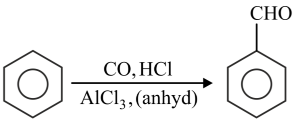 | IV. Rosenmund reaction |
Reaction $$\mathrm{A}$$ shows the conversion of a nitrile to an aldehyde using:
$$\mathrm{SnCl_2/HCl}$$
followed by hydrolysis.
This reaction is known as the Stephen reaction.
$$\mathrm{R-CN \xrightarrow[\ H_2O\ ]{SnCl_2/HCl} R-CHO}$$
Therefore:
$$\mathrm{A \rightarrow III}$$
Reaction $$\mathrm{B}$$ shows oxidation of toluene using chromyl chloride:
$$\mathrm{CrO_2Cl_2}$$
to form benzaldehyde.
This reaction is known as the Etard reaction.
$$\mathrm{C_6H_5CH_3 \xrightarrow{CrO_2Cl_2} C_6H_5CHO}$$
Therefore:
$$\mathrm{B \rightarrow II}$$
Reaction $$\mathrm{C}$$ shows reduction of an acid chloride to an aldehyde using:
$$\mathrm{H_2/Pd-BaSO_4}$$
This reaction is known as the Rosenmund reduction.
$$\mathrm{R-COCl \xrightarrow{H_2/Pd-BaSO_4} R-CHO}$$
Therefore:
$$\mathrm{C \rightarrow IV}$$
Reaction $$\mathrm{D}$$ shows formylation of benzene using:
$$\mathrm{CO + HCl/AlCl_3}$$
This reaction is known as the Gatterman-Koch reaction.
$$\mathrm{C_6H_6 \xrightarrow{CO/HCl,\ AlCl_3} C_6H_5CHO}$$
Therefore:
$$\mathrm{D \rightarrow I}$$
Correct matching:
$$\boxed{\mathrm{A-III,\ B-II,\ C-IV,\ D-I}}$$
Was this solution helpful?
Click on the Email ☝️ to Watch the Video Solution
Create a FREE account and get:
_1.webp)

Educational materials for JEE preparation

Ask our AI anything

AI can make mistakes. Please verify important information.
AI can make mistakes. Please verify important information.
