
 Group
Group
 Group
Group

JEE Biomolecules PYQ
Biomolecules is one of the easiest and most scoring chapters in JEE Chemistry if you revise it properly. The chapter mainly deals with substances found in living organisms, such as carbohydrates, proteins, amino acids, vitamins, enzymes, and nucleic acids.
Most questions from this chapter are based on basic concepts, structures, examples, and facts given in NCERT. There are very few calculations, but students often lose marks because they confuse similar terms or forget small details.
Solving JEE PYQ from Biomolecules is a good way to understand what type of questions are asked in the exam. It also helps you find out which topics are repeated and which facts need more revision.
On this page, you can revise the important concepts, download the PYQ PDF, learn key points, avoid common mistakes, and practise chapter-wise questions.
With regular revision and question practice, Biomolecules can become a reliable scoring chapter in JEE Chemistry.
JEE Biomolecules Previous-Year Questions
Previous-year questions help you understand the most important parts of the chapter. In Biomolecules, questions are commonly asked from carbohydrates, amino acids, proteins, vitamins, enzymes, DNA, and RNA.
While solving JEE Main PYQ, read the question and all the options carefully. Many questions include terms that sound similar but have different meanings.
For example, glucose and fructose are both monosaccharides. However, glucose is an aldohexose, while fructose is a ketohexose.
In the same way, sucrose, maltose, and lactose are all disaccharides, but their properties are not the same. Sucrose is a non-reducing sugar, while maltose and lactose are reducing sugars.
For protein-based questions, first check what the question is asking. It may be related to amino acids, peptide bonds, protein structure, or denaturation.
In nucleic acid questions, always remember the difference between a nucleoside and a nucleotide. A nucleoside contains a sugar and a nitrogenous base. A nucleotide contains a sugar, a nitrogenous base, and a phosphate group.
Try to solve every question within a fixed time. After completing the set, check your incorrect answers and understand why you made each mistake.
Common reasons may include:
- Confusing reducing and non-reducing sugars
- Mixing up vitamins and deficiency diseases
- Forgetting the parts of a nucleotide
- Confusing different protein structures
- Reading the question too quickly
Making short notes for similar terms can save time during revision. It also makes it easier to remember important differences before the exam.
JEE Biomolecules PYQs PDF
You can download the JEE Biomolecules PYQs PDF from the section below.
Try to solve the PDF without checking the answers first. Complete the questions in one sitting so that you can judge your current preparation level.
After solving the PDF, divide the questions into three groups:
- Questions you solved easily
- Questions that took more time
- Questions you could not solve
Revise the weak topics and attempt the difficult questions again after a few days.
You can also keep this PDF with your JEE Study Material and use it for quick revision before school tests, coaching tests, or the final examination.
While checking the solutions, do not only note the correct option. Read the explanation and revise the related concept from NCERT.
Biomolecules contains many direct facts, so one-time reading is usually not enough. You need regular revision to remember classifications, examples, structures, and important properties.
Flashcards can be useful for vitamins, deficiency diseases, sugar types, and nitrogenous bases. Short handwritten notes can also make revision faster.
When you solve the PDF again, focus more on the questions that were wrong or took too much time.
Important Formulas for JEE Biomolecules PYQs
Biomolecules does not have many numerical formulas. However, it includes several important facts, structures, classifications, and linkages that you should remember.
You can add the following points to your JEE Chemistry Formula Sheet for quick revision.
| Concept | Important Fact | Simple Explanation |
|---|---|---|
| Glucose | $$\mathrm{Aldohexose}$$ | It contains six carbon atoms and an aldehyde group in its open-chain form. |
| Fructose | $$\mathrm{Ketohexose}$$ | It contains six carbon atoms and a ketone group in its open-chain form. |
| Sucrose | $$\mathrm{Non\text{-}reducing\ Sugar}$$ | Both anomeric carbons participate in the glycosidic bond. |
| Maltose | $$\mathrm{Reducing\ Sugar}$$ | It has one free anomeric carbon. |
| Peptide Bond | $$\mathrm{-CO-NH-}$$ | It links two amino-acid residues. |
| Zwitterion | $$\mathrm{^{+}H_3N-CHR-COO^{-}}$$ | It contains both positive and negative charges. |
| Protein Denaturation | $$\mathrm{Loss\ of\ Native\ Structure\ and\ Biological\ Activity}$$ | The secondary and higher structures are disturbed without normally breaking peptide bonds. |
| Nucleoside | $$\mathrm{Sugar + Nitrogenous\ Base}$$ | It does not contain a phosphate group. |
| Nucleotide | $$\mathrm{Sugar + Nitrogenous\ Base + Phosphate}$$ | It is the fundamental building unit of DNA and RNA. |
| DNA Base Pairing | $$\mathrm{A-T\quad and\quad G-C}$$ | The complementary bases are joined by hydrogen bonds. |
Do not learn these points only by memorising them. Try to understand the reason behind each fact.
For example, sucrose is non-reducing because both anomeric carbons are involved in the glycosidic bond. Maltose is reducing because one anomeric carbon remains free.
Also remember that protein denaturation usually does not break peptide bonds. It mainly affects the secondary and tertiary structures of the protein.
Vitamins should be revised along with their sources and deficiency diseases. Learning them together makes them easier to remember.
Common Mistakes to Avoid in JEE Biomolecules PYQs
One common mistake is memorising examples without understanding their classification.
Students often confuse monosaccharides, disaccharides, and polysaccharides. Glucose and fructose are monosaccharides. Sucrose, maltose, and lactose are disaccharides. Starch, cellulose, and glycogen are polysaccharides.
Another common mistake is thinking that every sugar is a reducing sugar. This is not correct. Sucrose is non-reducing, while glucose, fructose, maltose, and lactose show reducing behaviour.
Students also confuse nucleosides and nucleotides. The easiest way to remember the difference is that a nucleotide contains a phosphate group, while a nucleoside does not.
While solving JEE Biomolecules Questions, pay attention to words such as “incorrect,” “not,” “except,” and “wrongly matched.” Missing one of these words can completely change the answer.
Another frequent mistake is assuming that denaturation breaks the primary structure of a protein. In most cases, denaturation affects the secondary and tertiary structures, while the peptide chain remains unchanged.
Vitamins and deficiency diseases can also be confusing. Divide vitamins into water-soluble and fat-soluble groups and revise them separately.
Do not leave this chapter for the last day. Since it is fact-based, short and regular revision works better than trying to memorise everything at once.
List of JEE Biomolecules PYQs
Use the questions given below as a short chapter test.
Try to solve them like a JEE Main Mock Test. Set a time limit, avoid using notes, and check the answers only after completing the full set.
After checking your score, revise every incorrect answer. Write down the fact or concept you forgot so that you do not repeat the same mistake in the next test.
Question 1
Consider the following sequence for aspartic acid:
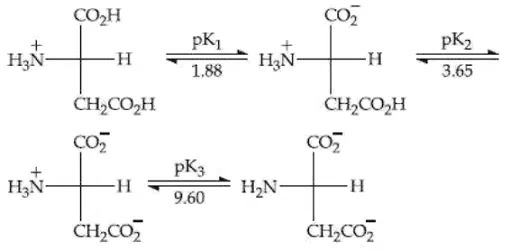
The pH (Isoelectric point) of aspartic acid is:
correct answer:- 2
Question 2
Which one of the following is an example of artificial sweetner?
correct answer:- 2
Question 3
The increasing order of pKa of the following amino acids in aqueous solution is: Glycine, Aspartate, Lysine, Arginine.
correct answer:- 4
Question 4
Match the LIST-I with LIST-II
| List-I Amino acid |
List-II Positive reaction/Test for functional group present in side chain of amino acid |
||
|---|---|---|---|
| A. | Glutamine | I. | Hinsberg's test |
| B. | Lysine | II. | Neutral FeCl$$_3$$ test |
| C. | Tyrosine | III. | Ceric ammonium nitrate test |
| D. | Serine | IV. | Hoffman bromamide degradation |
Choose the correct answer from the options given below:
correct answer:- 2
Question 5
Which of the following tests cannot be used for identifying amino acids?
correct answer:- 3

Question 6
The correct name of the following polymer is:
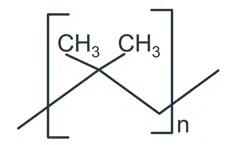
correct answer:- 1
Question 7
The number of

groups present in a tripeptide Asp - Glu - Lys is ____
correct answer:- 5
Question 8
A protein 'A' contains $$0.30\%$$ of glycine (molecular weight $$75$$). The minimum molar mass of the protein 'A' is ______ $$\times 10^3$$ g mol$$^{-1}$$ [nearest integer]
correct answer:- 25
Question 9
Match List I with List II: List-I: A. Glucose/$$NaHCO_3$$/$$\Delta$$ B. Glucose/$$HNO_3$$ C. Glucose/HI/$$\Delta$$ D. Glucose/Bromine water. List-II: I. Gluconic acid II. No reaction III. n-hexane IV. Saccharic acid. Choose the correct answer from the options given below:
correct answer:- 2
Question 10
Which one of the following statement is not true?
correct answer:- 1

Question 11
The number of chiral centres present in threonine is __________
correct answer:- 2
Question 12
Which of the following statement is not true for glucose?
correct answer:- 2
Question 13
Structures of four disaccharides are given below. Among the given disaccharides, the non-reducing sugar is :
correct answer:- 2
Question 14
Which of the following compounds will behave as reducing sugar in an aqueous KOH solution?
correct answer:- 4
Question 15
The correct match between item (I) and item (II) is:
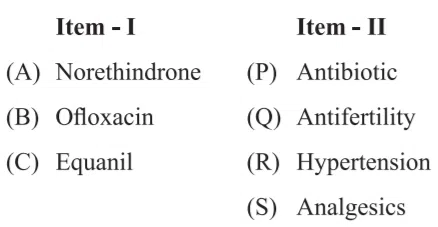
correct answer:- 2

Question 16
Structure of some important polymers are given. Which one represents Buna-S?
correct answer:- 2
Question 17
The homopolymer formed from 4-hydroxy-butanoic acids is:
correct answer:- 4
Question 18
Which of the following amino acids contains a sulfur atom in its side chain, possesses a primary amine group, and gives a positive xanthoproteic test?

correct answer:- 4
Question 19
Biochemical oxygen demand (BOD) value can be a measure of water pollution caused by the organic matter. Which of the following statements is correct?
correct answer:- 1
Question 20
Which of the following statements is not true?
correct answer:- 2

Question 21
The total number of correct statements, regarding the nucleic acids is _________.
A. RNA is regarded as the reserve of genetic information.
B. DNA molecule self-duplicates during cell division.
C. DNA synthesizes proteins in the cell.
D. The message for the synthesis of particular proteins is present in DNA.
E. Identical DNA strands are transferred to daughter cells.
correct answer:- 3
Question 22
The incorrect statement among the following is
correct answer:- 1
Question 23
Which of the following is the correct structure of adenosine?
correct answer:- 1
Question 24
Which one of the following bases is not present in DNA?
correct answer:- 1
Question 25
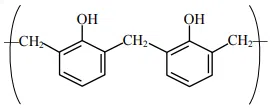
is a repeating unit for:
correct answer:- 1

Question 26
The copolymer formed by addition polymerization of styrene and acrylonitrile in the presence of peroxide is:
correct answer:- 2
Question 27
Which of the following is the correct structure of adenosine?
correct answer:- 1
Question 28
Which one of the following class of compounds is obtained by polymerization of acetylene?
correct answer:- 1
Question 29
The most appropriate method of making egg-albumin sol is:
correct answer:- 1
Question 30
Which structure of protein remains intact after coagulation of egg white on boiling?
correct answer:- 1
.webp)