
Join Our JEE Preparation Group
Prep with like-minded aspirants; Get access to free daily tests and study material.
Sign in
Please select an account to continue using cracku.in
↓ →
Join Our JEE Preparation Group
Prep with like-minded aspirants; Get access to free daily tests and study material.
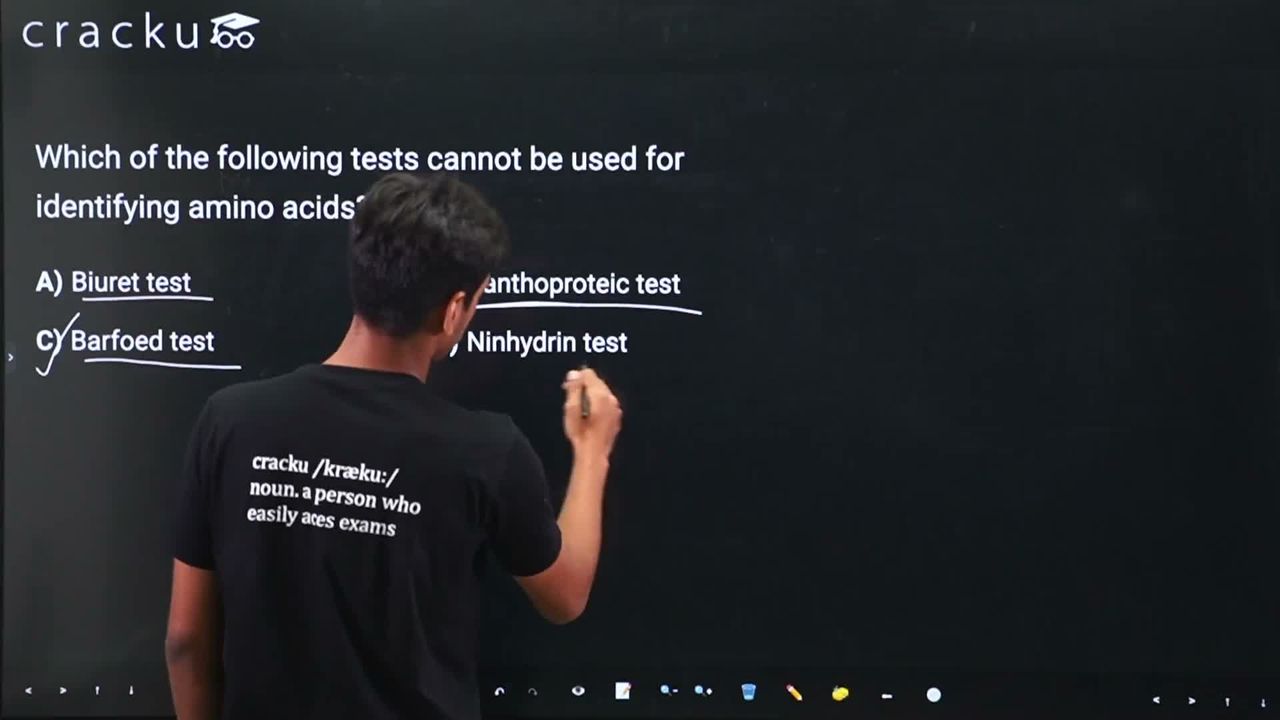
The problem asks us to decide which one of the four given qualitative tests is not suitable for detecting or identifying amino acids. To reach the conclusion, we shall recall, one by one, what chemical group each test responds to, and then match that information with the functional groups present in amino acids.
First, let us note that a typical α-amino acid contains two principal functional groups: an amino group $$\left( -\mathrm{NH_2} \right)$$ and a carboxyl group $$\left( -\mathrm{COOH} \right)$$. Depending on the side chain, extra groups such as phenyl, hydroxyl, or sulfur may also be present, but the defining feature is the $$- \mathrm{NH_2}$$ group on the carbon that also bears the $$- \mathrm{COOH}$$ group.
Now we analyse each test:
Biuret test: The Biuret test is based on the complexation of $$\mathrm{Cu^{2+}}$$ ions in alkaline medium with two or more peptide (-CONH-) linkages. Even a single amino acid does not contain a peptide bond by itself, yet when several amino acids are linked (as in di-, tri-, or polypeptides), the test becomes positive and yields a violet or purple colour. In many practical laboratory manuals, the Biuret test is nevertheless mentioned in the context of proteins and peptides—derivatives of amino acids. Hence, although a free amino acid gives a very faint or negative response, the test is broadly connected with amino‐acid chemistry.
Xanthoproteic test: This test relies on the nitration of activated aromatic rings (such as those present in the side chains of tyrosine, tryptophan, and phenylalanine) by concentrated $$\mathrm{HNO_3}$$, producing a yellow nitro derivative. On making the solution alkaline, the colour deepens to orange. Because many amino acids possess aromatic rings, the Xanthoproteic test is employed specifically to identify such amino acids.
Ninhydrin test: The Ninhydrin reaction is a classic general test for free amino acids. Ninhydrin oxidatively deaminates $$\alpha$$-amino acids, giving $$\mathrm{CO_2}$$, an aldehyde with one fewer carbon, and ammonia. Simultaneously, the reduced ninhydrin condenses with the liberated ammonia to form Ruhemann’s purple, a deep blue-violet colour. Therefore, the Ninhydrin test is explicitly designed for detecting amino acids.
Barfoed test: Barfoed’s reagent is an acidic solution of $$\mathrm{Cu^{2+}}$$ ions (commonly $$\mathrm{Cu(CH_3COO)_2}$$ in dilute acetic acid). The reagent is reduced by monosaccharides—that is, simple reducing sugars—to metallic copper or cuprous oxide $$\left(\mathrm{Cu_2O}\right)$$, giving a brick-red precipitate upon heating. The operationally important point is that the reagent is kept acidic so that only monosaccharides, and not disaccharides, reduce it at an appreciable rate. The Barfoed test has nothing to do with amino groups or peptide bonds; it is designed solely to distinguish monosaccharides from higher carbohydrates.
We now compare: Biuret, Xanthoproteic, and Ninhydrin have direct or at least partial applicability to amino acids or their polypeptide derivatives, whereas Barfoed’s test concerns reducing sugars and does not respond to amino or peptide functional groups at all.
Therefore, the test that cannot be used for identifying amino acids is Barfoed’s test.
Hence, the correct answer is Option C.
Was this solution helpful?
Click on the Email ☝️ to Watch the Video Solution
Create a FREE account and get:
_1.webp)

Educational materials for JEE preparation

Ask our AI anything

AI can make mistakes. Please verify important information.
AI can make mistakes. Please verify important information.


