Join WhatsApp Icon JEE WhatsApp Group

NTA JEE Main 10th January 2019 Shift 2

For the following questions answer them individually

The diameter and height of a cylinder are measured by a meter scale to be $$12.6 \pm 0.1$$ cm and $$34.2 \pm 0.1$$ cm, respectively. What will be the value of its volume in appropriate significant figures?

Two vectors $$\vec{A}$$ and $$\vec{B}$$ have equal magnitudes. The magnitude of $$(\vec{A} + \vec{B})$$ is '$$n$$' times the magnitude of $$(\vec{A} - \vec{B})$$. The angle between $$\vec{A}$$ and $$\vec{B}$$ is:

Two forces P and Q, of magnitude 2F and 3F, respectively, are at an angle $$\theta$$ with each other. If the force Q is doubled, then their resultant also gets doubled. Then, the angle $$\theta$$ is:

A particle which is experiencing a force, given by $$\vec{F} = 3\hat{i} - 12\hat{j}$$, undergoes a displacement of $$\vec{d} = 4\hat{i}$$. If the particle had a kinetic energy of 3 J at the beginning of the displacement, what is its kinetic energy at the end of the displacement?

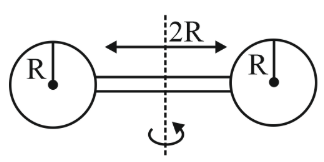
Two identical spherical balls of mass $$M$$ and radius $$R$$ each are stuck on two ends of a rod of length $$2R$$ and mass $$M$$ (see figure). The moment of inertia of the system about the axis passing perpendicularly through the centre of the rod is:

image

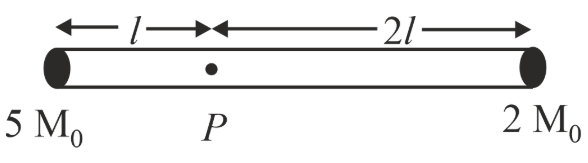
A rigid massless rod of length $$3l$$ has two masses attached at each end as shown in the figure. The rod is pivoted at point P on the horizontal axis. When released from the initial horizontal position, its instantaneous angular acceleration will be:

image

Two stars of masses $$3 \times 10^{31}$$ kg each, and at distance $$2 \times 10^{11}$$ m rotate in a plane about their common centre of mass O. A meteorite passes through O moving perpendicular to the star's rotation plane. In order to escape from the gravitational field of this double star, the minimum speed that meteorite should have at O is: (Take Gravitational constant $$G = 6.67 \times 10^{-11}$$ N m$$^2$$ kg$$^{-2}$$)

An unknown metal of mass 192 g heated to a temperature of 100$$^{\circ}$$C was immersed into a brass calorimeter of mass 128 g containing 240 g of water at a temperature of 8.4$$^{\circ}$$C. Calculate the specific heat of the unknown metal if water temperature stabilizes at 21.5$$^{\circ}$$C. (Specific heat of brass is 394 J kg$$^{-1}$$K$$^{-1}$$)

A hoop and a solid cylinder of same mass and radius are made of a permanent magnetic material with their respective axes. But the magnetic moment of hoop is twice of solid cylinder. They are placed in a uniform magnetic field in such a manner that their magnetic moments make a small angle with the field. If the oscillation periods of hoop and cylinder are $$T_h$$ and $$T_c$$ respectively, then:

A particle executes simple harmonic motion with an amplitude of 5 cm. When the particle is at 4 cm from the mean position, the magnitude of its velocity in SI units is equal to that of its acceleration. Then, its periodic time in seconds is:

A cylindrical plastic bottle of negligible mass is filled with 310 ml of water and left floating in a pond with still water. If pressed downward slightly and released, it starts performing simple harmonic motion at angular frequency $$\omega$$. If the radius of the bottle is 2.5 cm then $$\omega$$ is close to: (density of water $$= 10^3$$ kg/m$$^3$$)

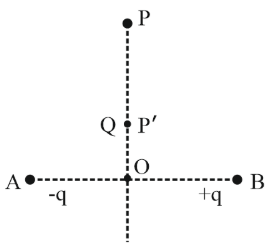
Charges $$-q$$ and $$+q$$, located at A and B, respectively, constitute an electric dipole. Distance $$AB = 2a$$, $$O$$ is the mid point of the dipole and $$OP$$ is perpendicular to $$AB$$. A charge $$Q$$ is placed at P where $$OP = y$$ and $$y \gg 2a$$. The charge $$Q$$ experiences an electrostatic force $$F$$. If $$Q$$ is now moved along the equatorial line to P' such that $$OP' = \frac{y}{3}$$, the force on $$Q$$ will be close to ($$\frac{y}{3} \ll 2a$$):

image

Four equal point charges $$Q$$ each are placed in the $$xy$$ plane at $$(0, 2)$$, $$(4, 2)$$, $$(4, -2)$$ and $$(0, -2)$$. The work required to put a fifth charge $$Q$$ at the origin of the coordinate system will be:

A parallel plate capacitor having capacitance 12 pF is charged by a battery to a potential difference of 10 V between its plates. The charging battery is now disconnected and a porcelain slab of dielectric constant 6.5 is slipped between the plates. The work done by the capacitor on the slab is:

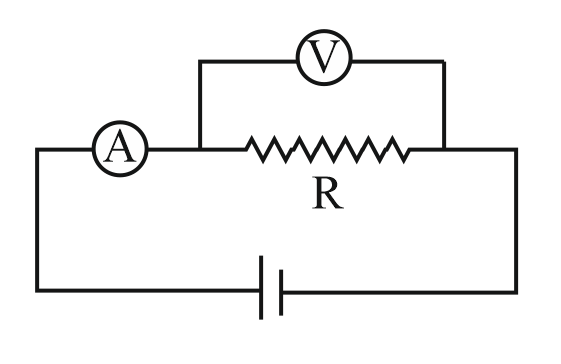
The actual value of resistance $$R$$, shown in the figure is 30$$\Omega$$. This is measured in an experiment as shown using the standard formula $$R = \frac{V}{I}$$, where V and I are the readings of the voltmeter and ammeter, respectively. If the measured value of $$R$$ is 5% less, then the internal resistance of the voltmeter is:

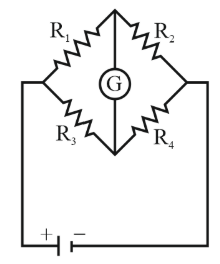
The Wheatstone bridge shown in the figure below, gets balanced when the carbon resistor used as $$R_1$$ has the colour code (orange, red, brown). The resistors $$R_2$$ and $$R_4$$ are 80 $$\Omega$$ and 40 $$\Omega$$, respectively. Assuming that the colour code for the carbon resistors gives their accurate values, the colour code for the carbon resistor, used as $$R_3$$, would be:

image

A current of 2 mA was passed through an unknown resistor which dissipated a power of 4.4 W. Dissipated power when an ideal power supply of 11 V is connected across it is:

At some location the horizontal component of earth's magnetic field is $$18 \times 10^{-6}$$ T. At this location, magnetic needle of length 0.12 m and pole strength 1.8 Am is suspended from its mid-point using a thread, it makes 45$$^{\circ}$$ angles with horizontal in equilibrium. To keep this needle horizontal, the vertical force that should be applied at one of its ends is:

The self induced emf of a coil is 25 volts. When the current in it is changed at uniform rate from 10A to 25A in 1s, the change in the energy of the inductance is:

The electric field of a plane polarized electromagnetic wave in free space at time $$t = 0$$ is given by the expression $$\vec{E}(x, y) = 10\hat{j}\cos(6x + 8z)$$. The magnetic field $$\vec{B}(x, z, t)$$ is given by ($$c$$ is the velocity of light.)

The eye can be regarded as a single refracting surface. The radius of curvature of this surface is equal to that of the cornea (7.8 mm). This surface separates two media of refractive indices 1 and 1.34. Calculate the distance from the refracting surface at which a parallel beam of light will come to focus.

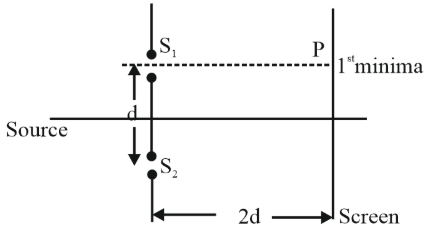
Consider a Young's double slit experiment as shown in figure. What should be the slit separation $$d$$ in terms of wavelength $$\lambda$$ such that the first minima occurs directly in front of the slit ($$S_1$$)?

image

A metal plate of area $$1 \times 10^{-4}$$ m$$^2$$ is illuminated by a radiation of intensity 16 m W/m$$^2$$. The work function of the metal is 5 eV. The energy of the incident photons is 10 eV and only 10% of it produces photo electrons. The number of emitted photo electrons per second and their maximum energy, respectively, will be: [$$1eV = 1.6 \times 10^{-19}$$ J]

Consider the nuclear fission, $$Ne^{20} \rightarrow 2He^4 + C^{12}$$. Given that the binding energy/nucleon of $$Ne^{20}$$, $$He^4$$ and $$C^{12}$$ are 8.03 MeV, 7.86 MeV, respectively. Identify the correct statement:

The modulation frequency of an AM radio station is 250 kHz, which is 10% of the carrier wave. If another AM station approaches you for license what broadcast frequency will you allot?

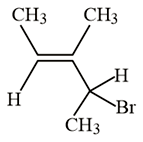
The process with negative entropy change is:

An ideal gas undergoes isothermal compression from 5 m$$^3$$ to 1 m$$^3$$ against a constant external pressure of 4 N m$$^{-2}$$. The heat released in this process is 24 J mol$$^{-1}$$ K$$^{-1}$$ and is used to increase the pressure of 1 mole of Al. The temperature of Al increases by:

5.1 g $$NH_4SH$$ is introduced in 3.0 L evacuated flask at 327$$^{\circ}$$C. 30% of the solid $$NH_4SH$$ is decomposed to $$NH_3$$ and $$H_2S$$ as gases. The $$K_P$$ of the reaction at 327$$^{\circ}$$C is: ($$R = 0.082$$ L atm mol$$^{-1}$$ K$$^{-1}$$, Molar mass of S = 32 g mol$$^{-1}$$, Molar mass of N = 14 g mol$$^{-1}$$)

The reaction that is not involved in the ozone layer depletion mechanism in the stratosphere is:

A compound of formula $$A_2B_3$$ has the HCP lattice. Which atom forms the HCP lattice and what fraction of the tetrahedral voids are occupied by the other atoms?

The elevation in boiling point for 1 molal solution of glucose is 2 K. The depression in freezing point for 2 molal solution of glucose in the same solvent is 2 K. The relation between $$K_b$$ and $$K_f$$ is:

In the cell, Pt(s)|H$$_2$$(g, 1 bar)|HCl(aq)|AgCl(s)|Ag(s)|Pt(s), the cell potential is 0.92 V when a $$10^{-6}$$ molar HCl solution is used. The standard electrode potential of Ag|AgCl|Cl$$^-$$ electrode is: (Given, $$\frac{2.303RT}{F} = 0.06$$ V at 298 K)

For an elementary chemical reaction, $$A_2 \underset{k_{-1}}{\overset{k_1}{\rightleftharpoons}} 2A$$, the expression for $$\frac{d[A]}{dt}$$ is:

The haemoglobin and the gold sol are examples of:

The electrolytes usually used in the electroplating of gold and silver, respectively, are:

Among the following reactions of hydrogen with halogens, the one that requires a catalyst is:

The pair that contains two $$P - H$$ bonds in each of the oxoacids is:

A reaction of cobalt (III) chloride and ethylenediamine in a 1 : 2 mole ratio generates two isomeric products A (violet-coloured) and B (green-coloured). A can show optical activity, but, B is optically inactive. What type of isomers do A and B represent?

The difference in the number of unpaired electrons of a metal ion in its high-spin and low-spin octahedral complexes is two. The metal ion is:

An aromatic compound 'A' having molecular formula $$C_7H_6O_2$$, on treating with aqueous ammonia and heating forms compound 'B'. The compound 'B' on reaction with molecular bromine and potassium hydroxide provides compound 'C' having molecular formula $$C_6H_7N$$. The structure of 'A' is:

The correct match between item I and item II is:
Item I (Compound)        Item II (Reagent)
a. Lysine                       p. 1-naphthol
b. Furfural                    q. Ninhydrin
c. Benzyl alcohol         r. KMnO$$_4$$
d. Styrene                     s. Ceric ammonium nitrate

Let $$z = \left(\frac{\sqrt{3}}{2} + \frac{i}{2}\right)^5 + \left(\frac{\sqrt{3}}{2} - \frac{i}{2}\right)^5$$. If $$R(z)$$ and $$I(z)$$ respectively denote the real and imaginary parts of $$z$$, then:

The length of the chord of the parabola $$x^2 = 4y$$ having equation $$x - \sqrt{2}y + 4\sqrt{2} = 0$$ is:

Let $$S = \left\{(x, y) \in R^2 : \frac{y^2}{1+r} - \frac{x^2}{1-r} = 1\right\}$$, where $$r \neq \pm 1$$. Then $$S$$ represents:

Consider the following three statements:
P: 5 is a prime number
Q: 7 is a factor of 192
R: LCM of 5 and 7 is 35
Then the truth value of which one of the following statements is true?

Let $$a_1, a_2, a_3, \ldots, a_{10}$$ be in G.P. with $$a_i > 0$$ for $$i = 1, 2, \ldots, 10$$ and $$S$$ be the set of pairs $$(r, k)$$, $$r, k \in N$$ (the set of natural numbers) for which $$\begin{vmatrix} \log_e a_1^r a_2^k & \log_e a_2^r a_3^k & \log_e a_3^r a_4^k \\ \log_e a_4^r a_5^k & \log_e a_5^r a_6^k & \log_e a_6^r a_7^k \\ \log_e a_7^r a_8^k & \log_e a_8^r a_9^k & \log_e a_9^r a_{10}^k \end{vmatrix} = 0$$. Then the number of elements in $$S$$, is:

Let $$N$$ be the set of natural numbers and two functions $$f$$ and $$g$$ be defined as $$f, g: N \to N$$ such that $$f(n) = \begin{cases} \frac{n+1}{2}, & \text{if n is odd} \\ \frac{n}{2}, & \text{if n is even} \end{cases}$$ and $$g(n) = n - (-1)^n$$. Then $$fog$$ is:

A helicopter is flying along the curve given by $$y - x^{3/2} = 7$$, $$(x \geq 0)$$. A soldier positioned at the point $$\left(\frac{1}{2}, 7\right)$$, who wants to shoot down the helicopter when it is nearest to him. Then this nearest distance is:

The value of $$\int_{-\pi/2}^{\pi/2} \frac{dx}{[x] + [\sin x] + 4}$$, where $$[t]$$ denotes the greatest integer less than or equal to $$t$$, is:

A curve amongst the family of curves represented by the differential equation, $$(x^2 - y^2)dx + 2xy \; dy = 0$$ which passes through $$(1, 1)$$, is:

Let $$f(x)$$ be a differentiable function such that $$f'(x) = 7 - \frac{3}{4}\frac{f(x)}{x}$$, $$(x > 0)$$ and $$f(1) \neq 4$$. Then $$\lim_{x \to 0^+} xf\left(\frac{1}{x}\right)$$:

Let $$\vec{\alpha} = (\lambda - 2)\vec{a} + \vec{b}$$ and $$\vec{\beta} = (4\lambda - 2)\vec{a} + 3\vec{b}$$, be two given vectors where vectors $$\vec{a}$$ and $$\vec{b}$$ are non-collinear. The value of $$\lambda$$ for which vectors $$\vec{\alpha}$$ and $$\vec{\beta}$$ are collinear, is:

On which of the following lines lies the point of intersection of the line, $$\frac{x-4}{2} = \frac{y-5}{2} = \frac{z-3}{1}$$ and the plane, $$x + y + z = 2$$?

If the probability of hitting a target by a shooter, in any shot is $$\frac{1}{3}$$, then the minimum number of independent shots at the target required by him so that the probability of hitting the target at least once is greater than $$\frac{5}{6}$$, is: