
Join Our JEE Preparation Group
Prep with like-minded aspirants; Get access to free daily tests and study material.
Sign in
Please select an account to continue using cracku.in
↓ →
Join Our JEE Preparation Group
Prep with like-minded aspirants; Get access to free daily tests and study material.
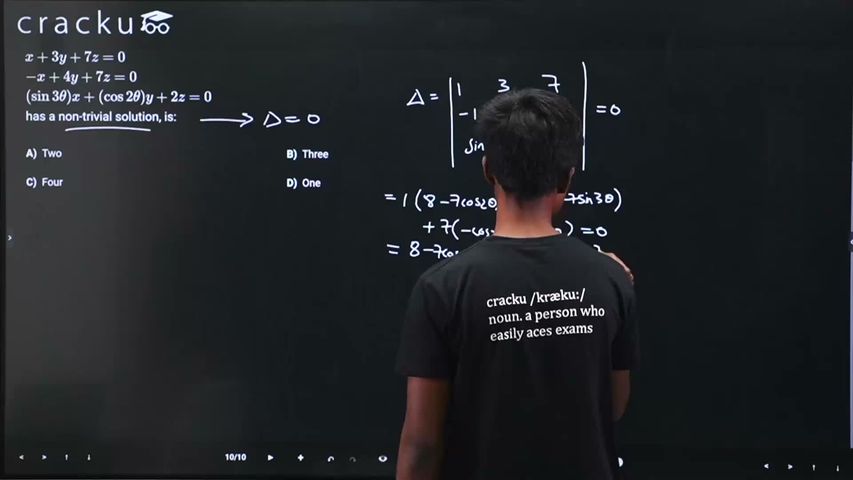
The number of values of $$\theta \in (0, \pi)$$ for which the system of linear equations
$$x + 3y + 7z = 0$$
$$-x + 4y + 7z = 0$$
$$(\sin 3\theta)x + (\cos 2\theta)y + 2z = 0$$
has a non-trivial solution, is:
For a homogeneous system of three linear equations, a non-trivial solution exists exactly when the determinant of the coefficient matrix is zero. We therefore begin by writing the coefficient matrix of the given system:
$$$ A=\begin{bmatrix} 1 & 3 & 7\\[2pt] -1 & 4 & 7\\[2pt] \sin 3\theta & \cos 2\theta & 2 \end{bmatrix}. $$$
We must solve $$\det A = 0$$ for $$\theta\in(0,\pi).$$ Expanding the determinant along the first row, we obtain
$$$ \det A =1\begin{vmatrix} 4 & 7\\[2pt] \cos 2\theta & 2 \end{vmatrix} -3\begin{vmatrix} -1 & 7\\[2pt] \sin 3\theta & 2 \end{vmatrix} +7\begin{vmatrix} -1 & 4\\[2pt] \sin 3\theta & \cos 2\theta \end{vmatrix}. $$$
Now we evaluate each 2 × 2 determinant one by one:
$$$ \begin{aligned} \begin{vmatrix} 4 & 7\\ \cos 2\theta & 2 \end{vmatrix} &=4\cdot2-7\cos 2\theta =8-7\cos 2\theta,\\[6pt] \begin{vmatrix} -1 & 7\\ \sin 3\theta & 2 \end{vmatrix} &=(-1)\cdot2-7\sin 3\theta =-2-7\sin 3\theta,\\[6pt] \begin{vmatrix} -1 & 4\\ \sin 3\theta & \cos 2\theta \end{vmatrix} &=(-1)\cos 2\theta-4\sin 3\theta =-\cos 2\theta-4\sin 3\theta. \end{aligned} $$$
Substituting these minors back, we have
$$$ \begin{aligned} \det A &=1\,(8-7\cos 2\theta) -3\,(-2-7\sin 3\theta) +7\,(-\cos 2\theta-4\sin 3\theta)\\[6pt] &=(8-7\cos 2\theta) +\bigl[6+21\sin 3\theta\bigr] +\bigl[-7\cos 2\theta-28\sin 3\theta\bigr]. \end{aligned} $$$
Collecting like terms gives
$$ \det A =14-14\cos 2\theta-7\sin 3\theta. $$
Dividing by 7 for convenience, the condition $$\det A=0$$ becomes
$$ 2-2\cos 2\theta-\sin 3\theta=0. $$
We now convert the double-angle term using the identity $$1-\cos 2\theta = 2\sin^2\theta.$$ Thus
$$ 2\bigl(1-\cos 2\theta\bigr)=4\sin^2\theta, $$
and the equation simplifies to
$$ 4\sin^2\theta=\sin 3\theta. $$
Next we express $$\sin 3\theta$$ by its standard expansion $$\sin 3\theta = 3\sin\theta-4\sin^3\theta.$$ Substituting, we get
$$ 4\sin^2\theta - \bigl(3\sin\theta-4\sin^3\theta\bigr)=0. $$
Simplifying term by term:
$$ 4\sin^2\theta-3\sin\theta+4\sin^3\theta=0. $$
Factoring out the common $$\sin\theta$$ yields
$$ \sin\theta\bigl(4\sin^2\theta+4\sin\theta-3\bigr)=0. $$
This gives two possibilities:
1. $$\sin\theta=0,$$ 2. $$4\sin^2\theta+4\sin\theta-3=0.$$
Because $$\theta\in(0,\pi),$$ the first possibility is impossible (it would require $$\theta=0$$ or $$\theta=\pi,$$ both endpoints being excluded). We therefore solve the quadratic in $$s=\sin\theta$$:
$$ 4s^{2}+4s-3=0. $$
Using the quadratic formula $$s=\dfrac{-b\pm\sqrt{b^{2}-4ac}}{2a},$$ with $$a=4,\;b=4,\;c=-3,$$ we have
$$ s=\frac{-4\pm\sqrt{16+48}}{8} =\frac{-4\pm8}{8}. $$
Hence
$$ s=\frac{1}{2}\quad\text{or}\quad s=-\frac{3}{2}. $$
The value $$s=-\dfrac{3}{2}$$ lies outside the interval $$[-1,1]$$ and is therefore inadmissible for a sine. The only valid solution is
$$ \sin\theta=\frac{1}{2}. $$
Within the open interval $$(0,\pi),$$ the equation $$\sin\theta=\dfrac{1}{2}$$ is satisfied at exactly two angles:
$$ \theta=\frac{\pi}{6}\quad\text{and}\quad\theta=\frac{5\pi}{6}. $$
Thus there are precisely two values of $$\theta$$ in $$(0,\pi)$$ for which the given system has a non-trivial solution.
Hence, the correct answer is Option A.
Was this solution helpful?
Click on the Email ☝️ to Watch the Video Solution
Create a FREE account and get:
_1.webp)

Educational materials for JEE preparation

Ask our AI anything

AI can make mistakes. Please verify important information.
AI can make mistakes. Please verify important information.


