
Join Our JEE Preparation Group
Prep with like-minded aspirants; Get access to free daily tests and study material.
Sign in
Please select an account to continue using cracku.in
↓ →
Join Our JEE Preparation Group
Prep with like-minded aspirants; Get access to free daily tests and study material.
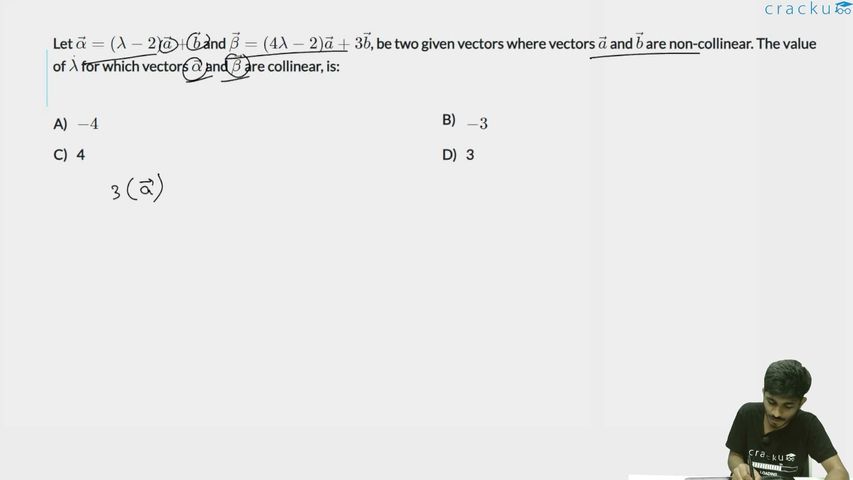
Let $$\vec{\alpha} = (\lambda - 2)\vec{a} + \vec{b}$$ and $$\vec{\beta} = (4\lambda - 2)\vec{a} + 3\vec{b}$$, be two given vectors where vectors $$\vec{a}$$ and $$\vec{b}$$ are non-collinear. The value of $$\lambda$$ for which vectors $$\vec{\alpha}$$ and $$\vec{\beta}$$ are collinear, is:
We have two vectors defined in terms of the non-collinear base vectors $$\vec a$$ and $$\vec b$$:
$$\vec\alpha = (\lambda-2)\vec a + \vec b$$
$$\vec\beta = (4\lambda-2)\vec a + 3\vec b$$
Because $$\vec a$$ and $$\vec b$$ are not collinear, they form an independent pair. Any vector written as a linear combination of them is uniquely determined by its two scalar coefficients. Two such vectors will be collinear if and only if their respective coefficients are in the same ratio. In other words, for some real number $$k$$ we must have
$$\vec\alpha = k\,\vec\beta.$$
Equating the coefficients of $$\vec a$$ and $$\vec b$$ separately, we obtain
$$\dfrac{\text{coefficient of }\vec a\text{ in }\vec\alpha}{\text{coefficient of }\vec a\text{ in }\vec\beta} \;=\; \dfrac{\text{coefficient of }\vec b\text{ in }\vec\alpha}{\text{coefficient of }\vec b\text{ in }\vec\beta}.$$
Explicitly substituting the given coefficients, this condition becomes
$$\frac{\lambda-2}{4\lambda-2} = \frac{1}{3}.$$
Now we solve step by step. First cross-multiply:
$$3(\lambda-2) = 1\,(4\lambda-2).$$
Expand both sides:
$$3\lambda - 6 = 4\lambda - 2.$$
Bring all terms to one side to isolate $$\lambda$$:
$$3\lambda - 6 - 4\lambda + 2 = 0.$$
Combine like terms:
$$(3\lambda - 4\lambda) + (-6 + 2) = 0,$$
$$-\,\lambda - 4 = 0.$$
Multiply by $$-1$$ to make the coefficient positive:
$$\lambda + 4 = 0.$$
Therefore,
$$\lambda = -4.$$
Hence, the correct answer is Option A.
Was this solution helpful?
Click on the Email ☝️ to Watch the Video Solution
Create a FREE account and get:
_1.webp)

Educational materials for JEE preparation

Ask our AI anything

AI can make mistakes. Please verify important information.
AI can make mistakes. Please verify important information.


