
Join Our JEE Preparation Group
Prep with like-minded aspirants; Get access to free daily tests and study material.
Sign in
Please select an account to continue using cracku.in
↓ →
Join Our JEE Preparation Group
Prep with like-minded aspirants; Get access to free daily tests and study material.
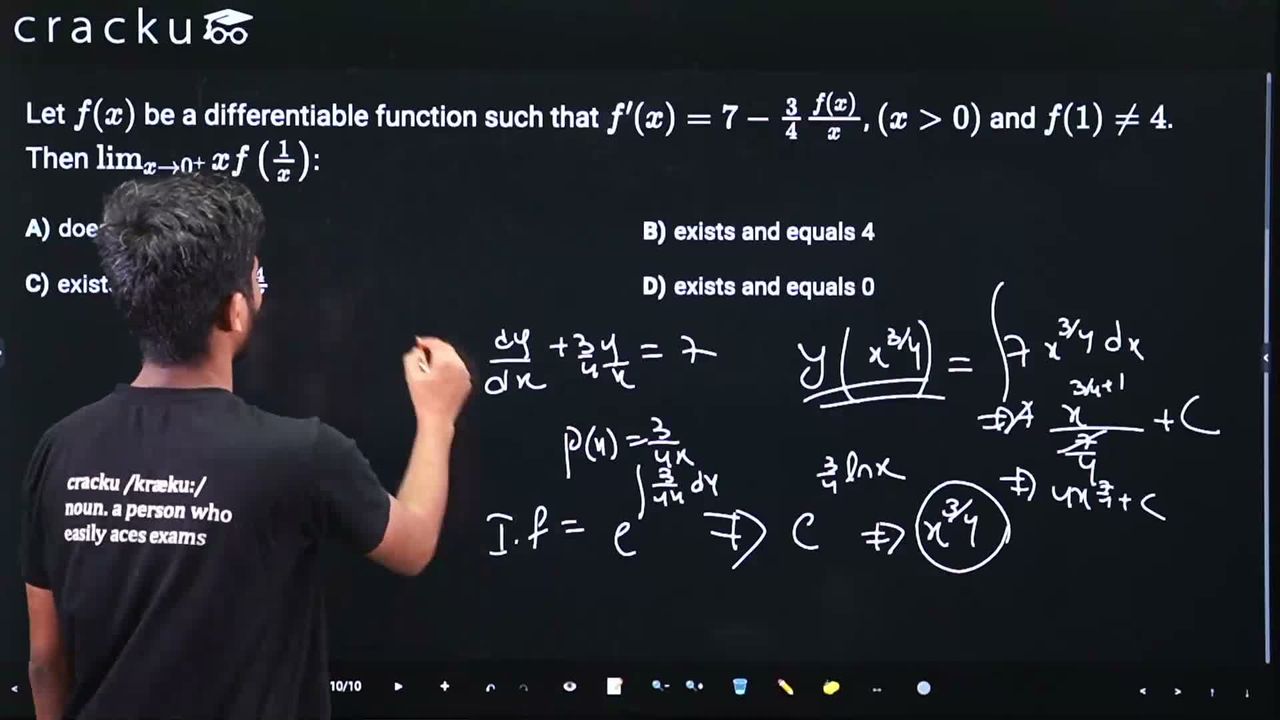
Let $$f(x)$$ be a differentiable function such that $$f'(x) = 7 - \frac{3}{4}\frac{f(x)}{x}$$, $$(x > 0)$$ and $$f(1) \neq 4$$. Then $$\lim_{x \to 0^+} xf\left(\frac{1}{x}\right)$$:
We start from the given differential equation
$$f'(x)=7-\frac34\frac{f(x)}{x},\qquad x>0.$$
Move all terms containing $$f$$ to the left so that we have the usual linear form $$f'(x)+P(x)f(x)=Q(x)$$. Doing this gives
$$f'(x)+\frac34\,\frac{f(x)}{x}=7.$$
Here the coefficient function is $$P(x)=\dfrac34\dfrac1x$$ and the non-homogeneous term is the constant $$Q(x)=7$$.
For a first-order linear ordinary differential equation the integrating factor is defined by the formula
$$\mu(x)=e^{\int P(x)\,dx}.$$
We therefore compute
$$\int P(x)\,dx=\int\frac34\frac1x\,dx=\frac34\ln x,$$
so that
$$\mu(x)=e^{(3/4)\ln x}=x^{3/4}.$$
Multiplying the whole differential equation by this integrating factor we obtain
$$x^{3/4}f'(x)+\frac34 x^{-1/4}f(x)=7x^{3/4}.$$
The left-hand side is precisely the derivative of the product $$x^{3/4}f(x)$$, because
$$\frac{d}{dx}\bigl(x^{3/4}f(x)\bigr)=x^{3/4}f'(x)+\frac34 x^{-1/4}f(x).$$
Hence the equation becomes
$$\frac{d}{dx}\bigl(x^{3/4}f(x)\bigr)=7x^{3/4}.$$
Integrating both sides with respect to $$x$$, we get
$$x^{3/4}f(x)=\int 7x^{3/4}\,dx+C,$$
where $$C$$ is the constant of integration. Evaluate the integral:
$$\int 7x^{3/4}\,dx=7\cdot\frac{x^{7/4}}{7/4}=4x^{7/4}.$$
So we have
$$x^{3/4}f(x)=4x^{7/4}+C.$$
Divide both sides by $$x^{3/4}$$ to isolate $$f(x)$$:
$$f(x)=4x+Cx^{-3/4}.$$
We are told that $$f(1)\neq4$$. Substituting $$x=1$$ into our expression gives
$$f(1)=4(1)+C(1)^{-3/4}=4+C.$$
Thus $$f(1)\neq4$$ simply tells us $$C\neq0$$, but the exact value of $$C$$ is otherwise unrestricted.
Now we turn to the limit that we must evaluate:
$$\lim_{x\to0^+}x\,f\!\left(\frac1x\right).$$
First compute $$f\!\left(\frac1x\right)$$ by substituting $$\frac1x$$ in place of $$x$$ in the formula for $$f$$:
$$f\!\left(\frac1x\right)=4\left(\frac1x\right)+C\left(\frac1x\right)^{-3/4}= \frac4x + Cx^{3/4}.$$
Multiply by $$x$$ as required:
$$x\,f\!\left(\frac1x\right)=x\left(\frac4x + Cx^{3/4}\right)=4+Cx^{7/4}.$$
As $$x\to0^+$$ we have $$x^{7/4}\to0$$, so the second term vanishes regardless of the (finite) constant $$C$$:
$$\lim_{x\to0^+}Cx^{7/4}=0.$$
Therefore
$$\lim_{x\to0^+}x\,f\!\left(\frac1x\right)=4+0=4.$$
The limit exists and equals $$4$$, independent of the particular non-zero value of $$C$$.
Hence, the correct answer is Option B.
Was this solution helpful?
Click on the Email ☝️ to Watch the Video Solution
Create a FREE account and get:
_1.webp)

Educational materials for JEE preparation

Ask our AI anything

AI can make mistakes. Please verify important information.
AI can make mistakes. Please verify important information.


