
Join Our JEE Preparation Group
Prep with like-minded aspirants; Get access to free daily tests and study material.
Sign in
Please select an account to continue using cracku.in
↓ →
Join Our JEE Preparation Group
Prep with like-minded aspirants; Get access to free daily tests and study material.
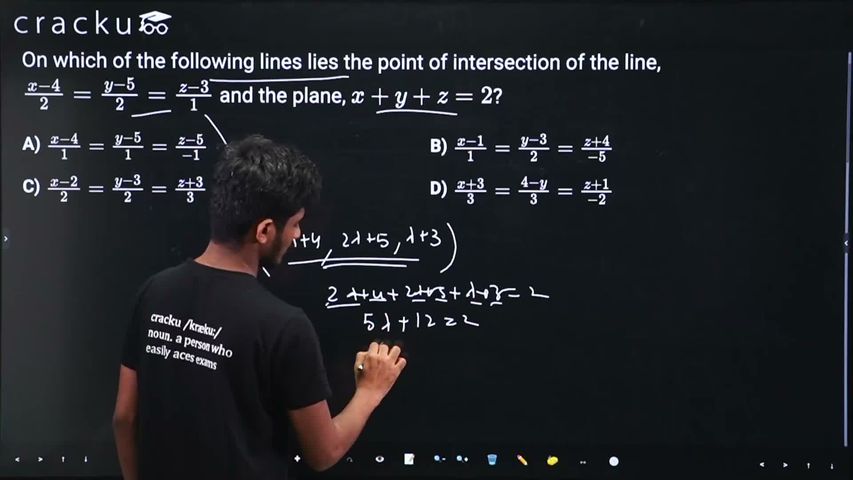
On which of the following lines lies the point of intersection of the line, $$\frac{x-4}{2} = \frac{y-5}{2} = \frac{z-3}{1}$$ and the plane, $$x + y + z = 2$$?
We are given the straight line $$\dfrac{x-4}{2}=\dfrac{y-5}{2}=\dfrac{z-3}{1}$$ and the plane $$x+y+z=2$$. To find their point of intersection we first write the symmetric form of the line in parametric form.
Let the common ratio be the parameter $$\lambda$$. Then
$$\dfrac{x-4}{2}=\lambda,\qquad \dfrac{y-5}{2}=\lambda,\qquad \dfrac{z-3}{1}=\lambda.$$
So we obtain the parametric equations
$$x=4+2\lambda,\qquad y=5+2\lambda,\qquad z=3+\lambda.$$
Any point on the line therefore has coordinates $$\bigl(4+2\lambda,\;5+2\lambda,\;3+\lambda\bigr).$$
Now we impose the condition that this point also lies on the plane $$x+y+z=2$$. Substituting the above expressions of $$x,y,z$$ into the plane equation, we get
$$\bigl(4+2\lambda\bigr)+\bigl(5+2\lambda\bigr)+\bigl(3+\lambda\bigr)=2.$$
Simplifying step by step, we first add the constant terms:
$$4+5+3=12,$$
and then add the coefficients of $$\lambda$$:
$$(2\lambda+2\lambda+\lambda)=5\lambda.$$
Thus the substitution produces
$$12+5\lambda=2.$$
Moving the constant term to the right side, we have
$$5\lambda = 2-12=-10,$$
so
$$\lambda=\dfrac{-10}{5}=-2.$$
Putting $$\lambda=-2$$ back into the parametric equations of the line, we find the exact point of intersection:
$$x = 4+2(-2)=4-4=0,$$
$$y = 5+2(-2)=5-4=1,$$
$$z = 3+(-2)=1.$$
Hence the required point is $$P(0,\,1,\,1).$$
Our task is now to decide which option describes a line passing through this point. We check each option one by one by substituting $$x=0,\;y=1,\;z=1$$ into its symmetric form and seeing whether the three fractions become equal.
Option A: $$\dfrac{x-4}{1}=\dfrac{y-5}{1}=\dfrac{z-5}{-1}.$$ At $$P(0,1,1)$$ we obtain $$\dfrac{0-4}{1}=-4,\; \dfrac{1-5}{1}=-4,\; \dfrac{1-5}{-1}=4.$$ Because $$-4 \neq 4,$$ the fractions are not equal; $$P$$ is not on this line.
Option B: $$\dfrac{x-1}{1}=\dfrac{y-3}{2}=\dfrac{z+4}{-5}.$$ Substituting $$P(0,1,1)$$ gives $$\dfrac{0-1}{1}=-1,\; \dfrac{1-3}{2}=\dfrac{-2}{2}=-1,\; \dfrac{1+4}{-5}=\dfrac{5}{-5}=-1.$$ All three values are the same (-1), so the point indeed lies on this line.
Option C: $$\dfrac{x-2}{2}=\dfrac{y-3}{2}=\dfrac{z+3}{3}.$$ For $$P(0,1,1)$$ we find $$\dfrac{0-2}{2}=-1,\; \dfrac{1-3}{2}=-1,\; \dfrac{1+3}{3}=\dfrac{4}{3},$$ and $$-1\neq\dfrac{4}{3}.$$ So $$P$$ is not on this line.
Option D: $$\dfrac{x+3}{3}=\dfrac{4-y}{3}=\dfrac{z+1}{-2}.$$ At $$P(0,1,1)$$ we get $$\dfrac{0+3}{3}=1,\; \dfrac{4-1}{3}=1,\; \dfrac{1+1}{-2}=-1.$$ Because $$1\neq-1,$$ this line also does not contain $$P.$$
Only Option B satisfies the condition that all three ratios are equal, which confirms that the desired line is the one given in Option B.
Hence, the correct answer is Option B.
Was this solution helpful?
Click on the Email ☝️ to Watch the Video Solution
Create a FREE account and get:
_1.webp)

Educational materials for JEE preparation

Ask our AI anything

AI can make mistakes. Please verify important information.
AI can make mistakes. Please verify important information.


