
Join Our JEE Preparation Group
Prep with like-minded aspirants; Get access to free daily tests and study material.
Sign in
Please select an account to continue using cracku.in
↓ →
Join Our JEE Preparation Group
Prep with like-minded aspirants; Get access to free daily tests and study material.
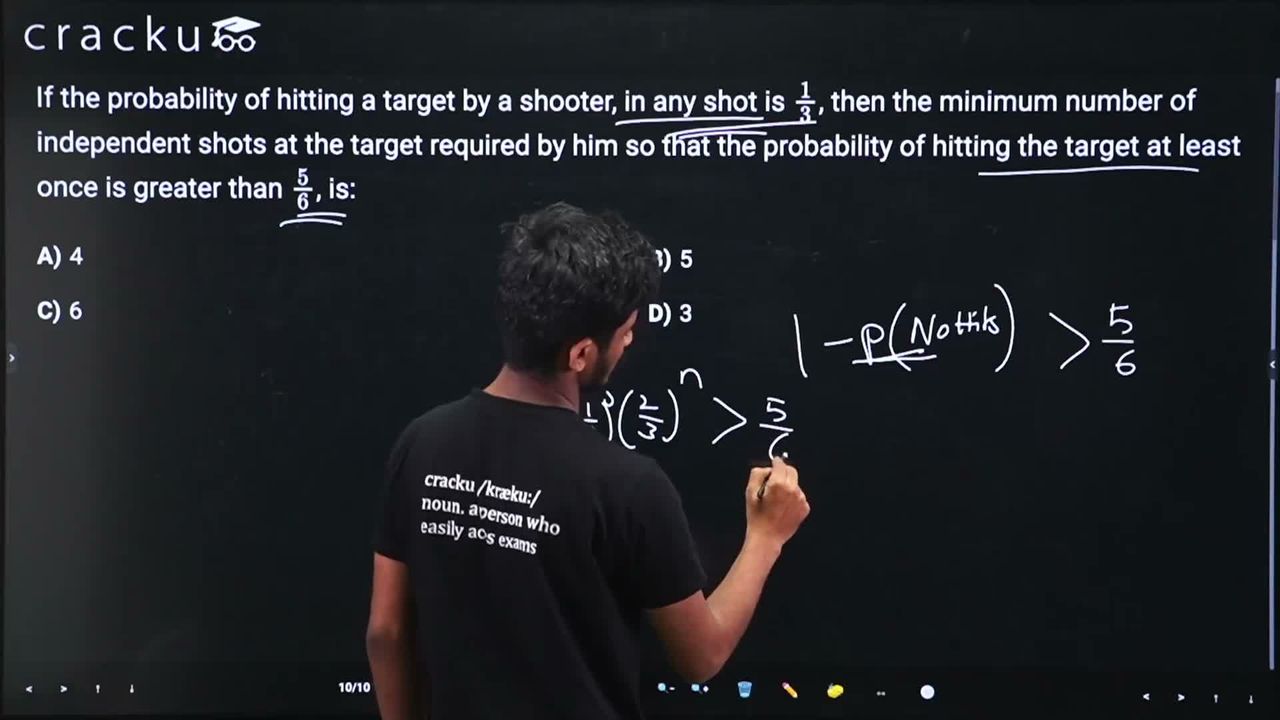
If the probability of hitting a target by a shooter, in any shot is $$\frac{1}{3}$$, then the minimum number of independent shots at the target required by him so that the probability of hitting the target at least once is greater than $$\frac{5}{6}$$, is:
We are told that the probability of the shooter hitting the target in a single, independent shot is $$p=\frac{1}{3}$$.
First, we recall the complementary rule of probability: if an event has probability $$p$$ of occurring in one trial, then the probability of it not occurring in that trial is $$1-p$$. Hence, the probability of missing the target in one shot is
$$q \;=\; 1-p \;=\; 1-\frac{1}{3} \;=\; \frac{2}{3}.$$
Because the shots are independent, the probability of missing the target in every one of $$n$$ shots is the product of the individual miss-probabilities, that is
$$q^n \;=\;\left(\frac{2}{3}\right)^n.$$
The probability of hitting the target at least once in those $$n$$ shots is obtained by subtracting the “miss-all” probability from $$1$$. Stated formally,
$$P(\text{at least one hit}) \;=\; 1 - P(\text{no hit in }n\text{ shots}) \;=\; 1 - \left(\frac{2}{3}\right)^n.$$
The problem demands that this probability be greater than $$\frac{5}{6}$$. Therefore we must solve the inequality
$$1 - \left(\frac{2}{3}\right)^n \;>\; \frac{5}{6}.$$
Now we move the term $$\left(\frac{2}{3}\right)^n$$ to the right:
$$-\left(\frac{2}{3}\right)^n \;>\; \frac{5}{6} - 1.$$
Since $$\frac{5}{6} - 1 = -\frac{1}{6}$$, we can multiply both sides by $$-1$$, remembering to reverse the inequality sign:
$$\left(\frac{2}{3}\right)^n \;<\; \frac{1}{6}.$$
To discover the smallest integer $$n$$ that satisfies this strict inequality, we now examine successive powers of $$\frac{2}{3}$$ and compare each to $$\frac{1}{6}$$.
For $$n=1$$:
$$\left(\frac{2}{3}\right)^1 = \frac{2}{3} \approx 0.667 \;>\; \frac{1}{6}\approx0.167.$$ So the inequality is not satisfied.
For $$n=2$$:
$$\left(\frac{2}{3}\right)^2 = \frac{4}{9} \approx 0.444 \;>\; 0.167.$$ Still not satisfied.
For $$n=3$$:
$$\left(\frac{2}{3}\right)^3 = \frac{8}{27} \approx 0.296 \;>\; 0.167.$$ Still too large.
For $$n=4$$:
$$\left(\frac{2}{3}\right)^4 = \frac{16}{81} \approx 0.198 \;>\; 0.167.$$ Again the inequality fails.
For $$n=5$$:
$$\left(\frac{2}{3}\right)^5 = \frac{32}{243} \approx 0.132 \;<\; 0.167.$$ Here, the inequality is finally satisfied.
Thus, the smallest integer $$n$$ that makes $$\left(\frac{2}{3}\right)^n < \frac{1}{6}$$ true is $$n=5$$.
Therefore, the shooter must fire at least $$5$$ independent shots for the probability of hitting the target at least once to exceed $$\frac{5}{6}$$.
Hence, the correct answer is Option B.
Was this solution helpful?
Click on the Email ☝️ to Watch the Video Solution
Create a FREE account and get:
_1.webp)

Educational materials for JEE preparation

Ask our AI anything

AI can make mistakes. Please verify important information.
AI can make mistakes. Please verify important information.


