
Join Our JEE Preparation Group
Prep with like-minded aspirants; Get access to free daily tests and study material.
Sign in
Please select an account to continue using cracku.in
↓ →
Join Our JEE Preparation Group
Prep with like-minded aspirants; Get access to free daily tests and study material.
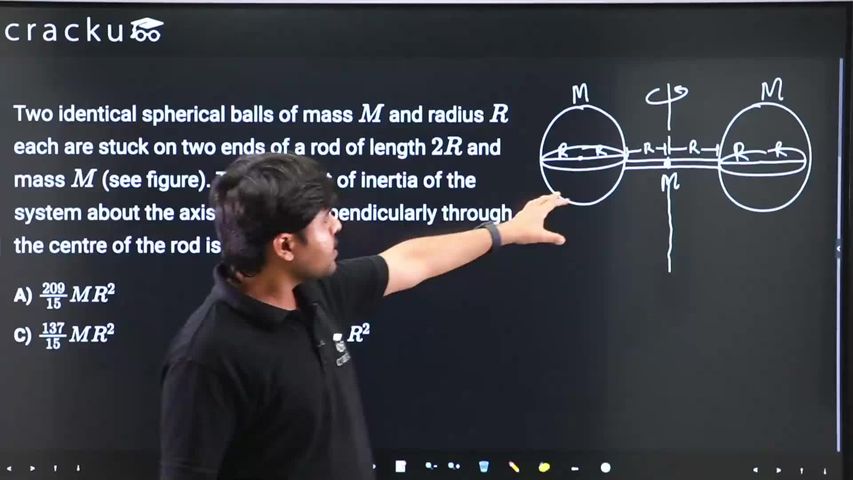
Two identical spherical balls of mass $$M$$ and radius $$R$$ each are stuck on two ends of a rod of length $$2R$$ and mass $$M$$ (see figure). The moment of inertia of the system about the axis passing perpendicularly through the centre of the rod is:
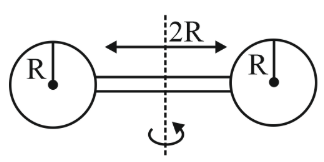
We have a uniform thin rod of length $$2R$$ and mass $$M$$. Exactly at each end of this rod, a solid sphere of radius $$R$$ and mass $$M$$ is fixed. The required axis passes perpendicularly through the centre of the rod and therefore lies in the plane of the diagram (coming out towards us). The task is to add the separate moments of inertia of the rod and of the two spheres about this same axis.
First we treat the rod. For a uniform rod of length $$L$$, the standard formula for the moment of inertia about an axis through its centre and perpendicular to its length is
$$I_{\text{rod,\,cm}}=\frac{1}{12} \, M L^{2}.$$
Here the length is $$L=2R$$, so
$$I_{\text{rod}}=\frac{1}{12}\,M\,(2R)^{2} =\frac{1}{12}\,M\,(4R^{2}) =\frac{4}{12}\,M R^{2} =\frac{1}{3}\,M R^{2}.$$
Now we consider one of the spheres. For a solid sphere, the well-known formula for the moment of inertia about any diameter (hence through its own centre) is
$$I_{\text{sphere,\,cm}}=\frac{2}{5}\,M R^{2}.$$
The axis under consideration, however, does not pass through the centre of either sphere; it passes through the midpoint of the rod. We therefore need the parallel-axis theorem, which states
$$I = I_{\text{cm}} + M d^{2},$$
where $$d$$ is the distance between the new axis and the centre of mass of the body. Because the rod’s half-length is $$R$$ and the sphere’s own radius is also $$R$$, the centre of each sphere is
$$d = R + R = 2R$$
away from the central axis. Using the parallel-axis theorem for one sphere we obtain
$$\begin{aligned} I_{\text{one sphere}} &= I_{\text{sphere,\,cm}} + M d^{2} \\ &= \frac{2}{5} M R^{2} + M (2R)^{2} \\ &= \frac{2}{5} M R^{2} + M \, 4R^{2} \\ &= \frac{2}{5} M R^{2} + \frac{20}{5} M R^{2} \\ &= \frac{22}{5} M R^{2}. \end{aligned}$$
Since there are two identical spheres, the combined contribution from both spheres is
$$I_{\text{both spheres}} = 2 \times \frac{22}{5} M R^{2} = \frac{44}{5} M R^{2}.$$
Finally, the total moment of inertia of the entire system about the stated axis is the sum of the rod’s value and the spheres’ combined value:
$$\begin{aligned} I_{\text{total}} &= I_{\text{rod}} + I_{\text{both spheres}} \\ &= \frac{1}{3} M R^{2} + \frac{44}{5} M R^{2}. \end{aligned}$$
To add these fractions we bring them to a common denominator of $$15$$:
$$\begin{aligned} I_{\text{total}} &= \left(\frac{1}{3}\right) M R^{2} + \left(\frac{44}{5}\right) M R^{2} \\ &= \left(\frac{5}{15}\right) M R^{2} + \left(\frac{132}{15}\right) M R^{2} \\ &= \frac{5 + 132}{15} \, M R^{2} \\ &= \frac{137}{15} \, M R^{2}. \end{aligned}$$
Hence, the correct answer is Option C.
Was this solution helpful?
Click on the Email ☝️ to Watch the Video Solution
Create a FREE account and get:
_1.webp)

Educational materials for JEE preparation

Ask our AI anything

AI can make mistakes. Please verify important information.
AI can make mistakes. Please verify important information.


