
Join Our JEE Preparation Group
Prep with like-minded aspirants; Get access to free daily tests and study material.
Sign in
Please select an account to continue using cracku.in
↓ →
Join Our JEE Preparation Group
Prep with like-minded aspirants; Get access to free daily tests and study material.
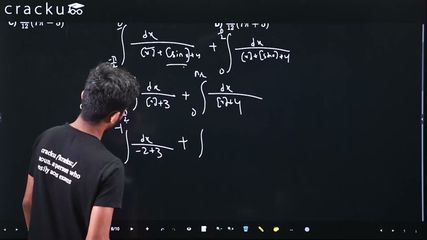
The value of $$\int_{-\pi/2}^{\pi/2} \frac{dx}{[x] + [\sin x] + 4}$$, where $$[t]$$ denotes the greatest integer less than or equal to $$t$$, is:
We have to evaluate the definite integral
$$I=\int_{-\pi/2}^{\pi/2}\dfrac{dx}{\,[x]+\,[\sin x]+4},$$
where $$[t]$$ denotes the greatest integer less than or equal to $$t$$.
First we study the two greatest-integer expressions separately on the interval $$\left[-\dfrac{\pi}{2},\,\dfrac{\pi}{2}\right].$$ Numerically $$\dfrac{\pi}{2}\approx 1.57$$, so every $$x$$ that occurs lies between about $$-1.57$$ and $$+1.57$$.
1. The value of $$[x]$$. Inside this interval the real line crosses the integers $$-2,\,-1,\,0,\,1,\,2$$. The only integer points that actually appear are $$-1,\,0,\,1$$ (because $$2>1.57$$ and $$-2<-1.57$$ is just outside for an end-point). Thus
$$ [x]=\begin{cases} -2,& -\dfrac{\pi}{2}\le x<-1,\\[6pt] -1,& -1\le x<0,\\[6pt] 0,& 0\le x<1,\\[6pt] 1,& 1\le x\le\dfrac{\pi}{2}. \end{cases} $$
2. The value of $$[\sin x]$$. Over $$\left[-\dfrac{\pi}{2},\,\dfrac{\pi}{2}\right]$$ we know $$-1\le\sin x\le1$$.
• For $$-\dfrac{\pi}{2}<x<0$$ we have $$-1<\sin x<0$$, hence $$[\sin x]=-1.$$
• At $$x=0$$, $$\sin x=0$$ so $$[\sin x]=0.$$
• For $$0<x<\dfrac{\pi}{2}$$ we have $$0<\sin x<1$$, hence $$[\sin x]=0.$$
• At the right end-point $$x=\dfrac{\pi}{2}$$, $$\sin x=1$$ so $$[\sin x]=1.$$ (A single point does not affect the value of the integral.)
Thus
$$ [\sin x]=\begin{cases} -1,& -\dfrac{\pi}{2}<x<0,\\[6pt] 0,& 0\le x<\dfrac{\pi}{2},\\[6pt] 1,& x=\dfrac{\pi}{2}. \end{cases} $$
3. Forming the denominator. We add the two results and then add 4:
$$D(x)=[x]+[\sin x]+4.$$
We look at each sub-interval where both greatest-integer functions are constant.
(i) For $$-\dfrac{\pi}{2}\le x<-1$$: $$[x]=-2,\:[\sin x]=-1\;\Longrightarrow\;D(x)=-2-1+4=1.$$
(ii) For $$-1\le x<0$$: $$[x]=-1,\:[\sin x]=-1\;\Longrightarrow\;D(x)=-1-1+4=2.$$
(iii) For $$0\le x<1$$: $$[x]=0,\:[\sin x]=0\;\Longrightarrow\;D(x)=0+0+4=4.$$
(iv) For $$1\le x<\dfrac{\pi}{2}$$: $$[x]=1,\:[\sin x]=0\;\Longrightarrow\;D(x)=1+0+4=5.$$
(The single point $$x=\dfrac{\pi}{2}$$ would give $$D=6$$, but the integral of a single point is zero, so we ignore it.)
4. Writing the integral as a sum of four simple integrals.
$$ I=\int_{-\pi/2}^{-1}\dfrac{dx}{1}+\int_{-1}^{0}\dfrac{dx}{2}+\int_{0}^{1}\dfrac{dx}{4}+\int_{1}^{\pi/2}\dfrac{dx}{5}. $$
5. Evaluating each integral. We use the elementary formula $$\displaystyle\int_a^b c\,dx=c\,(b-a).$$
• First interval:
$$\int_{-\pi/2}^{-1}\dfrac{dx}{1}=1\Bigl(-1-\bigl(-\dfrac{\pi}{2}\bigr)\Bigr)=\dfrac{\pi}{2}-1.$$
• Second interval:
$$\int_{-1}^{0}\dfrac{dx}{2}=\dfrac12(0-(-1))=\dfrac12\cdot1=\dfrac12.$$
• Third interval:
$$\int_{0}^{1}\dfrac{dx}{4}=\dfrac14(1-0)=\dfrac14.$$
• Fourth interval:
$$\int_{1}^{\pi/2}\dfrac{dx}{5}=\dfrac15\Bigl(\dfrac{\pi}{2}-1\Bigr)=\dfrac{\pi}{10}-\dfrac15.$$
6. Adding the four results.
$$ I=\left(\dfrac{\pi}{2}-1\right)+\dfrac12+\dfrac14+\left(\dfrac{\pi}{10}-\dfrac15\right). $$
We group the $$\pi$$ terms and the rational terms separately:
$$ I=\left(\dfrac{\pi}{2}+\dfrac{\pi}{10}\right)+\left(-1+\dfrac12+\dfrac14-\dfrac15\right). $$
The $$\pi$$ part:
$$\dfrac{\pi}{2}+\dfrac{\pi}{10}=\dfrac{5\pi}{10}+\dfrac{\pi}{10}=\dfrac{6\pi}{10}=\dfrac{3\pi}{5}.$$
The rational part (take common denominator 20):
$$-1+\dfrac12+\dfrac14-\dfrac15=-\dfrac{20}{20}+\dfrac{10}{20}+\dfrac{5}{20}-\dfrac{4}{20}=-\dfrac{9}{20}.$$
Combining,
$$ I=\dfrac{3\pi}{5}-\dfrac{9}{20}. $$
We extract the common factor 3 to reveal the option’s pattern:
$$ I=\dfrac{3}{20}\Bigl(4\pi-3\Bigr). $$
Hence, the correct answer is Option A.
Was this solution helpful?
Click on the Email ☝️ to Watch the Video Solution
Create a FREE account and get:
_1.webp)

Educational materials for JEE preparation

Ask our AI anything

AI can make mistakes. Please verify important information.
AI can make mistakes. Please verify important information.


