
Join Our JEE Preparation Group
Prep with like-minded aspirants; Get access to free daily tests and study material.
Sign in
Please select an account to continue using cracku.in
↓ →
Join Our JEE Preparation Group
Prep with like-minded aspirants; Get access to free daily tests and study material.
If $$\int x^5 e^{-4x^3}dx = \frac{1}{48}e^{-4x^3}f(x) + C$$, where $$C$$ is a constant of integration, then $$f(x)$$ is equal to:
We are told that
$$\int x^{5}\,e^{-4x^{3}}\;dx=\frac1{48}\,e^{-4x^{3}}\,f(x)+C,$$
where $$C$$ is the constant of integration. In order to determine the unknown function $$f(x)$$ we differentiate the right-hand side and demand that the derivative equals the original integrand. In other words, if we set
$$F(x)=\frac1{48}\,e^{-4x^{3}}\,f(x),$$
then by the Fundamental Theorem of Calculus we must have
$$F'(x)=x^{5}\,e^{-4x^{3}}.$$
Now we actually compute $$F'(x)$$. We see a product of two factors, so we first state the product rule:
$$\frac{d}{dx}[u(x)\,v(x)]=u'(x)\,v(x)+u(x)\,v'(x).$$
Here we let
$$u(x)=\frac1{48}\,f(x)\quad\text{and}\quad v(x)=e^{-4x^{3}}.$$
Applying the product rule gives
$$F'(x)=\frac1{48}\,f'(x)\,e^{-4x^{3}}+\frac1{48}\,f(x)\,\frac{d}{dx}\!\left(e^{-4x^{3}}\right).$$
Next we differentiate the exponential. Using the chain rule, which says
$$\frac{d}{dx}\bigl(e^{g(x)}\bigr)=e^{g(x)}\,g'(x),$$
we have $$g(x)=-4x^{3}$$ and therefore $$g'(x)=-12x^{2}.$$ So
$$\frac{d}{dx}\!\left(e^{-4x^{3}}\right)=e^{-4x^{3}}\cdot(-12x^{2})=-12x^{2}\,e^{-4x^{3}}.$$
Substituting this back, we obtain
$$F'(x)=\frac1{48}\,e^{-4x^{3}}\Bigl[f'(x)-12x^{2}f(x)\Bigr].$$
But we also know that $$F'(x)=x^{5}\,e^{-4x^{3}}.$$ Since the factor $$e^{-4x^{3}}$$ is common on both sides, we cancel it. Multiplying the remaining equation by $$48$$ to clear the denominator, we reach the first-order differential equation
$$f'(x)-12x^{2}f(x)=48x^{5}.$$
At this stage it is natural to guess that $$f(x)$$ might be a polynomial. Observing the term $$48x^{5}$$ on the right, a cubic polynomial is a reasonable trial. So we assume
$$f(x)=k_{1}x^{3}+k_{0},$$
where $$k_{1}$$ and $$k_{0}$$ are constants to be determined. We differentiate:
$$f'(x)=3k_{1}x^{2}.$$
Substituting $$f(x)$$ and $$f'(x)$$ into the differential equation yields
$$3k_{1}x^{2}-12x^{2}(k_{1}x^{3}+k_{0})=48x^{5}.$$
We now expand and collect like terms:
$$3k_{1}x^{2}-12k_{1}x^{5}-12k_{0}x^{2}=48x^{5}.$$
Combine the $$x^{2}$$ terms and the $$x^{5}$$ terms separately:
$$\bigl(3k_{1}-12k_{0}\bigr)x^{2}+(-12k_{1})x^{5}=48x^{5}.$$
For this polynomial identity to hold for every $$x$$, the coefficients of each power of $$x$$ must match. Therefore, we must satisfy the simultaneous equations
$$-12k_{1}=48\quad\text{and}\quad 3k_{1}-12k_{0}=0.$$
From the first equation we get
$$k_{1}=-4.$$
Substituting $$k_{1}=-4$$ into the second equation gives
$$3(-4)-12k_{0}=0\;\;\Longrightarrow\;\;-12-12k_{0}=0\;\;\Longrightarrow\;\;k_{0}=-1.$$
Hence the explicit form of $$f(x)$$ is
$$f(x)=-4x^{3}-1.$$
Looking at the four options, we see that this corresponds exactly to Option A.
Hence, the correct answer is Option A.
Was this solution helpful?
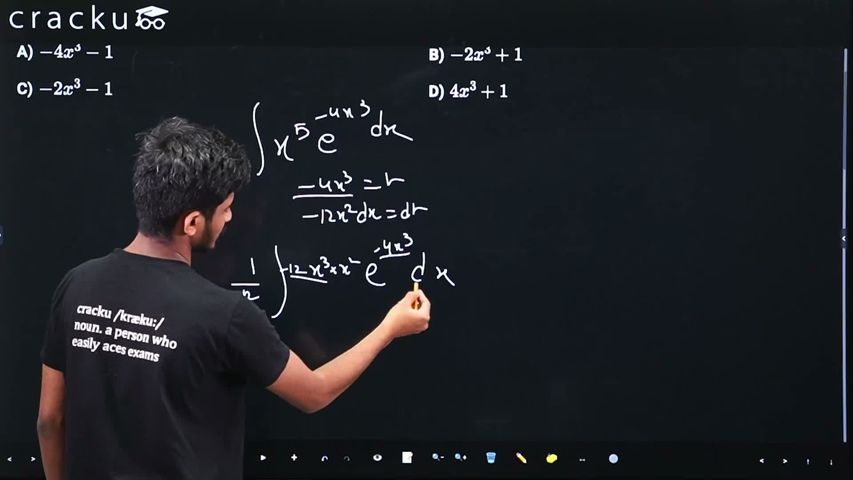
Click on the Email ☝️ to Watch the Video Solution
Create a FREE account and get:
_1.webp)

Educational materials for JEE preparation

Ask our AI anything

AI can make mistakes. Please verify important information.
AI can make mistakes. Please verify important information.


