
Join Our JEE Preparation Group
Prep with like-minded aspirants; Get access to free daily tests and study material.
Sign in
Please select an account to continue using cracku.in
↓ →
Join Our JEE Preparation Group
Prep with like-minded aspirants; Get access to free daily tests and study material.
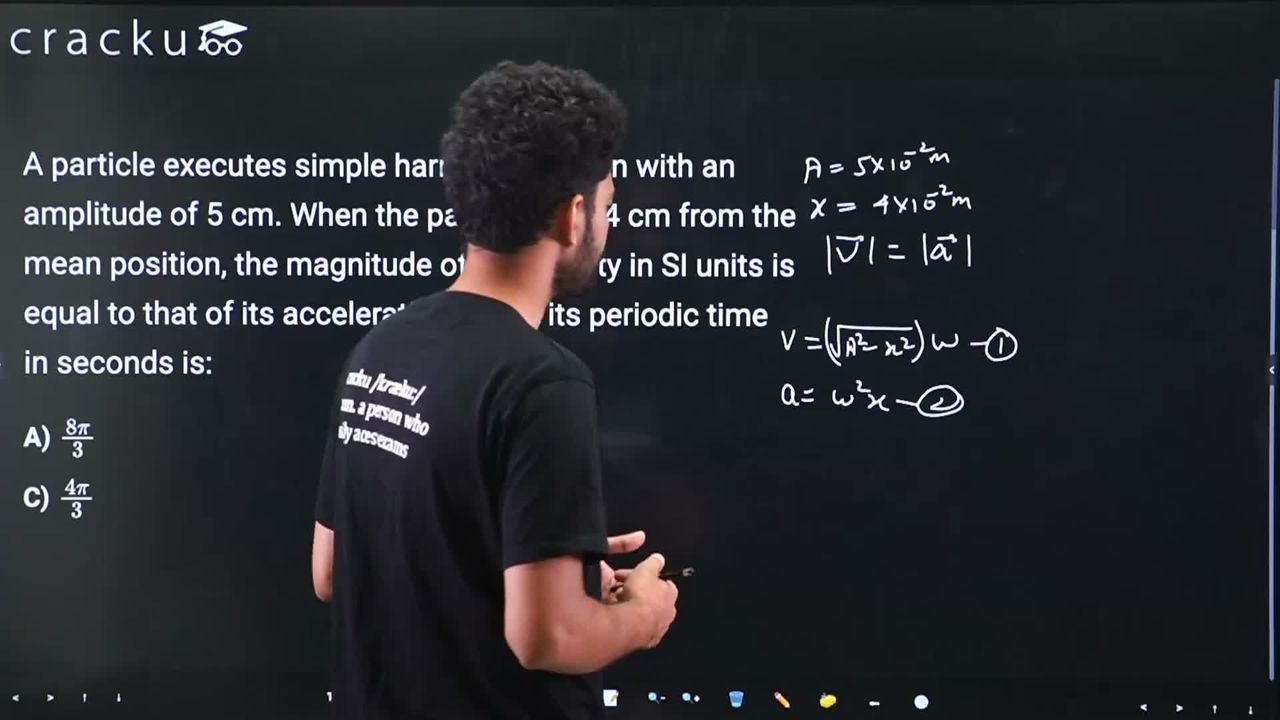
A particle executes simple harmonic motion with an amplitude of 5 cm. When the particle is at 4 cm from the mean position, the magnitude of its velocity in SI units is equal to that of its acceleration. Then, its periodic time in seconds is:
We are told that the motion is simple harmonic, so the particle’s displacement from the mean position can be written as $$x(t)=A\sin(\omega t+\phi)$$. For any SHM the following standard relations hold:
1. The instantaneous speed (magnitude of velocity) is given by the well-known formula $$v=\omega\sqrt{A^{2}-x^{2}}.$$ 2. The instantaneous acceleration (its magnitude) is obtained from the second derivative of displacement and is $$a=\omega^{2}x.$$
The data given in the question are
Amplitude $$A = 5\ \text{cm} = 0.05\ \text{m},$$ Instantaneous displacement $$x = 4\ \text{cm} = 0.04\ \text{m}.$$
The statement “the magnitude of its velocity is equal to the magnitude of its acceleration” means that, numerically in SI units,
$$v = a.$$
Substituting the standard expressions for $$v$$ and $$a$$ we get
$$\omega\sqrt{A^{2}-x^{2}}=\omega^{2}x.$$
The angular frequency $$\omega$$ is not zero, so we can divide both sides of the above equation by $$\omega$$ to obtain
$$\sqrt{A^{2}-x^{2}}=\omega x.$$
Now we substitute the given values of $$A$$ and $$x$$ (we may keep them in centimetres because the ratio will be dimensionless; the numeric equality is all that matters):
First calculate $$A^{2}-x^{2}$$: $$A^{2}-x^{2}=5^{2}-4^{2}=25-16=9.$$
Therefore $$\sqrt{A^{2}-x^{2}}=\sqrt{9}=3\ \text{cm}.$$
Putting this into the earlier relation gives
$$3=\omega\,(4).$$
Hence the angular frequency is
$$\omega=\frac{3}{4}\ \text{s}^{-1}.$$
The periodic time $$T$$ (time‐period) of an SHM is connected to the angular frequency by the basic relation
$$T=\frac{2\pi}{\omega}.$$
Substituting $$\omega=\dfrac{3}{4}\ \text{s}^{-1}$$ we get
$$T=\frac{2\pi}{3/4}=2\pi\times\frac{4}{3}=\frac{8\pi}{3}\ \text{s}.$$
Hence, the correct answer is Option A.
Was this solution helpful?
Click on the Email ☝️ to Watch the Video Solution
Create a FREE account and get:
_1.webp)

Educational materials for JEE preparation

Ask our AI anything

AI can make mistakes. Please verify important information.
AI can make mistakes. Please verify important information.


