
Join Our JEE Preparation Group
Prep with like-minded aspirants; Get access to free daily tests and study material.
Sign in
Please select an account to continue using cracku.in
↓ →
Join Our JEE Preparation Group
Prep with like-minded aspirants; Get access to free daily tests and study material.
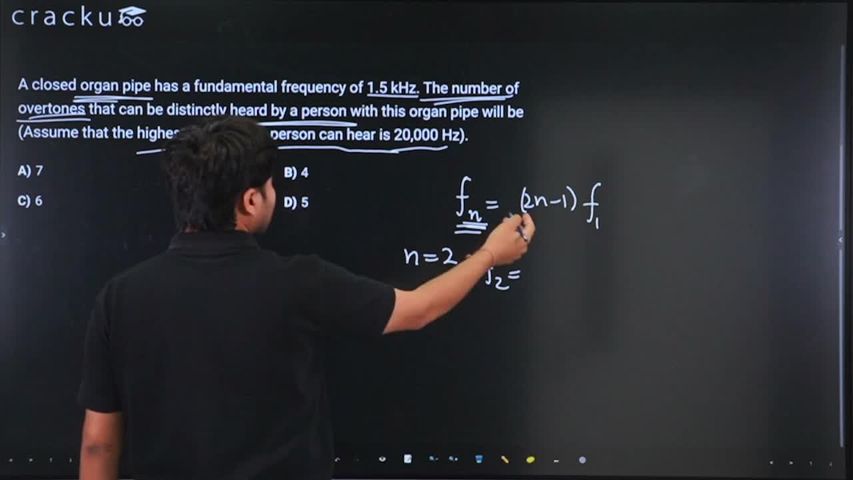
A closed organ pipe has a fundamental frequency of 1.5 kHz. The number of overtones that can be distinctly heard by a person with this organ pipe will be (Assume that the highest frequency a person can hear is 20,000 Hz).
We have a closed organ pipe whose fundamental (first harmonic) frequency is given as $$f_1 = 1.5\ \text{kHz} = 1500\ \text{Hz}.$$
For a pipe closed at one end, only odd harmonics are present. The general formula for the frequency of the $$n^{\text{th}}$$ harmonic in such a pipe is
$$f_n = (2n - 1)\,f_1,\qquad n = 1, 2, 3, \ldots$$
Now we substitute $$f_1 = 1500\ \text{Hz}$$ to generate all possible harmonics and compare them with the upper audible limit of $$20000\ \text{Hz}.$$
For $$n = 1$$ (fundamental):
$$f_1 = (2\!\times\!1 - 1)\,f_1 = 1\,f_1 = 1500\ \text{Hz}.$$
For $$n = 2$$ (third harmonic, but first overtone):
$$f_2 = (2\!\times\!2 - 1)\,f_1 = 3\,f_1 = 3 \times 1500 = 4500\ \text{Hz}.$$
For $$n = 3$$:
$$f_3 = (2\!\times\!3 - 1)\,f_1 = 5\,f_1 = 5 \times 1500 = 7500\ \text{Hz}.$$
For $$n = 4$$:
$$f_4 = (2\!\times\!4 - 1)\,f_1 = 7\,f_1 = 7 \times 1500 = 10500\ \text{Hz}.$$
For $$n = 5$$:
$$f_5 = (2\!\times\!5 - 1)\,f_1 = 9\,f_1 = 9 \times 1500 = 13500\ \text{Hz}.$$
For $$n = 6$$:
$$f_6 = (2\!\times\!6 - 1)\,f_1 = 11\,f_1 = 11 \times 1500 = 16500\ \text{Hz}.$$
For $$n = 7$$:
$$f_7 = (2\!\times\!7 - 1)\,f_1 = 13\,f_1 = 13 \times 1500 = 19500\ \text{Hz}.$$
For $$n = 8$$:
$$f_8 = (2\!\times\!8 - 1)\,f_1 = 15\,f_1 = 15 \times 1500 = 22500\ \text{Hz}.$$ This exceeds the audible limit of $$20000\ \text{Hz}$$ and therefore cannot be heard.
So all harmonics whose frequencies are ≤ $$20000\ \text{Hz}$$ correspond to $$n = 1, 2, 3, 4, 5, 6, 7.$$ That makes $$7$$ audible harmonics in total.
However, the question asks for the number of overtones. Overtones are all audible harmonics except the fundamental. Thus,
$$\text{Number of overtones} = 7 \;(\text{audible harmonics}) - 1 \;(\text{fundamental}) = 6.$$
Hence, the correct answer is Option C.
Was this solution helpful?
Click on the Email ☝️ to Watch the Video Solution
Create a FREE account and get:
_1.webp)

Educational materials for JEE preparation

Ask our AI anything

AI can make mistakes. Please verify important information.
AI can make mistakes. Please verify important information.


