
Join Our JEE Preparation Group
Prep with like-minded aspirants; Get access to free daily tests and study material.
Sign in
Please select an account to continue using cracku.in
↓ →
Join Our JEE Preparation Group
Prep with like-minded aspirants; Get access to free daily tests and study material.
Charges $$-q$$ and $$+q$$, located at A and B, respectively, constitute an electric dipole. Distance $$AB = 2a$$, $$O$$ is the mid point of the dipole and $$OP$$ is perpendicular to $$AB$$. A charge $$Q$$ is placed at P where $$OP = y$$ and $$y \gg 2a$$. The charge $$Q$$ experiences an electrostatic force $$F$$. If $$Q$$ is now moved along the equatorial line to P' such that $$OP' = \frac{y}{3}$$, the force on $$Q$$ will be close to ($$\frac{y}{3} \ll 2a$$):
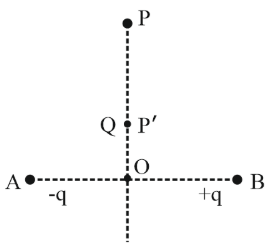
The electric field ($$E$$) at a distance $$r$$ on the equatorial plane of a dipole where $$r \gg 2a$$ is given by: $$E = \frac{k p}{r^3}$$
Since the electrostatic force on a charge $$Q$$ is $$F = Q \cdot E$$, the force is inversely proportional to the cube of the distance ($$F \propto \frac{1}{r^3}$$): $$F = \frac{k \cdot Q \cdot p}{y^3}$$
When the charge $$Q$$ is moved to position $$P'$$ at a distance $$r' = \frac{y}{3}$$ (given that it still satisfies far-field approximations relative to the small dipole separation), the new force $$F'$$ becomes:
$$F' = \frac{k \cdot Q \cdot p}{\left(\frac{y}{3}\right)^3} = \frac{k \cdot Q \cdot p}{\frac{y^3}{27}} = 27 \cdot \left(\frac{k \cdot Q \cdot p}{y^3}\right) = 27F$$
Was this solution helpful?
Create a FREE account and get:
_1.webp)

Educational materials for JEE preparation

Ask our AI anything

AI can make mistakes. Please verify important information.
AI can make mistakes. Please verify important information.


