Join Our JEE Preparation Group
Prep with like-minded aspirants; Get access to free daily tests and study material.
Sign in
Please select an account to continue using cracku.in
↓ →
Join Our JEE Preparation Group
Prep with like-minded aspirants; Get access to free daily tests and study material.
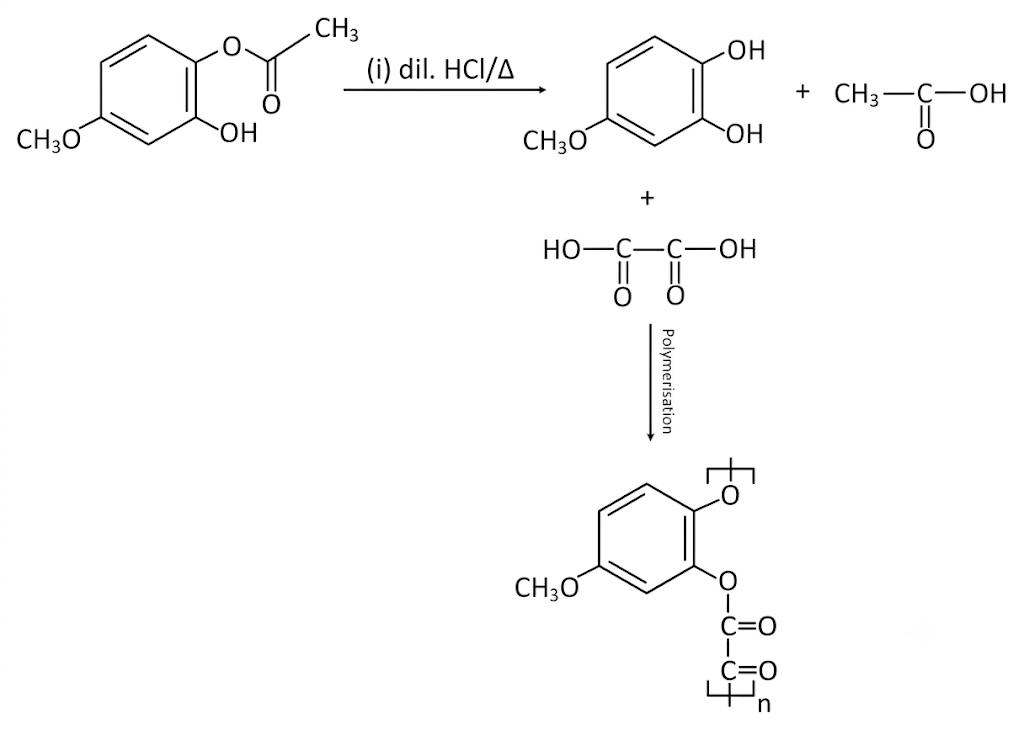
Step 1: Acid-Catalyzed Hydrolysis (Cleavage)
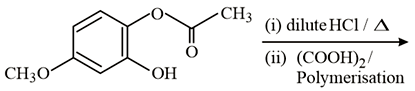
Treating the substrate with dilute $$\text{HCl}$$ and heat ($$\Delta$$) selectively hydrolyzes both the methoxy ether ($$-\text{OCH}_3$$) and the ester group ($$-\text{O--C}(=\text{O})\text{CH}_3$$). This unmasks two phenolic hydroxyl groups ($$-\text{OH}$$) on the aromatic ring, yielding a catechol-like intermediate with a net total of two reactive phenolic hydroxyl groups.
Step 2: Condensation Polymerization
The resulting dihydroxy aromatic intermediate reacts with oxalic acid ($$(\text{COOH})_2$$), which acts as a dicarboxylic acid monomer. A step-growth condensation polymerization takes place, eliminating water ($$\text{H}_2\text{O}$$) molecules to form alternating ester linkages (a polyester backbone).
Was this solution helpful?
Create a FREE account and get:
_1.webp)

Educational materials for JEE preparation

Ask our AI anything

AI can make mistakes. Please verify important information.
AI can make mistakes. Please verify important information.