
Join Our JEE Preparation Group
Prep with like-minded aspirants; Get access to free daily tests and study material.
Sign in
Please select an account to continue using cracku.in
↓ →
Join Our JEE Preparation Group
Prep with like-minded aspirants; Get access to free daily tests and study material.
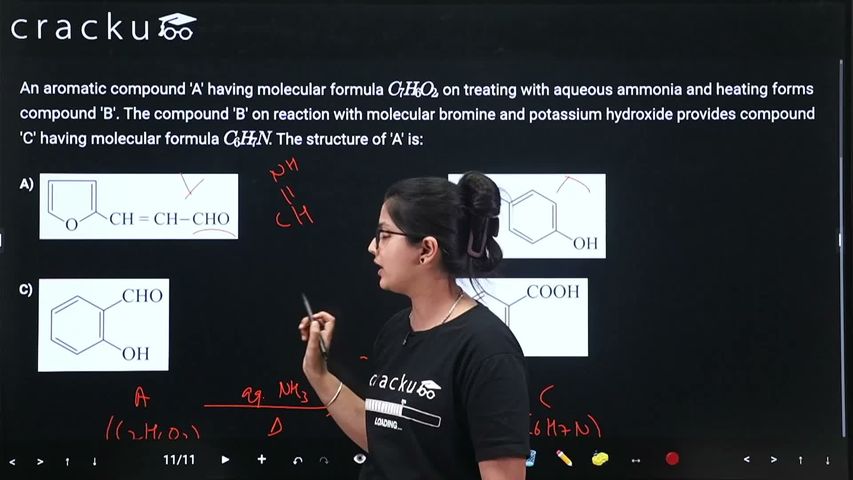
An aromatic compound 'A' having molecular formula $$C_7H_6O_2$$, on treating with aqueous ammonia and heating forms compound 'B'. The compound 'B' on reaction with molecular bromine and potassium hydroxide provides compound 'C' having molecular formula $$C_6H_7N$$. The structure of 'A' is:
We have an aromatic compound ‘A’ whose molecular formula is $$C_7H_6O_2$$. The four structures proposed in the options are:
(i) Furfural (ii) p-Hydroxy-benzaldehyde (iii) Salicylaldehyde (iv) Benzoic acid
All the options except furfural are benzenoid and possess the same molecular formula as that of ‘A’, so we must look at the given reactions to decide.
First reaction: “A on treating with aqueous ammonia and heating forms compound ‘B’.” Aqueous ammonia converts a carboxylic acid into its amide when the mixture is heated:
$$\text{R-COOH}+NH_3 \;\xrightarrow{\ \Delta\ }\; \text{R-CONH}_2+H_2O$$
Out of the given structures only benzoic acid (Option D) is a carboxylic acid; the two hydroxy-benzaldehydes contain an aldehyde group while furfural is a hetero-aromatic aldehyde. Hence, if ‘A’ were benzoic acid, the reaction with ammonia would give benzamide:
$$C_6H_5COOH + NH_3 \;\xrightarrow{\ \Delta\ }\; C_6H_5CONH_2 + H_2O$$
Let us check the formula of benzamide so obtained. The ring contributes $$C_6H_5$$ and the CONH2 group contributes one carbon, one oxygen, one nitrogen and two hydrogens. Therefore the total is $$C_7H_7NO$$, exactly what would be expected for ‘B’.
Second reaction: “B on reaction with molecular bromine and KOH gives compound ‘C’ having molecular formula $$C_6H_7N$$.” Bromine in alkaline medium converts an amide into an amine with one carbon atom less: this is the Hofmann rearrangement:
$$\text{R-CONH}_2 \;+\; Br_2 \;+\; 4\,KOH \;\longrightarrow\; \text{R-NH}_2 \;+\; K_2CO_3 \;+\; 2\,KBr \;+\; 2\,H_2O$$
Applying the same to benzamide:
$$C_6H_5CONH_2 \xrightarrow[{KOH}]{Br_2}\; C_6H_5NH_2 + CO_2$$
The amine obtained is aniline; its molecular formula is $$C_6H_7N$$ (six carbons from the ring, five ring hydrogens plus two hydrogens on -NH2). This matches perfectly with the formula given for compound ‘C’, confirming our deduction.
Since the whole sequence of reactions fits only when ‘A’ is benzoic acid, we conclude that:
‘A’ ≡ $$C_6H_5COOH$$, i.e., benzoic acid.
Hence, the correct answer is Option D.
Was this solution helpful?
Click on the Email ☝️ to Watch the Video Solution
Create a FREE account and get:
_1.webp)

Educational materials for JEE preparation

Ask our AI anything

AI can make mistakes. Please verify important information.
AI can make mistakes. Please verify important information.


