
Join Our JEE Preparation Group
Prep with like-minded aspirants; Get access to free daily tests and study material.
Sign in
Please select an account to continue using cracku.in
↓ →
Join Our JEE Preparation Group
Prep with like-minded aspirants; Get access to free daily tests and study material.
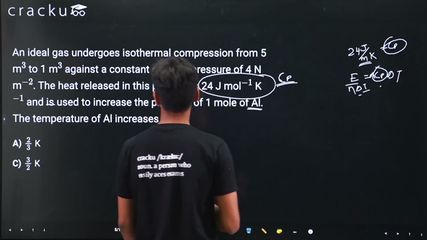
An ideal gas undergoes isothermal compression from 5 m$$^3$$ to 1 m$$^3$$ against a constant external pressure of 4 N m$$^{-2}$$. The heat released in this process is 24 J mol$$^{-1}$$ K$$^{-1}$$ and is used to increase the pressure of 1 mole of Al. The temperature of Al increases by:
We begin with the isothermal compression of an ideal gas. For an ideal gas kept at constant temperature, the change in internal energy is zero, so we must have, according to the First Law of Thermodynamics,
$$\Delta U \;=\; q \;+\; w \;=\; 0.$$
Here $$q$$ is the heat absorbed by the gas (positive if the gas takes in heat) and $$w$$ is the work done on the gas (positive if work is done on the system).
The compression is carried out against a constant external pressure $$p_{\text{ext}} = 4\;\text{N m}^{-2}$$. The initial and final volumes are $$V_i = 5\;\text{m}^3$$ and $$V_f = 1\;\text{m}^3$$ respectively. The change in volume is therefore
$$\Delta V \;=\; V_f \;-\; V_i \;=\; 1\;-\;5 \;=\; -4\;\text{m}^3.$$
The work done on the gas in an irreversible process at constant external pressure is given by the formula
$$w \;=\; -\,p_{\text{ext}}\;\Delta V.$$
Substituting the numerical values, we have
$$w \;=\; -\,\bigl(4\;\text{N m}^{-2}\bigr)\;\bigl(-4\;\text{m}^3\bigr) \;=\; +16\;\text{J}.$$
Thus $$16\;\text{J}$$ of work is done on the gas.
Because the process is isothermal, $$\Delta U = 0$$. Inserting this and the value of $$w$$ into the First-Law relation $$\Delta U = q + w$$, we obtain
$$0 \;=\; q \;+\; 16\;\text{J},$$
so
$$q \;=\; -16\;\text{J}.$$
The negative sign tells us that the gas releases $$16\;\text{J}$$ of heat to the surroundings.
This released heat is entirely absorbed by $$1$$ mole of aluminium. The molar heat capacity of aluminium (at constant pressure) is given in the statement as
$$C_{p,\text{Al}} \;=\; 24\;\text{J mol}^{-1}\,\text{K}^{-1}.$$
For a substance absorbing heat at constant pressure, the temperature rise is obtained from the relation
$$q \;=\; n\,C_p\,\Delta T,$$
where $$n$$ is the amount of substance. Here $$n = 1\;\text{mol}$$ and the magnitude of the absorbed heat is $$|q| = 16\;\text{J}$$. Therefore
$$16\;\text{J} \;=\; 1\;\text{mol}\;\times\;24\;\text{J mol}^{-1}\,\text{K}^{-1}\;\times\;\Delta T,$$
which gives
$$\Delta T \;=\; \frac{16}{24}\;\text{K} \;=\; \frac{2}{3}\;\text{K}.$$
Thus the temperature of the aluminium rises by $$\dfrac{2}{3}\;\text{K}$$.
Hence, the correct answer is Option A.
Was this solution helpful?
Click on the Email ☝️ to Watch the Video Solution
Create a FREE account and get:
_1.webp)

Educational materials for JEE preparation

Ask our AI anything

AI can make mistakes. Please verify important information.
AI can make mistakes. Please verify important information.


