
Join Our JEE Preparation Group
Prep with like-minded aspirants; Get access to free daily tests and study material.
Sign in
Please select an account to continue using cracku.in
↓ →
Join Our JEE Preparation Group
Prep with like-minded aspirants; Get access to free daily tests and study material.
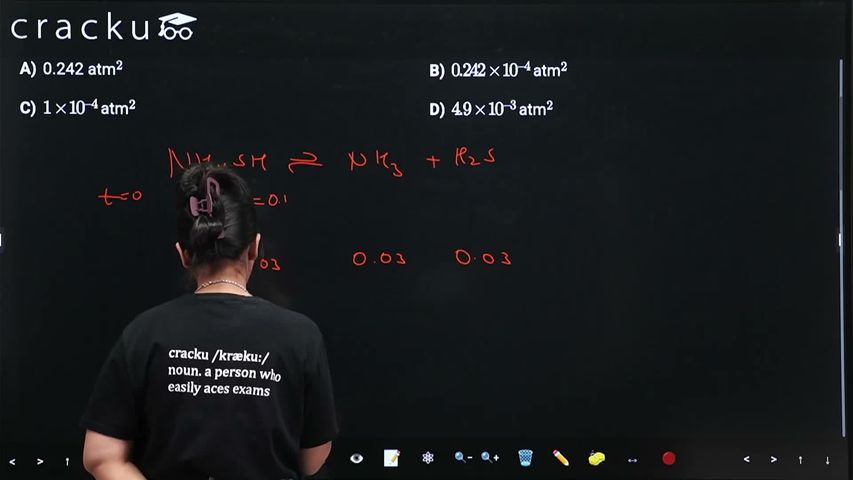
5.1 g $$NH_4SH$$ is introduced in 3.0 L evacuated flask at 327$$^{\circ}$$C. 30% of the solid $$NH_4SH$$ is decomposed to $$NH_3$$ and $$H_2S$$ as gases. The $$K_P$$ of the reaction at 327$$^{\circ}$$C is: ($$R = 0.082$$ L atm mol$$^{-1}$$ K$$^{-1}$$, Molar mass of S = 32 g mol$$^{-1}$$, Molar mass of N = 14 g mol$$^{-1}$$)
We consider the equilibrium
$$NH_4SH(s) \;\rightleftharpoons\; NH_3(g) + H_2S(g)$$
The solid $$NH_4SH$$ does not appear in the equilibrium-constant expression, so we only need the partial pressures of $$NH_3$$ and $$H_2S$$ that are produced by the decomposition.
First we calculate how many moles of the solid are initially present. The molar mass of $$NH_4SH$$ is obtained by adding the atomic masses of all the atoms:
$$M(NH_4SH)=M(N)+4M(H)+M(S)+M(H) = 14 + 4(1) + 32 + 1 = 51\ {\rm g\;mol^{-1}}$$
So, from 5.1 g we have
$$n_{\text{initial}}(NH_4SH)=\frac{5.1\ \text{g}}{51\ \text{g mol}^{-1}}=0.10\ \text{mol}$$
Only 30 % of this amount decomposes. Hence the number of moles that actually break down is
$$n_{\text{decomposed}} = 0.30 \times 0.10\ \text{mol}=0.030\ \text{mol}$$
Because the stoichiometry of the reaction is 1 : 1 : 1, the same amount of each gas is formed:
$$n(NH_3)=0.030\ \text{mol}, \qquad n(H_2S)=0.030\ \text{mol}$$
The gases occupy a flask whose volume is 3.0 L, and the temperature is $$T = 327^{\circ}{\rm C} = 327 + 273 = 600\ {\rm K}$$
We now use the ideal-gas equation, stated here for one gas, $$PV = nRT$$ to obtain the partial pressures.
For $$NH_3$$ we have
$$P_{NH_3} = \frac{nRT}{V} = \frac{0.030\ \text{mol}\;(0.082\ \text{L atm mol}^{-1}\text{K}^{-1})\;(600\ \text{K})}{3.0\ \text{L}}$$
$$P_{NH_3} = \frac{0.030 \times 0.082 \times 600}{3.0}\ {\rm atm}$$
$$P_{NH_3} = \frac{1.476}{3.0} = 0.492\ {\rm atm}$$
Exactly the same calculation holds for $$H_2S$$ because it has the same number of moles, so
$$P_{H_2S}=0.492\ {\rm atm}$$
The equilibrium constant in pressure units for the reaction is
$$K_P = P_{NH_3}\,P_{H_2S}$$
Substituting the calculated partial pressures,
$$K_P = (0.492\ {\rm atm}) \times (0.492\ {\rm atm})$$
$$K_P = 0.242\ {\rm atm}^2$$
Hence, the correct answer is Option A.
Was this solution helpful?
Click on the Email ☝️ to Watch the Video Solution
Create a FREE account and get:
_1.webp)

Educational materials for JEE preparation

Ask our AI anything

AI can make mistakes. Please verify important information.
AI can make mistakes. Please verify important information.


