
Join Our JEE Preparation Group
Prep with like-minded aspirants; Get access to free daily tests and study material.
Sign in
Please select an account to continue using cracku.in
↓ →
Join Our JEE Preparation Group
Prep with like-minded aspirants; Get access to free daily tests and study material.
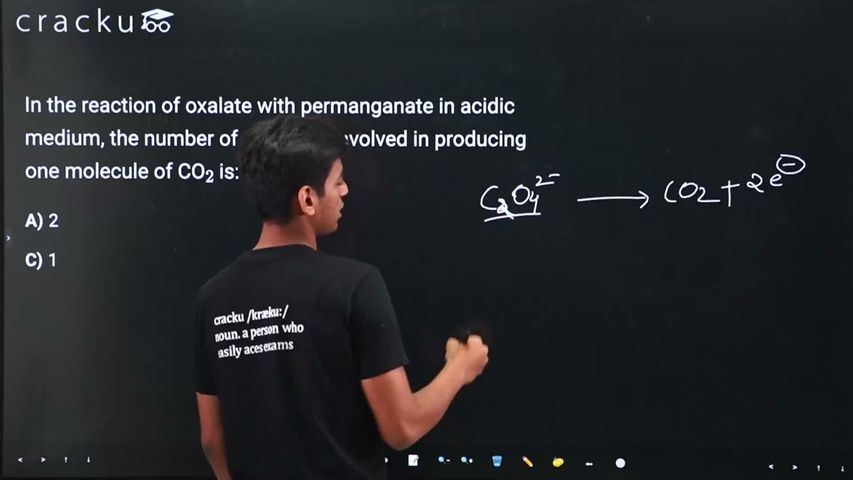
In the reaction of oxalate with permanganate in acidic medium, the number of electrons involved in producing one molecule of CO$$_2$$ is:
We begin by assigning oxidation numbers so that the change in oxidation state, and therefore the electron transfer, can be seen explicitly.
The oxalate ion is $$\mathrm{C_2O_4^{2-}}$$. A general rule states that the sum of oxidation numbers of all atoms in an ion equals the net charge on that ion. Oxygen almost always has oxidation number $$-2$$ in its covalent compounds and ions.
So, if the oxidation number of carbon in oxalate is $$x$$, we write
$$2\,x + 4(-2) = -2.$$
Simplifying, we have
$$2x - 8 = -2,$$
and hence
$$2x = 6.$$
Dividing both sides by $$2$$ gives
$$x = +3.$$
Therefore each carbon atom in oxalate has oxidation number $$+3$$.
Now the product formed on oxidation is carbon dioxide, $$\mathrm{CO_2}$$. In $$\mathrm{CO_2}$$ we again let the oxidation number of carbon be $$y$$. Using the same rule, we write
$$y + 2(-2) = 0,$$
because the molecule is neutral. Hence
$$y - 4 = 0,$$
which gives
$$y = +4.$$
So, in going from oxalate to carbon dioxide the oxidation number of carbon increases from $$+3$$ to $$+4$$. An increase in oxidation number by $$1$$ means that one electron is lost by that carbon atom.
Oxalate contains two carbon atoms. The half-reaction for its oxidation may therefore be written as
$$\mathrm{C_2O_4^{2-} \;\longrightarrow\; 2\,CO_2 \;+\; 2\,e^-}.$$
We see from this balanced oxidation half-reaction that the loss of $$2$$ electrons produces $$2$$ molecules of $$\mathrm{CO_2}$$.
Now we focus on the requirement of the question: the number of electrons corresponding to one molecule of $$\mathrm{CO_2}$$. We have
$$\frac{2\ \text{electrons}}{2\ \text{CO}_2} = 1\ \text{electron per CO}_2.$$
Hence exactly $$1$$ electron is involved in the formation of one molecule of carbon dioxide during the reaction of oxalate with permanganate in acidic medium.
Hence, the correct answer is Option C.
Was this solution helpful?
Click on the Email ☝️ to Watch the Video Solution
Create a FREE account and get:
_1.webp)

Educational materials for JEE preparation

Ask our AI anything

AI can make mistakes. Please verify important information.
AI can make mistakes. Please verify important information.


