
Join Our JEE Preparation Group
Prep with like-minded aspirants; Get access to free daily tests and study material.
Sign in
Please select an account to continue using cracku.in
↓ →
Join Our JEE Preparation Group
Prep with like-minded aspirants; Get access to free daily tests and study material.
A reaction of cobalt (III) chloride and ethylenediamine in a 1 : 2 mole ratio generates two isomeric products A (violet-coloured) and B (green-coloured). A can show optical activity, but, B is optically inactive. What type of isomers do A and B represent?
The metal salt given is cobalt(III) chloride, written as $$\text{CoCl}_3$$.
The ligand is ethylenediamine, commonly abbreviated as $$\text{en}$$.
According to the statement, the mole ratio is $$1:2$$, so we combine one mole of the metal salt with two moles of the bidentate ligand:
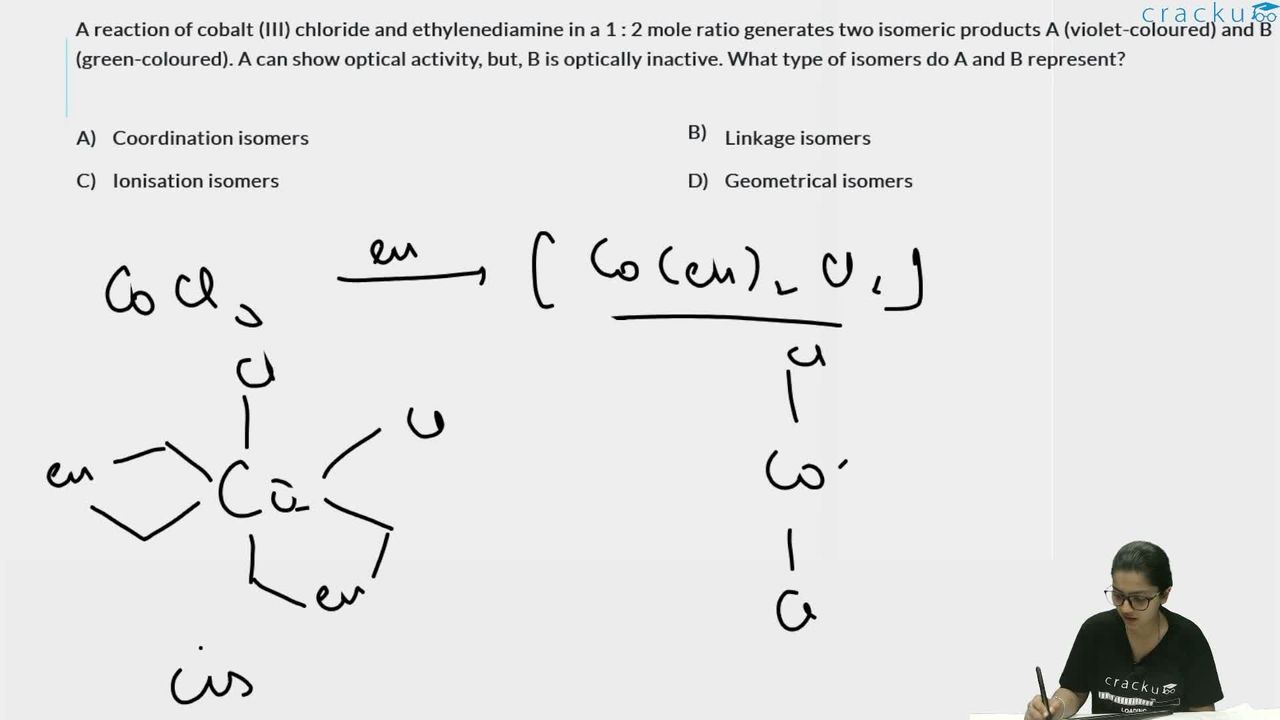
$$\text{CoCl}_3 + 2\,\text{en} \;\longrightarrow\; [\text{Co}(\text{en})_2\text{Cl}_2]\text{Cl}$$
In the product ion $$[\text{Co}(\text{en})_2\text{Cl}_2]^+$$, the cobalt(III) centre has six coordination sites.
We fill those six sites as follows: two sites are occupied by one $$\text{en}$$ ligand (because $$\text{en}$$ is bidentate), another two sites are occupied by the second $$\text{en}$$ ligand, and the remaining two sites are taken by two chloride ions bound directly to cobalt.
Thus the coordination sphere is octahedral:
$$[\text{Co}(\text{en})_2\text{Cl}_2]^+$$
Whenever an octahedral complex contains two identical bidentate ligands ($$\text{en}$$ and $$\text{en}$$) and two identical monodentate ligands ($$\text{Cl}^-$$ and $$\text{Cl}^-$$), two distinct spatial arrangements are possible:
1. Cis arrangement - the two chloride ligands occupy adjacent positions.
2. Trans arrangement - the two chloride ligands occupy positions opposite each other.
The cis form of $$[\text{Co}(\text{en})_2\text{Cl}_2]^+$$ lacks any plane of symmetry or centre of symmetry because the two bidentate $$\text{en}$$ ligands are twisted in such a way that the whole complex becomes chiral.
Therefore the cis isomer is optically active and can rotate the plane of polarised light.
The trans form has a plane of symmetry passing through the cobalt atom and between the two $$\text{en}$$ ligands; this destroys any chirality, rendering the complex optically inactive.
We are told that product A is violet and optically active, while product B is green and optically inactive.
Hence, A must be the cis isomer and B must be the trans isomer.
The cis-trans pair represents a difference in the spatial (geometric) positions of the ligands around the same central atom without altering the connectivity of ligands.
This type of relationship is called geometrical isomerism.
So, A and B are geometrical isomers of each other.
Hence, the correct answer is Option D.
Was this solution helpful?
Click on the Email ☝️ to Watch the Video Solution
Create a FREE account and get:
_1.webp)

Educational materials for JEE preparation

Ask our AI anything

AI can make mistakes. Please verify important information.
AI can make mistakes. Please verify important information.


