
Join Our JEE Preparation Group
Prep with like-minded aspirants; Get access to free daily tests and study material.
Sign in
Please select an account to continue using cracku.in
↓ →
Join Our JEE Preparation Group
Prep with like-minded aspirants; Get access to free daily tests and study material.
The difference in the number of unpaired electrons of a metal ion in its high-spin and low-spin octahedral complexes is two. The metal ion is:
We have to find that metal ion for which the difference between the number of unpaired electrons in its high-spin octahedral complex and in its low-spin octahedral complex is exactly two. For every ion we shall first count its d-electrons, then write the electronic distribution in the octahedral crystal field, and finally count the unpaired electrons.
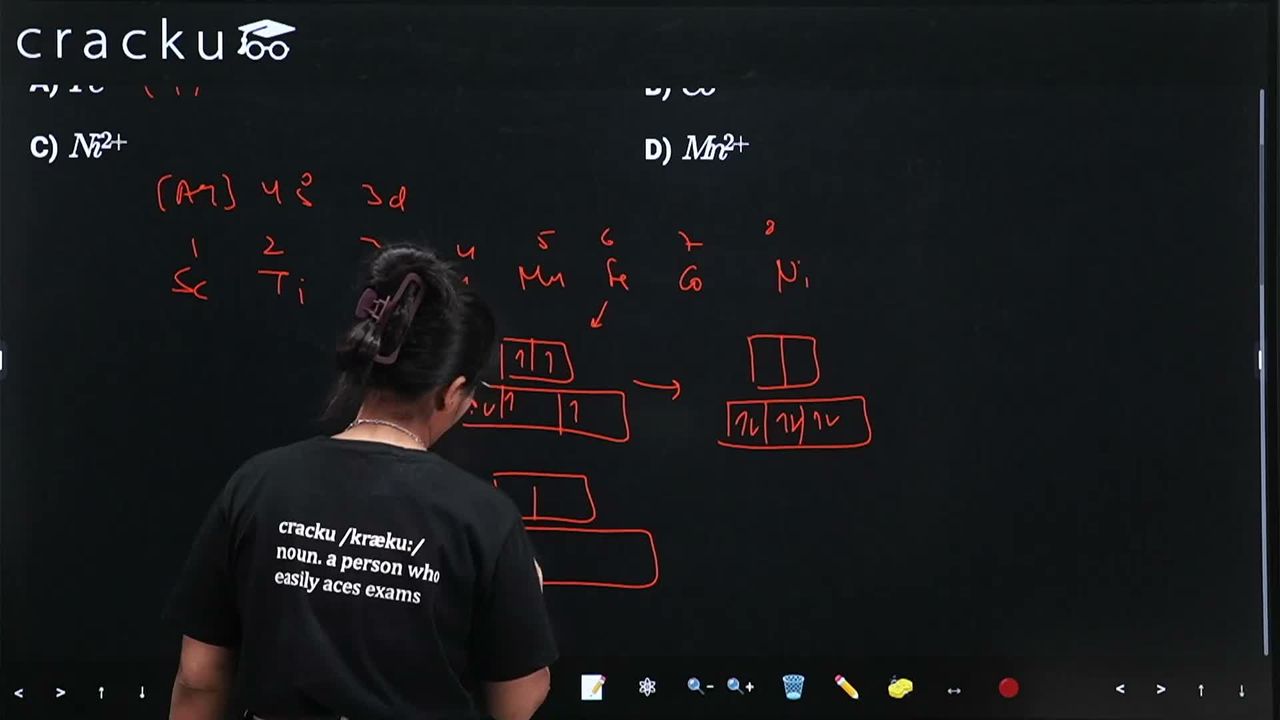
The crystal-field splitting pattern for an octahedral complex is stated first: the five d-orbitals split into the lower energy triply-degenerate $$t_{2g}$$ set and the higher energy doubly-degenerate $$e_{g}$$ set.
For a weak-field (high-spin) case, electrons prefer to occupy the higher $$e_{g}$$ orbitals singly rather than pair in the lower $$t_{2g}$$ orbitals; whereas for a strong-field (low-spin) case, electrons pair in the lower $$t_{2g}$$ orbitals before entering the $$e_{g}$$ set. This rule, together with Hund’s rule (singly occupy each degenerate orbital before pairing within that set), will now be applied to every ion.
Option A: $$Fe^{2+}$$
Atomic number of Fe is 26, so $$Fe^{2+}$$ has $$26-2 = 24$$ electrons, giving a d-count of $$24-18 = 6$$, i.e. $$d^{6}$$.
High-spin $$d^{6}\!: \; t_{2g}^{4}\,e_{g}^{2}$$ Counting unpaired electrons: the four electrons in $$t_{2g}$$ leave two unpaired, and the two electrons in $$e_{g}$$ are unpaired, giving $$n_{\text{u,HS}} = 4$$.
Low-spin $$d^{6}\!: \; t_{2g}^{6}\,e_{g}^{0}$$ is completely paired, so $$n_{\text{u,LS}} = 0$$.
Difference $$= 4-0 = 4 \neq 2$$; so $$Fe^{2+}$$ is rejected.
Option B: $$Co^{2+}$$
Atomic number of Co is 27, hence $$Co^{2+}$$ has $$27-2 = 25$$ electrons, i.e. $$d^{7}$$.
High-spin $$d^{7}\!: \; t_{2g}^{5}\,e_{g}^{2}$$ Inside $$t_{2g}$$ the first three electrons are singly filled (↑↑↑), the next two pair in the first two orbitals, leaving one unpaired electron there. The two electrons in $$e_{g}$$ occupy the two $$e_{g}$$ orbitals singly. Thus $$n_{\text{u,HS}} = 1 + 2 = 3$$.
Low-spin $$d^{7}\!: \; t_{2g}^{6}\,e_{g}^{1}$$ is obtained by first fully pairing $$t_{2g}$$. All six $$t_{2g}$$ electrons are paired, and the single $$e_{g}$$ electron remains unpaired, so $$n_{\text{u,LS}} = 1$$.
Difference $$= 3-1 = 2$$, exactly the required value, so $$Co^{2+}$$ satisfies the condition.
Option C: $$Ni^{2+}$$
Atomic number of Ni is 28, so $$Ni^{2+}$$ has $$28-2 = 26$$ electrons, corresponding to $$d^{8}$$.
Both high-spin and low-spin arrangements give the same distribution $$t_{2g}^{6}\,e_{g}^{2}$$ because once $$t_{2g}$$ is full any additional electron must enter $$e_{g}$$. In the two degenerate $$e_{g}$$ orbitals the electrons occupy them singly, producing $$n_{\text{u,HS}} = n_{\text{u,LS}} = 2$$.
Difference $$= 2-2 = 0 \neq 2$$; hence $$Ni^{2+}$$ is ruled out.
Option D: $$Mn^{2+}$$
Atomic number of Mn is 25, giving $$Mn^{2+}$$ $$\rightarrow d^{5}$$.
High-spin $$d^{5}\!: \; t_{2g}^{3}\,e_{g}^{2}$$ has all five electrons unpaired, $$n_{\text{u,HS}} = 5$$.
Low-spin $$d^{5}\!: \; t_{2g}^{5}\,e_{g}^{0}$$ has one orbital in $$t_{2g}$$ containing a single electron, the other two orbitals paired, giving $$n_{\text{u,LS}} = 1$$.
Difference $$= 5-1 = 4 \neq 2$$; therefore $$Mn^{2+}$$ is also rejected.
Among the four choices, only $$Co^{2+}$$ shows a difference of exactly two in the number of unpaired electrons between its high-spin and low-spin octahedral complexes.
Hence, the correct answer is Option B.
Was this solution helpful?
Click on the Email ☝️ to Watch the Video Solution
Create a FREE account and get:
_1.webp)

Educational materials for JEE preparation

Ask our AI anything

AI can make mistakes. Please verify important information.
AI can make mistakes. Please verify important information.


