
Join Our JEE Preparation Group
Prep with like-minded aspirants; Get access to free daily tests and study material.
Sign in
Please select an account to continue using cracku.in
↓ →
Join Our JEE Preparation Group
Prep with like-minded aspirants; Get access to free daily tests and study material.
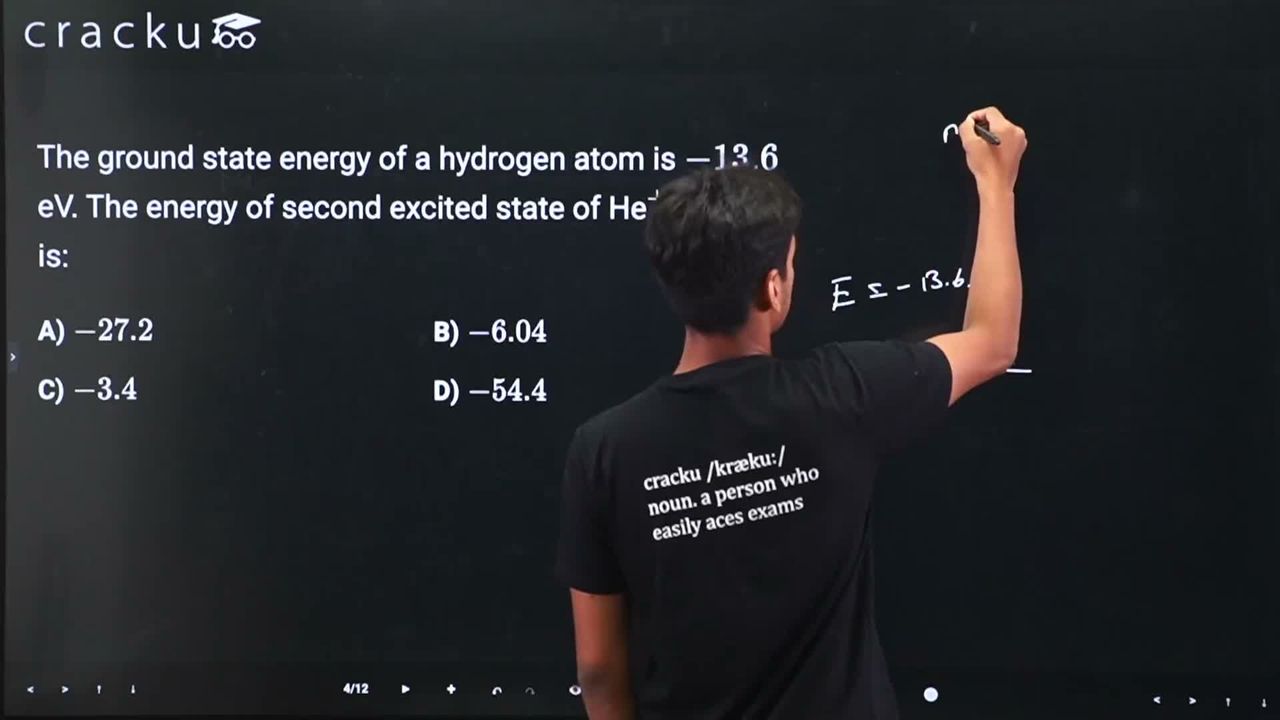
The ground state energy of a hydrogen atom is $$-13.6$$ eV. The energy of second excited state of He$$^+$$ ion in eV is:
We are dealing with hydrogen-like (single-electron) species. For any such species, the energy of an electron in the $$n^{\text{th}}$$ stationary state is given by the well-known expression
$$E_n = -13.6\;{\rm eV}\;\frac{Z^2}{n^2},$$
where $$Z$$ is the atomic number of the nucleus and $$n$$ is the principal quantum number. The factor $$-13.6\;{\rm eV}$$ is the ground-state energy of the hydrogen atom ($$Z = 1,\; n = 1$$) that has been provided in the question.
For the helium ion He$$^+$$ we have only one electron but the nuclear charge is double that of hydrogen, so
$$Z = 2.$$
Next we interpret the phrase “second excited state.” The counting of states goes as follows:
Hence we must use $$n = 3$$ for our calculation.
Substituting $$Z = 2$$ and $$n = 3$$ into the energy formula gives
$$E_3 = -13.6\;{\rm eV}\;\frac{(2)^2}{(3)^2}.$$
We now carry out the algebra step by step:
$$E_3 = -13.6\;{\rm eV}\;\frac{4}{9}.$$
Multiplying numerator and denominator we get
$$E_3 = -13.6 \times \frac{4}{9}\;{\rm eV}.$$
First compute the product in the numerator:
$$13.6 \times 4 = 54.4.$$
Therefore,
$$E_3 = -\frac{54.4}{9}\;{\rm eV}.$$
Finally, dividing $$54.4$$ by $$9$$ yields
$$E_3 = -6.044\ldots\;{\rm eV} \approx -6.04\;{\rm eV}.$$
Looking at the given options, this value matches Option B.
Hence, the correct answer is Option B.
Was this solution helpful?
Click on the Email ☝️ to Watch the Video Solution
Create a FREE account and get:
_1.webp)

Educational materials for JEE preparation

Ask our AI anything

AI can make mistakes. Please verify important information.
AI can make mistakes. Please verify important information.


