
Join Our JEE Preparation Group
Prep with like-minded aspirants; Get access to free daily tests and study material.
Sign in
Please select an account to continue using cracku.in
↓ →
Join Our JEE Preparation Group
Prep with like-minded aspirants; Get access to free daily tests and study material.
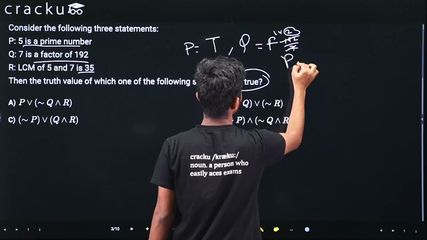
Consider the following three statements:
P: 5 is a prime number
Q: 7 is a factor of 192
R: LCM of 5 and 7 is 35
Then the truth value of which one of the following statements is true?
First, we list the three simple statements exactly as given and decide whether each one is true or false.
$$P : \; 5 \text{ is a prime number}$$ Because a prime number has exactly two distinct positive divisors, namely 1 and itself, and $$5$$ satisfies this definition, we have $$P = \text{True}.$$
$$Q : \; 7 \text{ is a factor of } 192$$ A number $$a$$ is a factor of $$b$$ if and only if $$b \div a$$ is an integer. Computing $$\dfrac{192}{7}=27.428571\ldots$$ which is not an integer, so $$7$$ is not a factor of $$192$$. Hence $$Q = \text{False}.$$
$$R : \; \text{LCM of } 5 \text{ and } 7 \text{ is } 35$$ Since $$5$$ and $$7$$ are coprime, their least common multiple equals their product, i.e. $$\text{LCM}(5,7)=5 \times 7 = 35.$$ Therefore $$R = \text{True}.$$
Next, we evaluate each compound statement in the options by substituting these truth values and applying the standard logical rules.
Option A: $$P \vee (\sim Q \wedge R)$$ First find each component: $$\sim Q = \text{not False} = \text{True},$$ so $$\sim Q \wedge R = \text{True} \wedge \text{True} = \text{True}.$$ Now use the value of $$P$$ together with the disjunction rule: $$P \vee (\sim Q \wedge R) = \text{True} \vee \text{True} = \text{True}.$$
Option B: $$(P \wedge Q) \vee (\sim R)$$ Compute the conjunction $$P \wedge Q$$: $$P \wedge Q = \text{True} \wedge \text{False} = \text{False}.$$ Next negate $$R$$: $$\sim R = \text{not True} = \text{False}.$$ Finally take their disjunction: $$(P \wedge Q) \vee (\sim R) = \text{False} \vee \text{False} = \text{False}.$$
Option C: $$(\sim P) \vee (Q \wedge R)$$ Negate $$P$$: $$\sim P = \text{not True} = \text{False}.$$ Find $$Q \wedge R$$: $$Q \wedge R = \text{False} \wedge \text{True} = \text{False}.$$ Now the disjunction: $$(\sim P) \vee (Q \wedge R) = \text{False} \vee \text{False} = \text{False}.$$
Option D: $$(\sim P) \wedge (\sim Q \wedge R)$$ From above, $$\sim P = \text{False}$$ and $$\sim Q \wedge R = \text{True}$$. Therefore the conjunction gives $$(\sim P) \wedge (\sim Q \wedge R) = \text{False} \wedge \text{True} = \text{False}.$$
Summarizing the evaluations:
$$\text{Option A} = \text{True}, \quad \text{Option B} = \text{False}, \quad \text{Option C} = \text{False}, \quad \text{Option D} = \text{False}.$$
Only Option A yields the truth value “True”.
Hence, the correct answer is Option A.
Was this solution helpful?
Click on the Email ☝️ to Watch the Video Solution
Create a FREE account and get:
_1.webp)

Educational materials for JEE preparation

Ask our AI anything

AI can make mistakes. Please verify important information.
AI can make mistakes. Please verify important information.


