
Join Our JEE Preparation Group
Prep with like-minded aspirants; Get access to free daily tests and study material.
Sign in
Please select an account to continue using cracku.in
↓ →
Join Our JEE Preparation Group
Prep with like-minded aspirants; Get access to free daily tests and study material.
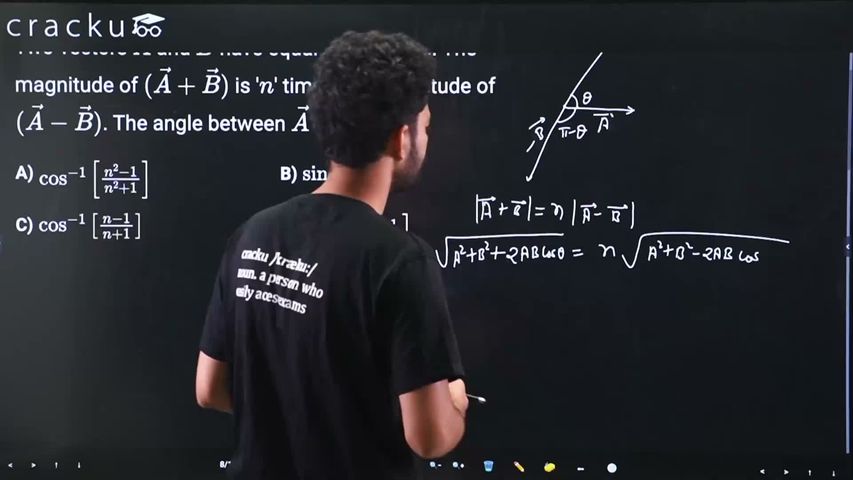
Two vectors $$\vec{A}$$ and $$\vec{B}$$ have equal magnitudes. The magnitude of $$(\vec{A} + \vec{B})$$ is '$$n$$' times the magnitude of $$(\vec{A} - \vec{B})$$. The angle between $$\vec{A}$$ and $$\vec{B}$$ is:
We are told that the two vectors $$\vec A$$ and $$\vec B$$ have the same magnitude. Let us denote this common magnitude by $$a$$, so that we can write $$|\vec A| = |\vec B| = a$$.
The angle between the two vectors will be denoted by $$\theta$$. Our objective is to find an expression for this angle in terms of the given constant $$n$$.
First, we recall the standard vector identity for the magnitude of the sum of two vectors:
$$|\vec A + \vec B|^2 = |\vec A|^2 + |\vec B|^2 + 2|\vec A|\,|\vec B|\cos\theta.$$
Substituting $$|\vec A| = |\vec B| = a$$ into this formula gives
$$|\vec A + \vec B|^2 \;=\; a^2 + a^2 + 2a\cdot a\cos\theta \;=\; 2a^2(1+\cos\theta).$$
In exactly the same way we use the identity for the magnitude of the difference of two vectors:
$$|\vec A - \vec B|^2 = |\vec A|^2 + |\vec B|^2 - 2|\vec A|\,|\vec B|\cos\theta.$$
Again substituting $$a$$ for the magnitudes, we obtain
$$|\vec A - \vec B|^2 \;=\; a^2 + a^2 - 2a\cdot a\cos\theta \;=\; 2a^2(1-\cos\theta).$$
The statement of the problem says that the magnitude of $$\vec A + \vec B$$ is $$n$$ times the magnitude of $$\vec A - \vec B$$, that is,
$$|\vec A + \vec B| = n\,|\vec A - \vec B|.$$
We square both sides to eliminate the square roots:
$$|\vec A + \vec B|^2 = n^2\,|\vec A - \vec B|^2.$$
Now we substitute the expressions we have already derived:
$$2a^2(1+\cos\theta) = n^2\,[\,2a^2(1-\cos\theta)\,].$$
Because the factor $$2a^2$$ is present on both sides, we can divide it out immediately, giving
$$(1+\cos\theta) = n^2(1-\cos\theta).$$
Let us bring all the terms involving $$\cos\theta$$ to one side so that we can solve for $$\cos\theta$$ explicitly:
$$(1+\cos\theta) = n^2 - n^2\cos\theta,$$
$$\cos\theta + n^2\cos\theta = n^2 - 1,$$
$$\cos\theta\,(1 + n^2) = n^2 - 1,$$
$$\cos\theta = \dfrac{n^2 - 1}{n^2 + 1}.$$
Thus the angle $$\theta$$ between the two vectors is given by the inverse cosine of the right-hand side:
$$\theta = \cos^{-1}\!\left(\dfrac{n^2 - 1}{n^2 + 1}\right).$$
This expression exactly matches Option A.
Hence, the correct answer is Option A.
Was this solution helpful?
Click on the Email ☝️ to Watch the Video Solution
Create a FREE account and get:
_1.webp)

Educational materials for JEE preparation

Ask our AI anything

AI can make mistakes. Please verify important information.
AI can make mistakes. Please verify important information.


