
Join Our JEE Preparation Group
Prep with like-minded aspirants; Get access to free daily tests and study material.
Sign in
Please select an account to continue using cracku.in
↓ →
Join Our JEE Preparation Group
Prep with like-minded aspirants; Get access to free daily tests and study material.
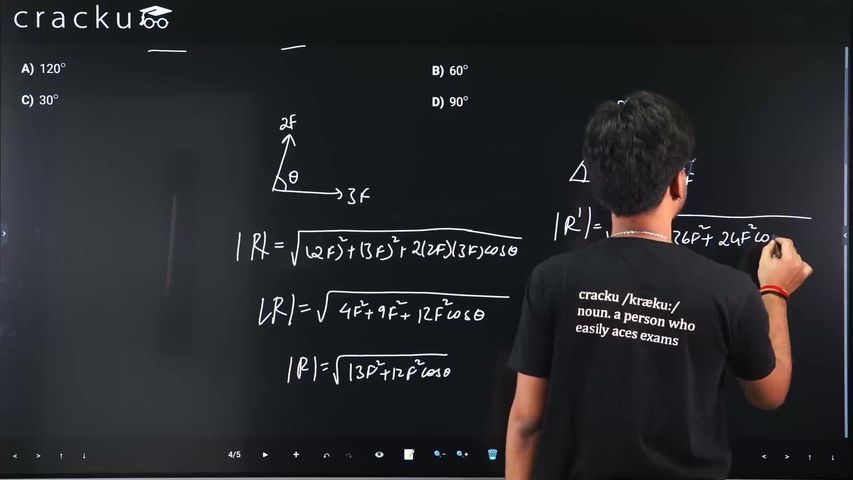
Two forces P and Q, of magnitude 2F and 3F, respectively, are at an angle $$\theta$$ with each other. If the force Q is doubled, then their resultant also gets doubled. Then, the angle $$\theta$$ is:
Let us denote the two original forces as $$P$$ and $$Q$$, with magnitudes
$$P = 2F \quad\text{and}\quad Q = 3F.$$
The magnitude of the resultant of two forces that act at an angle $$\theta$$ is given by the law of vector addition (parallelogram law):
$$R \;=\; \sqrt{P^{2} + Q^{2} + 2PQ\cos\theta}.$$
Substituting the given values of $$P$$ and $$Q$$, we obtain
$$R \;=\; \sqrt{(2F)^{2} \;+\; (3F)^{2} \;+\; 2\,(2F)(3F)\cos\theta}.$$
Carrying out the squares and the product,
$$R \;=\; \sqrt{4F^{2} \;+\; 9F^{2} \;+\; 12F^{2}\cos\theta}.$$
Adding the first two terms inside the square root,
$$R \;=\; \sqrt{13F^{2} \;+\; 12F^{2}\cos\theta}.$$
So we have
$$R^{2} \;=\; 13F^{2} + 12F^{2}\cos\theta. \quad -(1)$$
Now, the problem states that the force $$Q$$ is doubled. Therefore, the new magnitude of that force becomes
$$Q' = 2Q = 2(3F) = 6F.$$
The magnitude $$R'$$ of the new resultant (with the same angle $$\theta$$ between $$P$$ and the new $$Q'$$) is then
$$R' \;=\; \sqrt{P^{2} + Q'^{2} + 2PQ'\cos\theta}.$$
Substituting $$P = 2F$$ and $$Q' = 6F$$ gives
$$R' \;=\; \sqrt{(2F)^{2} \;+\; (6F)^{2} \;+\; 2\,(2F)(6F)\cos\theta}.$$
This becomes
$$R' \;=\; \sqrt{4F^{2} \;+\; 36F^{2} \;+\; 24F^{2}\cos\theta}.$$
So,
$$R'^{2} \;=\; 40F^{2} + 24F^{2}\cos\theta. \quad -(2)$$
The crucial information given is that the new resultant is twice the original resultant, i.e.
$$R' = 2R.$$
Squaring this relation, we get
$$R'^{2} = 4R^{2}. \quad -(3)$$
Now we substitute the expressions from (1) and (2) into equation (3):
$$40F^{2} + 24F^{2}\cos\theta \;=\; 4\bigl(13F^{2} + 12F^{2}\cos\theta\bigr).$$
Expanding the right-hand side,
$$40F^{2} + 24F^{2}\cos\theta \;=\; 52F^{2} + 48F^{2}\cos\theta.$$
Next, we collect like terms on one side. Subtract the right-hand side from the left-hand side:
$$\bigl(40F^{2} - 52F^{2}\bigr) + \bigl(24F^{2}\cos\theta - 48F^{2}\cos\theta\bigr) = 0.$$
This simplifies to
$$-12F^{2} \;-\; 24F^{2}\cos\theta = 0.$$
Dividing every term by the non-zero quantity $$-12F^{2}$$, we obtain
$$1 + 2\cos\theta = 0.$$
Hence,
$$2\cos\theta = -1 \quad\Longrightarrow\quad \cos\theta = -\dfrac{1}{2}.$$
The cosine of $$120^{\circ}$$ is $$-1/2$$, so
$$\theta = 120^{\circ}.$$
Hence, the correct answer is Option A.
Was this solution helpful?
Click on the Email ☝️ to Watch the Video Solution
Create a FREE account and get:
_1.webp)

Educational materials for JEE preparation

Ask our AI anything

AI can make mistakes. Please verify important information.
AI can make mistakes. Please verify important information.


